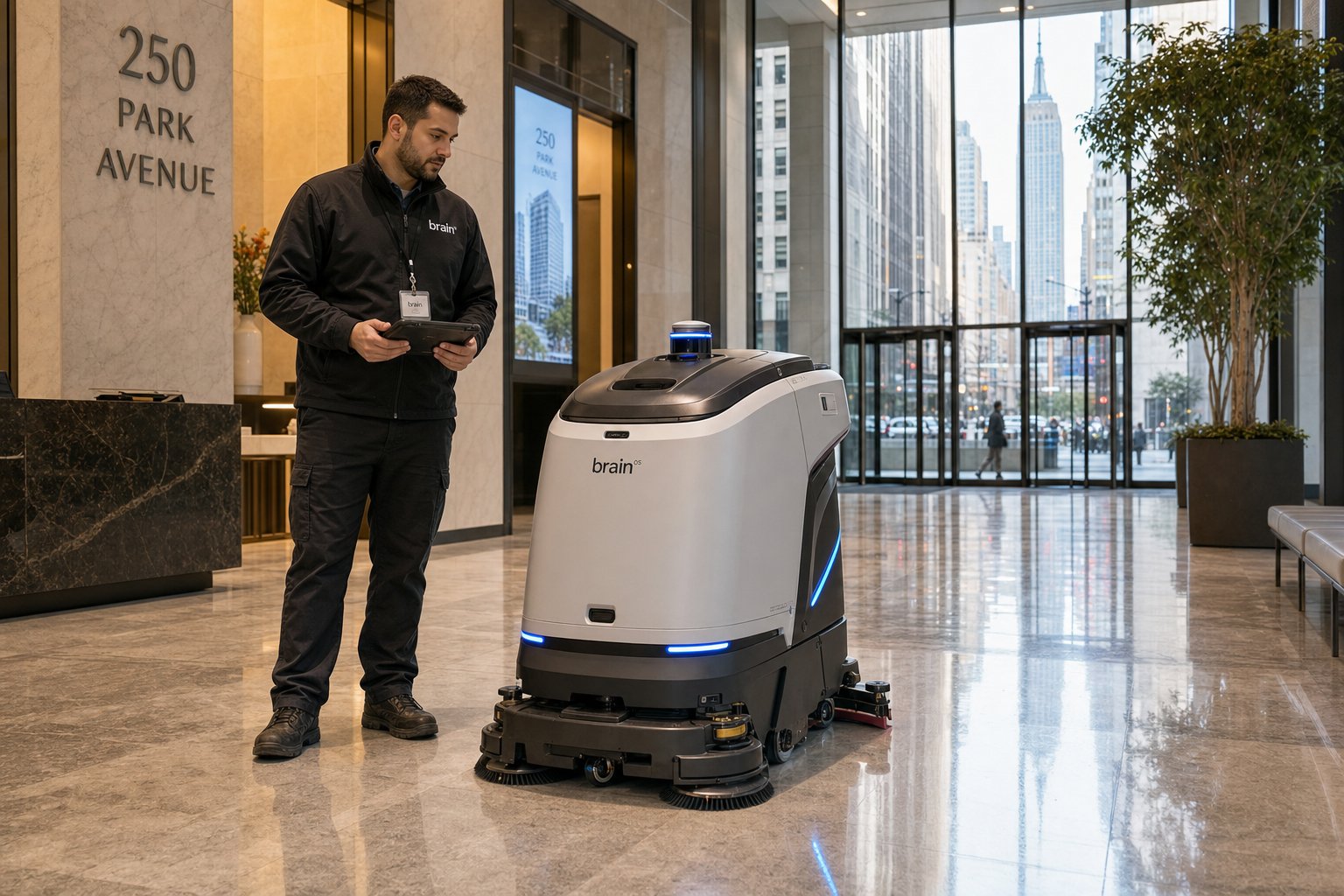
Robotic floor cleaning has moved from trade-show demonstration to a practical option for selected commercial spaces, but autonomy is not a substitute for a complete janitorial program. In New York City, a floor robot may scrub a large, open lobby overnight while a trained technician handles edges, stairs, elevators, restrooms, spill response, and quality verification. The strongest deployment is a partnership between equipment and people. GreenPoint Maintenance Services evaluates traffic, floor type, access, safety, and measurable outcomes before recommending autonomous equipment. A facility manager can call 347-332-9348 to schedule a NYC walkthrough or request a fixed-price quote.
Where autonomous floor equipment fits best
Robotic scrubbers are most useful in predictable, unobstructed areas with consistent floor surfaces: airports, distribution centers, large office lobbies, hospitals’ non-clinical corridors, universities, and retail concourses. They need enough turning radius, a route that can be mapped, charging access, and a floor-care method compatible with the machine. A 50,000-square-foot open slab in Long Island City is a different opportunity from a 5,000-square-foot prewar office with narrow doorways and multiple thresholds.
GreenPoint starts with a workflow study. The [warehouse and industrial cleaning best practices](/blog/warehouse-industrial-cleaning-best-practices/) guide explains why dust, forklifts, dock traffic, and safety zones affect the cleaning method. In a Manhattan lobby near Hudson Yards, a robot may cover the center field while a technician protects pedestrian flow and cleans around turnstiles. In a Brooklyn facility near Industry City, route planning must account for loading operations, mixed-use traffic, and floor transitions.
Robots do not clean every part of a building
A floor robot typically cannot replace detail work. Edges, corners, baseboards, stairs, escalators, furniture legs, elevator thresholds, spill spots, floor drains, and congested areas still need human attention. Restrooms require a separate program for fixtures, partitions, dispensers, and touchpoints. Glass, high dusting, carpet, waste removal, and emergency response are also outside the machine’s normal route. GreenPoint Maintenance Services writes the scope so the client sees the division between autonomous floor coverage and technician-led tasks.
A realistic labor plan may assign the robot to a defined 20,000-square-foot corridor loop while a technician performs pre-use inspection, fills solution, sets safety signs, monitors pedestrians, handles edges, and completes the close-out. GreenPoint uses JaniTrack timestamped GPS-tagged photos and checklists to verify both parts of the program. The [digital cleaning verification systems guide](/blog/digital-cleaning-verification-systems/) shows how a property can document a completed route rather than assume the robot’s battery log equals a clean floor.
Map NYC traffic, access, and safety constraints
New York buildings operate on tight schedules. A robot cannot block a fire exit, ADA route, elevator landing, security checkpoint, or emergency access lane. In a Midtown tower near Grand Central, the best route may be after the evening commute; in Lower Manhattan, it may require coordination with security and tenant freight elevators. In Queens near LaGuardia or JFK, airport and logistics rules can be more restrictive. GreenPoint’s walkthrough identifies charging, storage, water, drainage, elevator permissions, and a safe staging area before any pilot.
The machine also needs a human safety plan. Mark the route, use visible wet-floor signage, set speed and obstacle behavior, confirm emergency stop access, and train building staff not to move barriers or place loose cables across the path. OSHA requirements and the manufacturer’s instructions govern equipment use and worker training. GreenPoint supervisors review the procedure with the building contact and record issues rather than treating a near miss as a minor inconvenience.
Match the machine to the floor and cleaning chemistry
Floor type determines brush, pad, pressure, water recovery, and chemical selection. VCT, terrazzo, polished concrete, ceramic tile, and sealed wood each have different tolerances. A robot running excessive water can leave a slip hazard or push moisture into seams; aggressive pads can dull a finish. The [VCT floor-care strip, seal, and wax guide](/blog/vct-floor-care-strip-seal-wax-guide/) is a useful reminder that maintenance should follow the finish manufacturer’s instructions. GreenPoint uses Green Seal certified products where appropriate and keeps the product choice tied to the surface and soil load.
Pilot on a representative section before promising a building-wide result. Measure cleaning width, route time, battery and recharge behavior, water usage, dry time, edge work, complaints, and visible appearance. If ATP testing is included for selected high-touch areas, keep that testing separate from the robot’s floor result; ATP is a residue indicator, not a machine-performance certificate. GreenPoint can capture before-and-after photos and supervisor notes in JaniTrack, then recommend a route or a different method based on evidence.
Calculate the business case beyond the purchase price
A robot’s total cost includes acquisition or lease, software, service, batteries, consumables, training, storage, insurance, route supervision, and downtime. Compare those costs with the labor and quality cost of the current process. A 100,000-square-foot facility may save route labor if the robot runs consistently, but a small building may spend more on setup and supervision than it saves. The [calculating true cleaning cost TCO guide](/blog/calculating-true-cleaning-cost-tco/) gives facility managers a framework for evaluating total cost rather than looking only at the invoice line for equipment.
GreenPoint Maintenance Services uses fixed pricing for the cleaning scope and no hidden hourly billing. The proposal can show which work is automated, which tasks remain technician-led, the service frequency, response expectations, and the equipment responsibilities. GreenPoint’s 98% client retention is supported by the habit of reviewing results with owners. Call 347-332-9348 for a building-specific quote.
Verify performance with people and data
A robot can report route completion, but route completion is not the same as a clean, dry, safe floor. GreenPoint combines machine logs with visual inspection, JaniTrack timestamps, GPS-tagged photos, and supervisor sign-off. Use a defined appearance standard, such as the ISSA clean-standards framework, and establish measurable acceptance criteria: no visible salt film, no standing water, consistent finish, and documented edge work. The [quality-assurance commercial cleaning program](/blog/quality-assurance-commercial-cleaning-program/) guide explains why verification should be built into the scope rather than added after a complaint.
Review performance weekly during a pilot and monthly after stabilization. Track route completion, unplanned stops, rework, complaints by zone, response time, chemical and water consumption, and safety events. If the machine repeatedly stops by the same column, fix the map or the obstruction. If the floor looks clean but edges accumulate soil, adjust human detail work. GreenPoint reports the operational story so the owner can decide whether to expand, change the route, or return to a conventional method.
NYC use cases by neighborhood and building type
A Midtown corporate lobby may benefit from overnight scrubbing in the open center while technicians detail turnstiles and elevator banks. A Downtown Brooklyn office near Jay Street–MetroTech may use a smaller route around shared workspaces. A Bronx community college can schedule a mapped corridor route between classes, while a Staten Island logistics site may use a robot on a large warehouse aisle after dock operations. In Westchester, Long Island, New Jersey, Connecticut, or Pennsylvania, a campus footprint may make autonomous coverage attractive because travel between buildings is time-consuming. GreenPoint assesses each setting rather than assuming a robot is automatically better.
Local access, tenant expectations, and building rules matter as much as square footage. A robot should be quiet enough for the service window, visible enough for safety, and supported by a technician who can respond when a visitor moves a chair into its path. GreenPoint Maintenance Services can schedule a walkthrough at 347-332-9348 and provide a fixed-price plan after measuring floor types, route length, operating hours, and human detail requirements.
The pilot should include the people who will live with the route. Security staff know when a lobby fills, engineers know which doors and elevators can be used, and cleaners know where soil accumulates. Ask them to observe the machine at opening, midday, and the planned service window. GreenPoint records obstacles, noise concerns, water recovery, and pedestrian interactions, then updates the map. A route that looks perfect on a vacant floor may fail when a delivery cart, stroller, or conference setup changes the path.
Robotic equipment can also improve consistency when it is used for a repeatable task. A mapped route can keep scrub width, speed, and overlap more stable than a rushed manual pass, but only if the floor is prepared and the technician responds to exceptions. GreenPoint Maintenance Services keeps human detail work in the scope and uses JaniTrack to show completion. Property leaders can call 347-332-9348 to compare a conventional plan with a supervised autonomous pilot before making a capital decision.
Consider the service window’s impact on tenants and neighbors. Some buildings require quiet operations after 9 p.m.; others need the floor dry before a 7 a.m. opening. A machine that completes a route in 90 minutes but leaves a slow-drying lane may create more risk than a two-hour low-moisture process. GreenPoint measures dry time and pedestrian readiness as part of the acceptance test, then documents the result for the owner. For a route assessment, call 347-332-9348.
FAQ: Robotic floor cleaning in NYC
Q: Can a cleaning robot replace a janitor? A: No. It can cover selected open floor routes, while people handle edges, stairs, restrooms, spills, waste, inspections, and exceptions. GreenPoint designs the human-and-machine scope together.
Q: Is robotic cleaning safe in a busy NYC lobby? A: It can be when the route, barriers, signage, speed, emergency stop, and service window are planned and supervised. GreenPoint evaluates pedestrian flow and building access before a pilot.
Q: What floor types work with autonomous scrubbers? A: Large, continuous areas of compatible resilient flooring, tile, sealed concrete, or similar surfaces are common candidates. GreenPoint tests the actual finish and follows manufacturer guidance before selecting pads, brushes, and chemistry.
Q: How is robot cleaning verified? A: Combine machine route data with visual inspection, JaniTrack timestamps, GPS-tagged photos, and defined appearance criteria. GreenPoint can add ATP testing only where a client’s approved protocol makes it useful.
Q: How can a NYC building request an assessment? A: Call GreenPoint at 347-332-9348 or email info@greenpointms.com to schedule a walkthrough and receive fixed pricing for the full cleaning program.
Evaluate automation with evidence, not hype: call GreenPoint Maintenance Services at 347-332-9348 for a NYC robotic-floor walkthrough and fixed-price quote. GreenPoint brings human supervision, JaniTrack proof, and a 98% client-retention record.