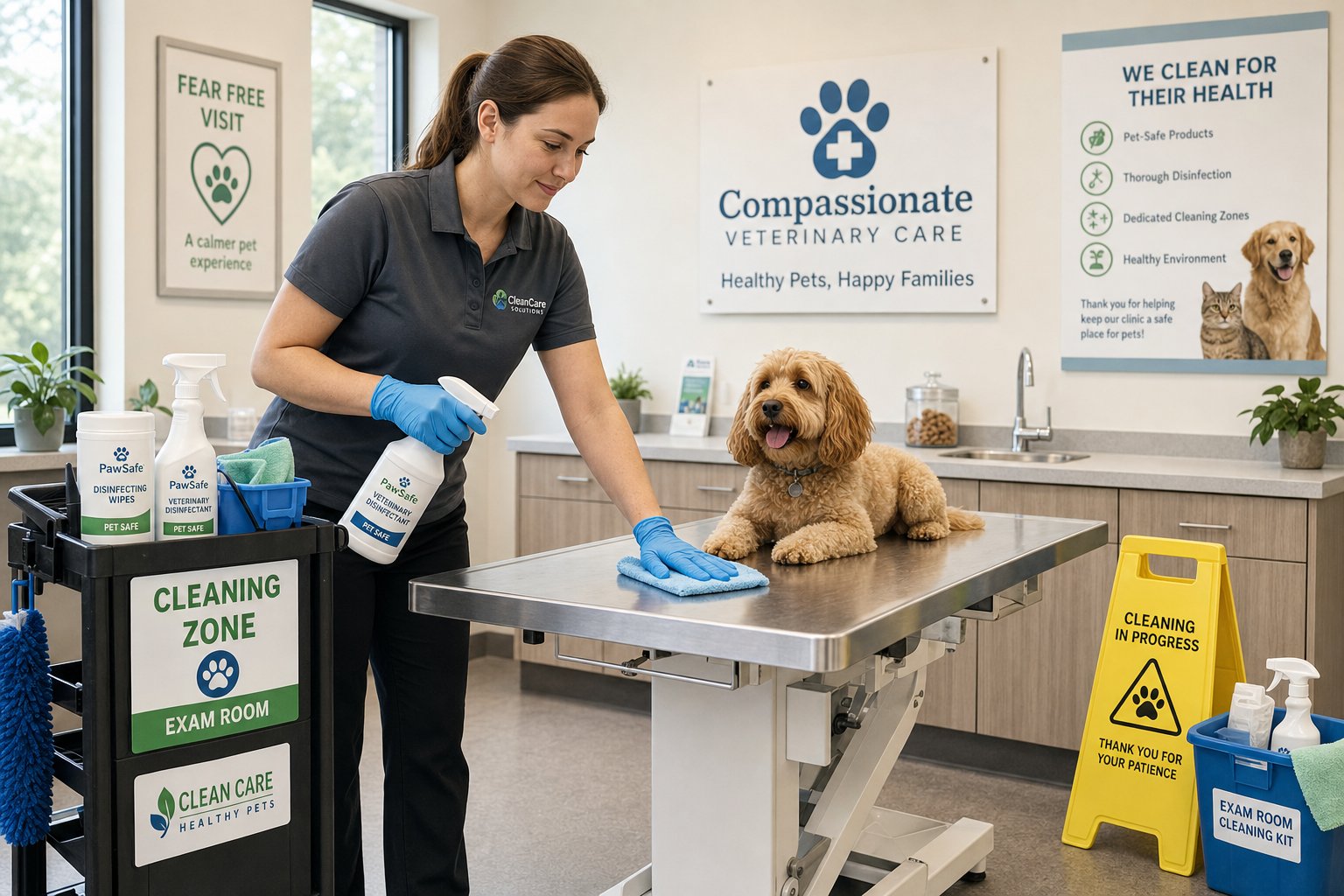
Veterinary clinic cleaning has to manage fur, dander, urine, fecal material, saliva, disinfectant dwell times, and anxious patients without disrupting care. Exam rooms, kennels, surgery support, reception, isolation, and staff areas each need a different cleaning sequence. Whether the clinic is in Brooklyn, Queens, Westchester, Long Island, New Jersey, Connecticut, Pennsylvania, or Florida, GreenPoint Maintenance Services Corp can build a documented scope that supports odor control and a customer-ready environment. This guide explains the staffing, zoning, products, and proof points to put into a veterinary janitorial plan.
Start with a veterinary zone map
Separate public reception, exam rooms, treatment and prep, kennels, isolation, surgery support, pharmacy or storage, staff spaces, and waste holding. Do not move tools between clean and contaminated zones without a defined decontamination step. GreenPoint labels equipment by zone and trains cleaners to follow the clinic’s direction for isolation rooms, animal movement, and restricted clinical surfaces. A site near Prospect Park, Astoria, White Plains, or a suburban shopping corridor may have different traffic and parking patterns, but the zoning principle remains the same. The map should also show drains, hose points, PPE stations, laundry, and the route for bagged waste.
Control odor at the source
Odor control is not achieved by masking smells with fragrance. Remove organic soil promptly, clean the correct surface, manage waste, dry damp areas, and escalate ventilation issues. The contract should identify response times for urine or vomit incidents and who provides absorbent materials. GreenPoint uses label-directed products and low-odor Green Seal certified options where appropriate, while respecting veterinary product compatibility. Cleaners never mix chemicals or improvise concentrations. A recurring odor log can identify a floor seam, drain, kennel joint, or waste staging issue that needs facilities repair rather than more fragrance. Call 844-814-0810 when you want a walkthrough focused on root causes.
Create a kennel and boarding cadence
Kennel areas experience concentrated soil, water, hair, noise, and animal turnover. The clinic should define whether janitorial staff clean empty kennels, surrounding floors, walls, drains, doors, and touchpoints, or whether veterinary technicians own some steps. GreenPoint can schedule zone checks around discharge and intake, use dedicated microfiber and tools, and document completion in StockPoint. Floors need the correct mechanical or manual method for their finish; excess water can create slip hazards and prolong odor. A supervisor should inspect corners, under kennel hardware, latch areas, splash zones, and waste bins rather than checking only the center of the aisle.
Use high-touch disinfection carefully
High-touch points may include exam-table controls, door pulls, reception counters, payment terminals, kennel latches, faucet handles, light switches, and clipboard surfaces. The product must be appropriate for the surface and used for the full wet contact time on its label. GreenPoint trains teams to clean soil before disinfection, use fresh cloths by zone, and keep animals and clients clear until surfaces are safe. The [healthcare-associated infections and environmental cleaning guide](/blog/healthcare-associated-infections-environmental-cleaning/) explains why sequence and contact time matter in care environments. ATP testing can support trend monitoring on selected surfaces, but it does not replace the clinic’s infection-control judgment.
Protect isolation and surgery-support areas
Isolation rooms and surgery-support spaces require the clinic to set restricted access, PPE, product, and sequence rules. Janitorial staff should never enter an isolation area casually or carry tools into a clean support space without approval. GreenPoint documents the boundary, provides color-coded equipment, and escalates body-fluid incidents according to the clinic’s written exposure procedure. Chemical SDS records, labeled secondary containers, and PPE requirements align with OSHA Hazard Communication expectations. Ask every vendor how they train relief workers; a policy known only by the primary cleaner is not a resilient program. GreenPoint’s supervisor checks that relief staff receive the same orientation before covering a shift.
Staff the clinic around appointments and admissions
An animal hospital with boarding or urgent care has a different schedule from a daytime general practice. Nightly cleaning may cover full floors, waste, restrooms, and detailed exam rooms, while a daytime porter responds to accidents, lobby soil, and high-turnover touchpoints. GreenPoint sizes labor from exam rooms, kennel counts, daily appointments, operating hours, isolation load, and floor finish. The [cleaning staffing ratios by square footage](/blog/cleaning-staffing-ratios-square-footage/) is a planning reference, not a substitute for a veterinary walkthrough. Fixed pricing identifies what is covered each day and what is a separately scheduled project.
Use StockPoint to connect checks to locations
Managers need to know whether an odor or touchpoint issue was handled and whether the same room keeps failing. GreenPoint uses StockPoint timestamped GPS-tagged photos where approved, checklist completion, supervisor inspections, and corrective-action notes in a live dashboard. Photos must avoid client records, payment information, and animal identifiers when the clinic requires that protection. Weekly trend reviews can show incidents by zone, response time, supply-outs, inspection pass rate, and open work orders. The [digital cleaning verification systems](/blog/digital-cleaning-verification-systems/) guide offers additional questions for evaluating a dashboard. Evidence turns a complaint into a solvable workflow.
Price products, waste boundaries, and emergencies clearly
A veterinary cleaning quote should say whether routine trash, regulated medical waste, sharps, laundry, odor treatment, carpet extraction, floor refinishing, and emergency body-fluid response are included. GreenPoint Maintenance Services uses fixed pricing with no hourly billing and no hidden fees, while documenting exclusions and written change-order triggers. Ask about insurance, workers’ compensation, training, replacement coverage, and product approvals. GreenPoint’s MBE/MWBE certifications, SAM.gov registration, Green Seal product options, and 98% client retention can support procurement reviews, but the scope still needs to fit the clinic. Email info@greenpointms.com or call 844-814-0810 for a clear proposal.
Make local logistics part of the care plan
A veterinary team cannot wait for a cleaner who cannot reach a clinic because of a street closure, storm, or late-night access problem. Write the arrival route, parking and loading rules, key or badge controls, alarm procedure, emergency contacts, and backup coverage. GreenPoint supports tri-state and Florida facilities and can standardize training across sites while keeping local realities in view, from subway-adjacent Brooklyn to Long Island parking lots and Florida storm preparation. Schedule a walkthrough with the practice manager and facilities lead; GreenPoint can mark clean/dirty routes and confirm the service window before the first shift.
Clinics should test their plan during a representative week rather than only during a quiet inspection. Include a busy morning, an urgent-care surge, a discharge or boarding turnover, and a period when the building is nearly empty. GreenPoint can use the pilot to confirm route times, supply placement, odor-response steps, and the right balance of porter and closing coverage. At the review, separate a cleaning failure from a flooring, drain, ventilation, or waste-handling problem so the right owner acts. Call 844-814-0810 to schedule a no-obligation walkthrough; GreenPoint will put the agreed response times and exclusions in the proposal. This documented approach gives owners a repeatable standard for onboarding, inspections, budgeting, and renewal decisions across changing occupancy and facility conditions.
Use a short pilot to test the route during real conditions: morning appointments, a kennel turnover, a busy lobby, and an evening close. GreenPoint can record where fur accumulates, which drains or floor seams hold odor, how many urgent spill calls occur, and whether the planned porter interval is realistic. The clinic should provide a clear contact for decisions about isolation, animals in rooms, regulated waste, and product compatibility. Cleaners can report a broken grout joint, leaking kennel, poor exhaust, or overflowing waste container, but facilities or clinical leadership must own the repair. A monthly scorecard should show incidents by zone, response time, inspection pass rate, supply availability, and recurring corrective actions. GreenPoint’s regional teams make it possible to standardize onboarding for a practice group across New York, New Jersey, Connecticut, Pennsylvania, and Florida while preserving each site’s clinical rules. Call 844-814-0810 to schedule a no-obligation walkthrough and a fixed quote with response times and exclusions written down.
A professional cleaning program is strongest when the operating record is easy to read six months later. Keep the approved scope, room inventory, frequency chart, product list, access rules, and escalation contacts together. At launch, GreenPoint reviews the first inspection with the client and records any baseline exceptions instead of allowing them to become an argument about performance. At renewal, compare the original assumptions with actual occupancy, traffic, events, tenant changes, and project work. That comparison helps an owner decide whether to change a route, add a periodic service, repair a facility condition, or keep the plan unchanged. GreenPoint’s supervisors can explain why a task is daily, weekly, monthly, or triggered by an event, and StockPoint gives the account team a factual record for that conversation. Managers should also name one person authorized to approve a scope change and one person who receives urgent notifications. This prevents duplicate instructions and protects the cleaning crew from conflicting requests. For a walkthrough, call 844-814-0810 or email info@greenpointms.com; GreenPoint will listen to the operational goals, confirm the boundaries, and provide a fixed-price quote that procurement and facilities can both understand.
FAQ: practical answers for facility decision-makers
Can a janitorial cleaner work in a veterinary isolation room? Only when the clinic authorizes it and provides the required PPE, product, sequence, and exposure procedure. Isolation boundaries should be written into the scope. GreenPoint trains assigned and relief staff, uses dedicated equipment, and escalates incidents rather than improvising.
How do veterinary clinics control cleaning odors? Remove organic soil quickly, use label-directed products, dry surfaces, manage waste, and investigate drains, seams, ventilation, and damaged flooring. Fragrance alone masks the cause. GreenPoint can create an odor log and response plan during a walkthrough.
Who should clean kennels and exam rooms? The clinic should define ownership for clinical and janitorial steps. GreenPoint can clean approved environmental surfaces, floors, doors, and common areas while technicians retain instrument and patient-care responsibilities. The written zone map prevents gaps and unsafe overlap.
Is ATP testing useful in an animal hospital? ATP can provide a trend signal on selected high-touch surfaces when used consistently, but it is not a sterility test and does not replace the clinic’s infection-control program. GreenPoint can add documented ATP checks when the client wants an objective QA measure.
How do I get a veterinary clinic cleaning quote? Call GreenPoint Maintenance Services at 844-814-0810 or email info@greenpointms.com. We will review exam rooms, kennels, isolation, waste, hours, odors, and emergency response before issuing a fixed-price proposal.
GreenPoint Maintenance Services Corp is ready to map the scope at a no-obligation walkthrough. Call GreenPoint at 844-814-0810 or email info@greenpointms.com to schedule a site review; we return a fixed-price proposal with no hourly billing and no hidden fees. [digital cleaning verification systems](/blog/digital-cleaning-verification-systems/)