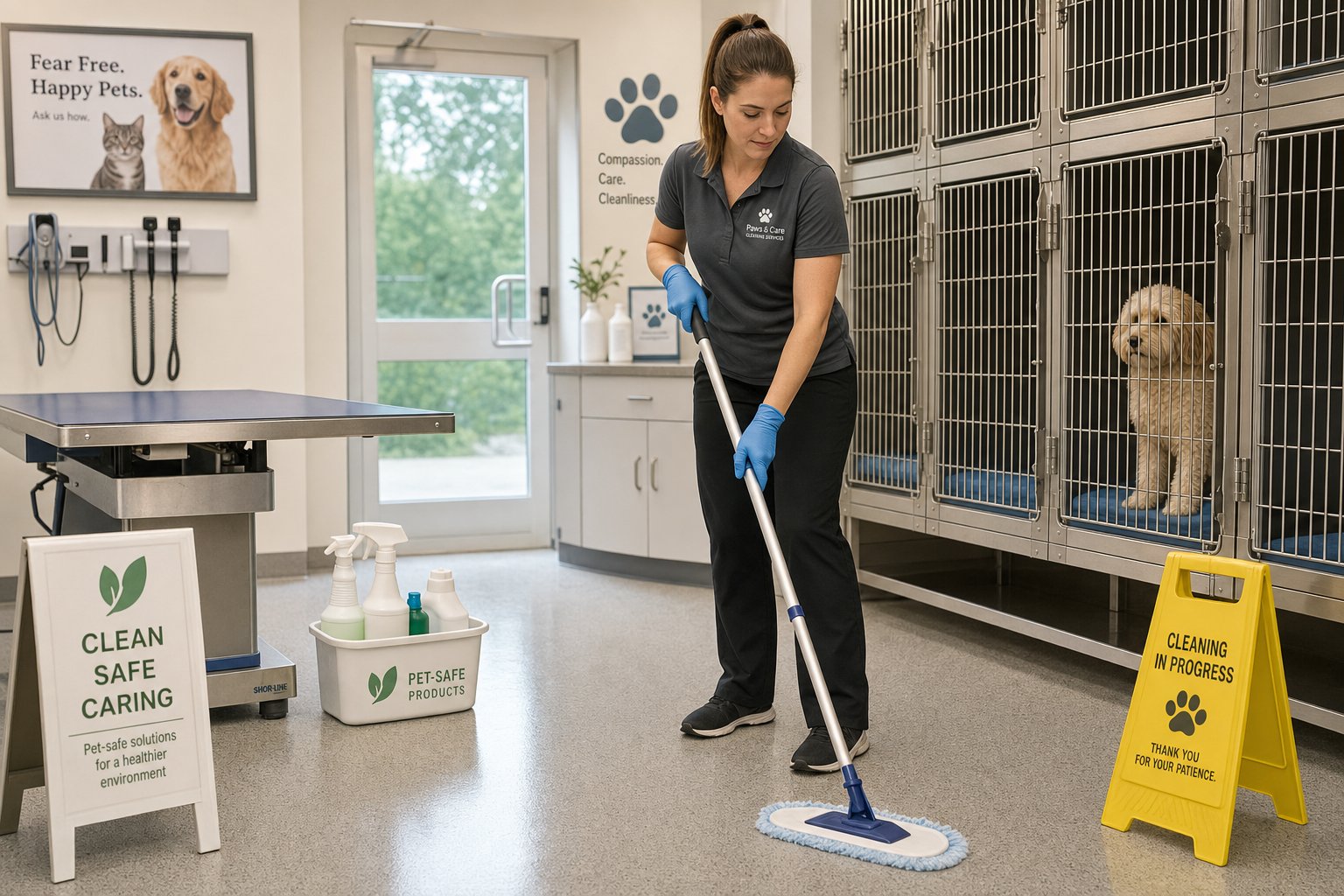
Veterinary clinic cleaning in the Tri-State Area must manage fur, organic soil, odors, anxious animals, and human traffic without disrupting patient care. A small practice near White Plains, a 24-hour animal hospital in Newark, and a Brooklyn clinic near Prospect Park have different kennel counts, loading rules, and emergency patterns. GreenPoint Maintenance Services uses written zone boundaries, Green Seal certified products where suitable, and JaniTrack verification to make the environmental program visible to practice managers. Call GreenPoint at 347-332-9348 to schedule a walkthrough and receive a fixed-price scope for your clinic.
Why veterinary facilities require specialized janitorial work
A veterinary facility is not simply an office with pet hair. Exam rooms, treatment areas, kennels, surgery support spaces, isolation rooms, reception, laundry, and waste staging each carry a different soil and exposure profile. The clinical team controls patient-care disinfection and medical procedures; the commercial cleaning partner supports the environmental surfaces assigned in the facility plan. GreenPoint begins by mapping animal flow, staff flow, clean supplies, dirty laundry, and waste so a mop or microfiber cloth cannot drift between incompatible zones.
The CDC’s [environmental infection-control principles](https://www.cdc.gov/infection-control/hcp/environmental-control/) emphasize risk-based cleaning, high-touch surfaces, and a written routine. In a veterinary setting, that means the checklist should include kennel latches, exam-table bases, door pushes, reception counters, scale platforms, leash hooks, laundry handles, and floor edges. GreenPoint’s supervisors turn those points into a frequency matrix instead of treating “odor control” as an undefined promise.
Tri-State logistics and local operating conditions
A practice serving New York City may receive deliveries through a constrained side entrance, while a suburban hospital in Westchester or Fairfield County may have a dedicated loading area but larger outdoor runs. A Newark or Jersey City animal hospital may operate 24/7 and require a quiet overnight route. GreenPoint’s walkthrough covers parking, elevator access, kennel access, emergency call procedures, and the time needed to move equipment safely around animals, owners, and clinical staff.
Seasonal conditions change the work. Salt and grit tracked from sidewalks near a PATH station can irritate paws and damage resilient floors; summer humidity can amplify odor in laundry and kennel rooms; storm days can raise the soil load at every entrance. GreenPoint can specify entrance mat care, spot response, and a daytime restroom or lobby check. If a clinic adds boarding capacity or a new isolation room, call 347-332-9348 before the current route becomes overloaded.
Kennels, runs, and odor source control
The most reliable odor program removes the source instead of masking it. After the veterinary team completes its patient-care or kennel protocol, environmental cleaning can address assigned floors, drains, walls, doors, latches, lower ledges, and waste-area surfaces with the correct product and contact time. GreenPoint uses dedicated tools for animal areas and documents when a room is unavailable because an animal is being treated. Drying checks matter: trapped moisture can create a second odor problem and a slip risk.
Kennel cleaning frequency follows occupancy and turnover. A boarding run with 20 animals and repeated daytime accidents may need spot response plus a full close-down, while a low-volume exam corridor may need nightly service. The written scope should identify who handles feces, urine, vomit, laundry, and regulated waste. GreenPoint will not improvise around a biological spill; the practice’s exposure-control procedure controls the response. For a related framework, see [healthcare-associated infections and environmental cleaning](/blog/healthcare-associated-infections-environmental-cleaning/).
Exam rooms, waiting areas, and hair control
Exam rooms collect hair and dander along baseboards, under tables, around scale platforms, and near door thresholds. A good sequence removes loose debris before wet cleaning, works from cleaner areas toward dirtier areas, and changes cloths at the defined zone boundary. Reception and waiting areas need a different rhythm: chair arms, check-in counters, pens, payment terminals, door pulls, and floors should be inspected through the day when appointment turnover is high. GreenPoint’s color-coded microfiber system reduces the chance that a restroom tool enters an exam zone.
Hair is also a maintenance signal. If a vacuum brush is overloaded, a filter is overdue, or a floor edge is skipped, the clinic will see the same accumulation return. GreenPoint logs exceptions in JaniTrack and can recommend a periodic detail route for vents, corners, kennel grilles, upholstery, and wall protection. The manager should be able to see what was completed without asking staff to take photos during patient care; call 347-332-9348 when the clinic needs a new route.
Isolation rooms and chemical safety
Isolation areas require explicit entry, exit, PPE, tool, and waste rules set by the veterinary practice. A cleaner should not enter an occupied isolation room or handle an infectious-animal cleanup without training, authorization, and the practice’s written procedure. GreenPoint records the boundary and escalates a room that is occupied, unlabeled, or outside the contracted protocol. This keeps the janitorial program useful without confusing it with veterinary clinical judgment.
OSHA’s [Hazard Communication Standard](https://www.osha.gov/hazcom) calls for labels, SDS access, and worker information about chemical hazards. GreenPoint uses label directions for dilution, dwell time, ventilation, and PPE, and selects Green Seal certified products when they are appropriate for the surface and the clinic’s approval process. A “pet-safe” claim is not enough; the facility should follow the product label and keep animals away until the stated re-entry condition is met.
JaniTrack proof for clinic managers
A veterinary manager often has to prove that cleaning happened while also handling an urgent patient. JaniTrack gives GreenPoint a practical record of task completion, timestamps, GPS-tagged photos of approved environmental areas, notes, and exceptions. Photo rules can exclude animals, owners, medical records, and clinical screens. The result is an auditable environmental route that does not ask a technician to photograph a patient-care event.
The data can improve operations. If ATP testing on agreed non-clinical touchpoints trends higher at the reception counter, GreenPoint can examine dwell time, cloth changes, or daytime frequency. If odor complaints cluster after weekend boarding, the schedule can add a targeted kennel detail. JaniTrack does not certify sterility and ATP does not diagnose infection; these are quality signals within a broader clinical program. Read [what is ATP bioluminescence testing](/blog/what-is-atp-bioluminescence-testing-cleaning/) for the measurement context.
Costs, staffing, and service frequencies
A 3,000-square-foot general practice with four exam rooms has a different cost profile from a 12,000-square-foot animal hospital with 40 kennels, surgery support, laundry, and overnight care. A useful quote separates nightly environmental cleaning, daytime spot response, kennel and laundry support, restroom service, consumables, periodic floor care, and any approved clinical-adjacent work. The [commercial cleaning cost per square foot](/blog/commercial-cleaning-cost-per-square-foot/) article explains why square footage alone can mislead.
GreenPoint provides fixed pricing, no hourly billing, and no hidden fees, with each included frequency written down. Ask how an absence is covered, who checks the route, and what happens after an unplanned biological spill. GreenPoint’s 98% client retention is a service proof point, while its MBE/MWBE certifications and SAM.gov registration support institutional procurement. Call 347-332-9348 for a walkthrough across New York, New Jersey, or Connecticut.
How to select a veterinary cleaning company
Ask a prospective vendor to walk through a kennel, an exam room, an isolation boundary, a laundry area, and the waste staging point. The vendor should explain tool separation, PPE, animal access, emergency escalation, product approval, and documentation. A generic office checklist is not enough. GreenPoint supplies a zone map, named supervisor, escalation process, and JaniTrack view so the practice can connect an odor complaint or hair buildup to a corrective action.
The right contract respects the practice’s clinical authority while making environmental work dependable. Review [questions to ask a commercial cleaning company](/blog/questions-to-ask-commercial-cleaning-company/) and ask for a fixed-price proposal after the walkthrough. GreenPoint can coordinate a quiet route around appointments, boarding, and emergency care; schedule at 347-332-9348 or email info@greenpointms.com.
Animal behavior belongs in the service design. A nervous dog in reception, a cat carrier in a corridor, or a boarding animal near a wet floor can create a safety issue even when the surface is clean. GreenPoint coordinates with the practice on closed-door windows, warning signs, drying time, and who can move an animal. The crew also reports damaged kennel hardware, leaking dispensers, or floor failures because those maintenance issues can defeat an otherwise careful cleaning routine.
Managers should review the program with the medical director at launch and after any expansion. New dentistry, grooming, boarding, surgery, or isolation capacity can change the soil load and the waste boundary. GreenPoint updates the route, JaniTrack zones, and supervisor checklist when the facility changes, keeping the contract aligned to the real patient flow instead of the old square-footage estimate.
The proposal should also identify consumables and response expectations. Hand soap, paper products, liners, odor-control supplies, and replacement microfiber all affect continuity, while a same-day spill response may need a separate service window. GreenPoint lists those assumptions in plain language so the practice can compare vendors on coverage, not just a low introductory number.
Frequently asked questions
Can a janitorial company clean an isolation room? Only when the practice has approved the task, trained the worker, defined PPE and tool controls, and made the room available. GreenPoint follows the clinic’s written boundary and escalates occupied or unapproved isolation work rather than improvising.
How does GreenPoint control pet hair and odor? The plan removes loose hair before wet cleaning, targets baseboards and kennel edges, uses dedicated tools, checks drying, and schedules spot response based on occupancy. GreenPoint addresses sources rather than masking odor with fragrance.
Are GreenPoint products safe around animals? Products are selected with the clinic, used according to the label, and paired with ventilation and re-entry rules. GreenPoint uses Green Seal certified products where appropriate, but the veterinary practice’s product approval and label directions control.
What does JaniTrack document? JaniTrack can record completed tasks, timestamps, GPS-tagged photos of approved areas, notes, and exceptions. GreenPoint configures privacy and animal-access rules so documentation does not interfere with patient care.
How do I request a Tri-State veterinary cleaning quote? Call GreenPoint at 347-332-9348 or email info@greenpointms.com. A walkthrough maps kennel counts, exam rooms, access, waste boundaries, and desired frequencies before a fixed-price scope is issued.
Protect a busy animal-care environment with a verifiable cleaning plan. Call GreenPoint Maintenance Services at 347-332-9348 for a Tri-State walkthrough and fixed-price quote, backed by JaniTrack and 98% client retention.