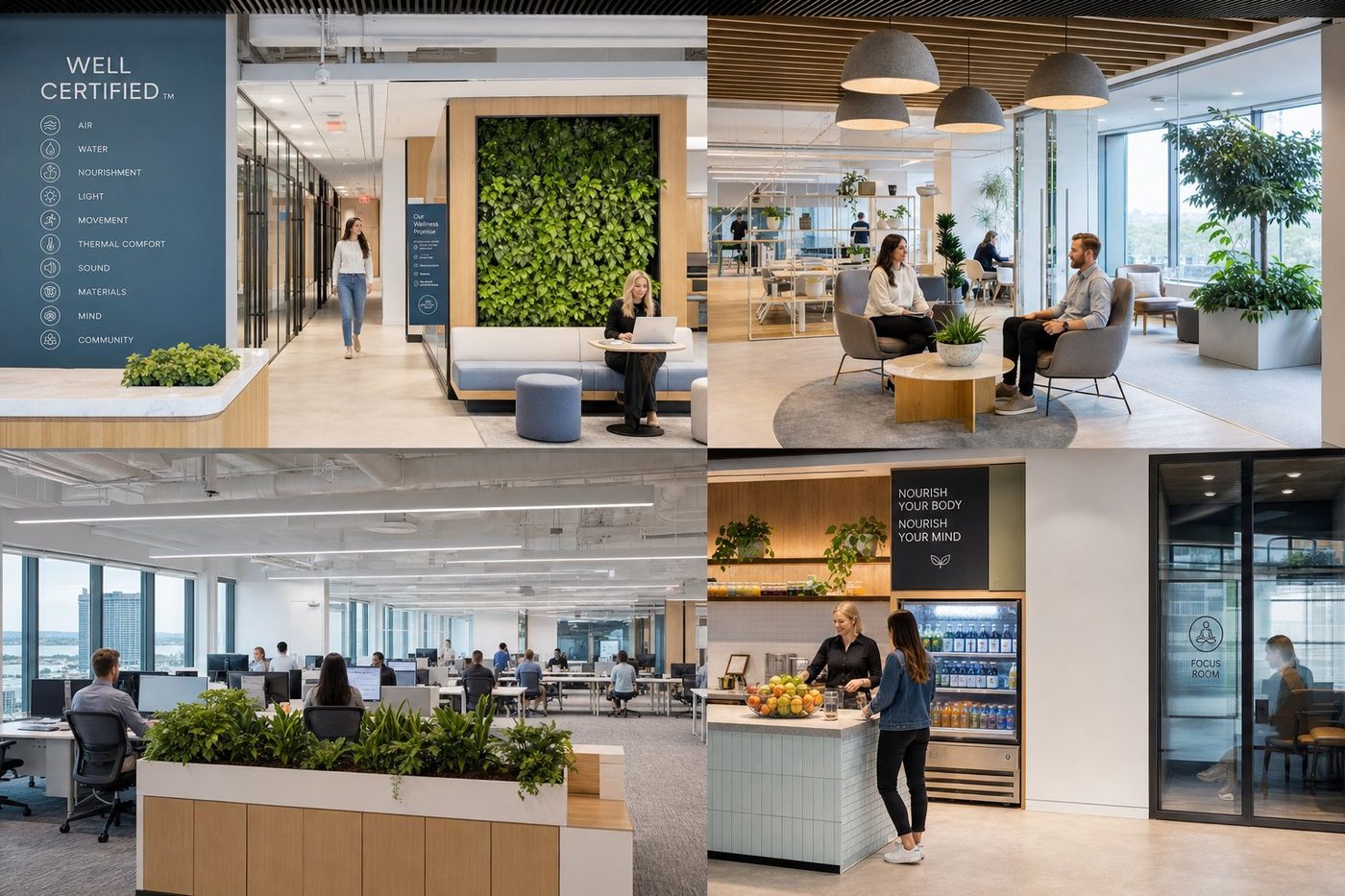
WELL certification puts human health at the center of building operations, so cleaning teams influence more than appearance. Product choices, dust control, restroom hygiene, drinking-water areas, food spaces, odors, and occupant communication can either support or undermine a WELL strategy. This guide shows facility managers how to connect cleaning routines to air, water, nourishment, materials, and comfort goals in buildings across New York, New Jersey, Connecticut, Pennsylvania, and Florida. GreenPoint Maintenance Services combines Green Seal certified products, documented training, fixed pricing, and JaniTrack verification. Call GreenPoint at 347-332-9348 to schedule a WELL-focused walkthrough.
Translate WELL goals into cleaning tasks
The International WELL Building Institute's standard is organized around concepts such as Air, Water, Nourishment, Materials, Mind, and Movement, with feature requirements that vary by project version and pathway. A janitorial scope should not claim to deliver certification by itself. Instead, GreenPoint maps each cleaning activity to the project team's stated intent: reducing dust and odors, keeping hydration points clean, protecting food-service areas, controlling chemical exposure, and giving occupants a clear way to report issues.
The map begins with an occupancy and risk survey. A law office near Bryant Park, a coworking floor in Downtown Brooklyn, a school in Queens, and a mixed-use property near Journal Square have different density, schedules, and touchpoints. GreenPoint records floor type, ventilation windows, water stations, kitchens, wellness rooms, showers, restrooms, and material restrictions, then proposes frequency and labor. Call 347-332-9348 or email info@greenpointms.com for a walkthrough quote.
Air: reduce dust, residue, and unnecessary fragrance
For WELL-aligned cleaning, air quality is managed through source control and technique. GreenPoint uses maintained vacuums, microfiber systems, appropriate dilution, careful wet work, and prompt waste removal. Fragrance should not be used to hide an odor source. In a sealed Midtown office, a school beside a busy Queens arterial, or a Stamford floor with limited ventilation time, scheduling and product volume matter as much as the product label.
High-dust projects need a different response from routine office soil. GreenPoint can coordinate with the building engineer during construction, filter changes, or furniture installation, using HEPA-capable equipment where appropriate and recording the affected rooms. [Our HEPA filtration commercial cleaning guide](/blog/hepa-filtration-commercial-cleaning/) explains the limits and maintenance requirements of filtration. JaniTrack notes can show the time, location, photo evidence, and corrective action when a dust complaint is raised.
Water: keep hydration and restroom points dependable
Cleaning supports the water concept by making hydration points, bottle fillers, sinks, showers, and restrooms visibly maintained and operational. The scope should name the fixtures, cleaning method, replenishment responsibility, and escalation path for leaks, low pressure, empty soap, or damaged filters. GreenPoint does not replace a licensed plumber or water-quality professional; it identifies and reports conditions that need the building team.
A high-traffic route near Grand Central, Atlantic Terminal, Newark Penn, Stamford Station, or Philadelphia's City Hall transit connections can empty soap and towels faster than a quiet office suite. GreenPoint can set inspection frequencies by usage and use JaniTrack to record restocking and exceptions. For hygiene controls, see [our restroom cleaning best practices guide](/blog/restroom-cleaning-best-practices-high-traffic/). Call 347-332-9348 when a hydration or restroom area needs a revised service plan.
Nourishment: clean food and break areas without cross-contamination
Break rooms and food areas need a separate logic from desks. GreenPoint assigns color-coded microfiber and dedicated tools, removes food waste on an agreed schedule, cleans touchpoints, and reports refrigeration, sink, or pest conditions rather than improvising repairs. A pantry serving 200 employees in Hudson Yards has a different load from a 20-person studio in Astoria. The contract should define whether appliances are interior-cleaned, whether dishes are excluded, and who manages spills during working hours.
Cleaning products should be used at the correct dilution and kept away from food-contact surfaces until the label method is complete. Staff follow OSHA Hazard Communication requirements and the building's approved chemical list. GreenPoint's [green cleaning commercial buildings guide](/blog/green-cleaning-commercial-buildings-guide/) provides a useful product and process framework. A facility manager can ask GreenPoint to include pre-holiday deep cleaning, event resets, or seasonal pest-prevention coordination in the fixed-price proposal.
Materials: choose methods that protect people and finishes
WELL-aligned material care means less residue, less damage, and fewer avoidable exposures. GreenPoint evaluates floor finish, carpet, countertops, painted surfaces, furniture, and acoustic materials before assigning chemicals and equipment. Green Seal certified products can support the program where their performance fits the surface; the green claim does not override dwell time, compatibility, or the need for proper ventilation. Product registers and SDS access make the method understandable to staff and auditors.
A facility should also consider paper, liners, microfiber, and equipment maintenance. Over-wet mopping can increase slip risk and damage seams; a neglected vacuum can redistribute dust; an unmarked bottle creates a training and safety issue. GreenPoint records product substitutions and equipment exceptions in JaniTrack, while [our OSHA cleaning chemical safety guide](/blog/osha-cleaning-chemical-safety-ghs-sds/) covers labels, SDS, and storage questions. For a local walkthrough, call 347-332-9348.
Occupant experience depends on response time and communication
WELL programs ask buildings to support comfort and confidence, which means a cleaning issue should have a visible owner. GreenPoint can provide a facility contact, day-porter response, QR or dashboard reporting, and a defined response time for spills, restroom outages, odor concerns, and high-traffic resets. The exact SLA belongs in the proposal. A tenant in White Plains, Jersey City, Miami, or Downtown Brooklyn should not need to search for a cleaner when a dispenser is empty.
Local conditions shape the service window. Snow and salt around Metro-North and PATH connections, humidity in Florida, construction dust near Long Island City, and event traffic near Barclays Center can all change the appearance and slip risk of an entry. GreenPoint builds seasonal checks into the plan, using [our winter facility maintenance checklist for the Northeast](/blog/winter-facility-maintenance-checklist-northeast/) when relevant. Call 347-332-9348 to schedule a site review.
Measure performance with evidence, not wellness language alone
JaniTrack can support WELL operations with timestamped GPS-tagged photos, task completion, inspection scores, supply exceptions, and corrective-action closure. Optional ATP testing can establish a baseline for selected high-touch points such as faucet handles or break-room surfaces, but it is one measurement tool, not a WELL certification result. The manager should pair the data with occupant complaints, product records, ventilation coordination, and periodic supervisor review.
A simple monthly dashboard can report completion rate, repeat issue count, average response time, supply-outs, inspection score, and open corrective actions. GreenPoint's 98% client retention reflects the value of reviewing those signals instead of waiting for a complaint. MBE/MWBE certification and SAM.gov registration can also simplify procurement conversations for institutions with supplier-diversity goals. Email info@greenpointms.com or call 347-332-9348 for a documentation sample.
Cleaning managers should coordinate with the WELL team, the building engineer, security, and occupants rather than working in isolation. A change to a disinfectant, ventilation schedule, pantry layout, or restroom fixture can affect several concepts at once. GreenPoint's kickoff meeting identifies the decision owner, approved escalation route, and record location for each change. That is especially important in a multi-tenant tower near Hudson Yards, a campus in New Brunswick or Princeton, a Stamford office, or a Florida property with seasonal humidity and storm preparation.
A practical occupant feedback loop can be small and still useful. Track the room, issue type, time reported, response time, whether the issue repeated, and the corrective action. GreenPoint can review this information with inspection scores and supply records, then recommend a frequency change or building-team referral. Managers should avoid promising a health outcome from one cleaning task; the stronger statement is that the facility has a documented process for reducing avoidable dust, residue, odor, supply-outs, and hygiene complaints. Schedule a walkthrough at 347-332-9348.
A WELL conversation should also include the people who clean after hours. Their observations about odors, leaks, supply-outs, dust, and occupant behavior often reveal issues before a dashboard does. GreenPoint gives supervisors a route to capture those observations, review them with the account contact, and escalate building-system concerns. Respecting that frontline information makes the program more accurate and more sustainable over time.
For procurement, the best WELL-aligned proposal distinguishes the health-supporting method from the certification claim. GreenPoint can state which products, equipment, training, and response controls are included, which records are delivered, and which features require the owner or consultant. That clarity helps an office, school, medical suite, or mixed-use property compare bids fairly. It also makes renewal easier because the next team can see the baseline, the measured issues, and the adjustments that improved the occupant experience.
The walkthrough should end with a written baseline: service hours, approved products, high-priority rooms, supply standards, response targets, inspection cadence, and the person who approves changes. GreenPoint can revisit that baseline after 30 days, then quarterly or whenever occupancy changes. A concise baseline makes the WELL discussion practical for the cleaners, the facility manager, and the consultant reviewing the project file.
FAQ: WELL Building Standard cleaning
Q: Does cleaning alone earn WELL certification? A: No. WELL certification is a project-level process with multiple concepts, features, and documentation requirements. GreenPoint supports the operational cleaning evidence and consistency; the owner and WELL team decide how the project complies.
Q: What cleaning changes help the WELL Air concept? A: Source control, dust removal, maintained equipment, correct chemical dilution, ventilation coordination, low-residue methods, and avoiding unnecessary fragrance are practical starting points. The exact requirements depend on the project's WELL pathway and feature set.
Q: How should WELL buildings handle hydration stations? A: Name each station, clean approved surfaces and touchpoints at a frequency matched to use, restock related supplies, and report leaks, filter, or plumbing concerns to the building team. JaniTrack can record completion and exceptions.
Q: Can GreenPoint provide WELL-aligned cleaning in New York, New Jersey, Connecticut, Pennsylvania, and Florida? A: Yes. GreenPoint works across those markets and adjusts for transit traffic, weather, occupancy, building access, and local operations. Call 347-332-9348 to confirm service availability.
Q: What evidence should a manager retain? A: Keep the approved product register, SDS access, training, equipment maintenance, cleaning matrix, inspection results, corrective actions, and relevant photos or task records. GreenPoint can organize these through JaniTrack and a regular review cadence.
Align cleaning with the way people experience your building. Call GreenPoint Maintenance Services at 347-332-9348 for a WELL-focused walkthrough and fixed-price plan. GreenPoint brings Green Seal certified options, documented training, JaniTrack proof, and 98% client retention.