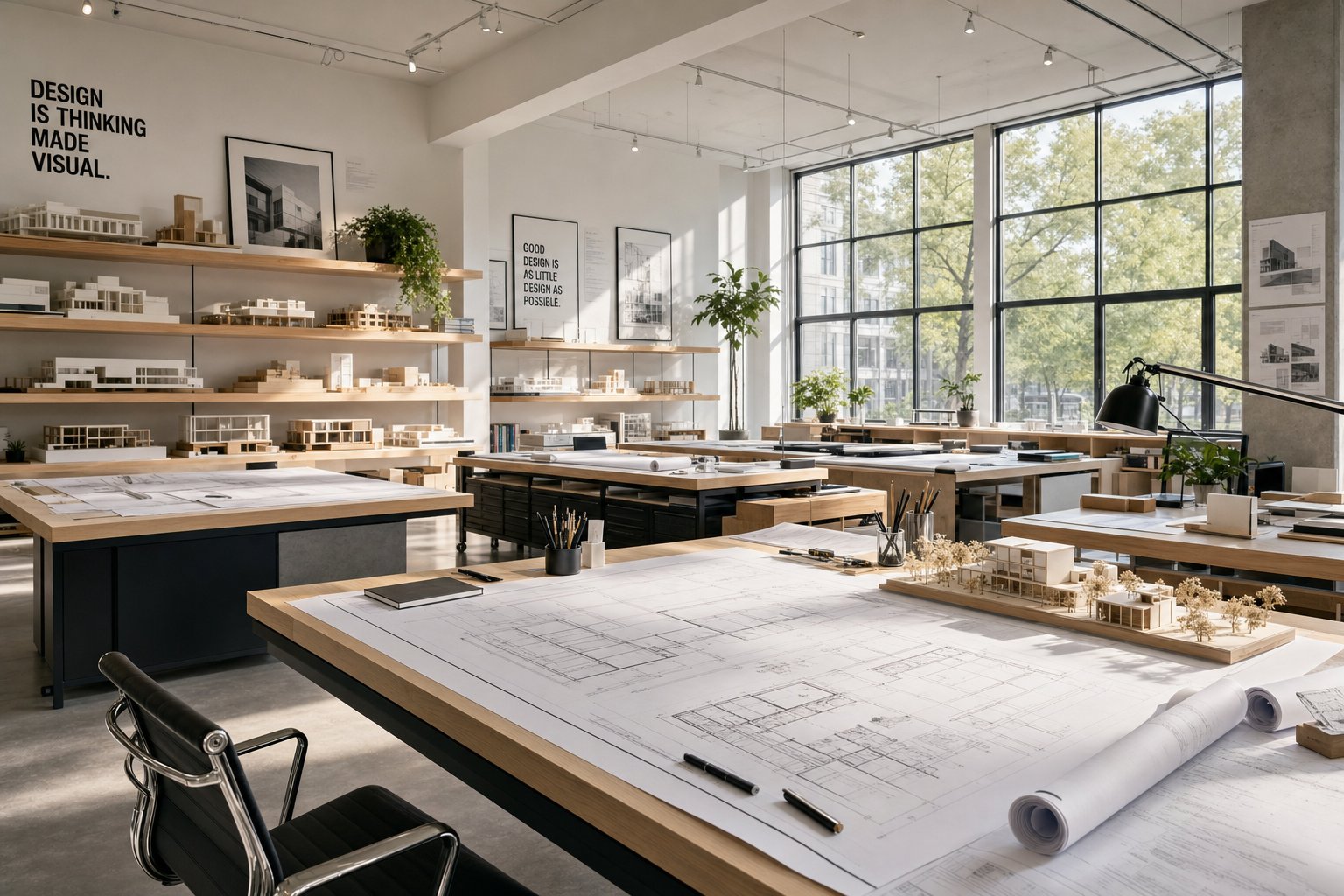
Architecture and design studios present a cleaning challenge most office janitorial teams aren't trained for: physical models built from foam, balsa wood, and acrylic that can't be vacuumed near, sample libraries with thousands of material swatches that shouldn't be disturbed, and open studio floors where large-format drawings and renderings sit on desks overnight. A standard commercial cleaning routine designed for a typical office can do real damage in this environment. GreenPoint Maintenance Services builds studio-specific cleaning programs for architecture and design firms across the tri-state area, with crews trained to work carefully around models, samples, and materials storage, verified through StockPoint—timestamped, GPS-tagged photos, ATP testing, and a live dashboard principals and studio managers can review. Call 844-814-0810 to schedule a walkthrough and get a fixed-price quote.
Why architecture studios need cleaning crews trained differently than standard office teams
A cleaning crew that treats a model room like a normal conference room can knock over a client presentation model that took a junior designer 40 hours to build, or disturb a materials sample wall that's organized by a system only the design team understands. GreenPoint trains studio-assigned crews on a room-by-room protocol developed with each firm during onboarding: which surfaces get touched, which get avoided entirely, and which need the studio manager's sign-off before any cleaning near active project materials. This upfront protocol-building is a standard part of our onboarding process for design and architecture accounts, not an add-on service.
Consistency of staffing matters more in this environment than almost any other commercial account type, because a rotating cast of unfamiliar cleaners increases the odds of an accidental disturbance. GreenPoint assigns dedicated, background-checked crew members to design studio accounts and keeps staffing consistent account to account, which our [guide on cleaning crew vetting and background checks](/blog/commercial-cleaning-crew-vetting-background-checks/) covers in more detail for facility managers evaluating vendors on this basis.
Benchmarking studio cleaning cost against square footage and headcount
Architecture and design studios typically run 2,500 to 15,000 square feet depending on firm size, and cleaning cost benchmarks should reflect not just square footage but the density of specialty rooms—model shops, sample libraries, and presentation spaces—that require more careful, slower cleaning than an open desk area. Our [breakdown of commercial cleaning cost per square foot](/blog/commercial-cleaning-cost-per-square-foot/) gives studio principals a general benchmark, though GreenPoint's actual quotes for design accounts typically run at a modest premium over a standard office rate given the additional care specialty rooms require.
This is worth understanding upfront rather than being surprised later: a vendor quoting a flat, low per-square-foot rate without asking about model shops or sample libraries is likely planning to clean those rooms the same way as an open desk area, which is exactly the scenario that leads to accidental damage. GreenPoint's quotes reflect specialty room handling from the first conversation.
Onboarding a new design studio account: how the protocol gets built
Before a single cleaning visit takes place, GreenPoint walks every design studio account through an onboarding site visit with the studio manager or office principal, mapping each room against a simple three-tier system: standard clean, dry-dust or exclusion zone, and sign-off-required areas. This walkthrough typically takes 45 minutes to an hour for a mid-size studio and produces a written scope document that both the studio and the assigned crew reference going forward, removing the guesswork that leads to accidental damage in other vendor relationships. Call 844-814-0810 to schedule this onboarding walkthrough and get a fixed-price quote based on your studio's specific layout.
This same documented approach extends into ongoing service. Every visit logged in StockPoint references the room-level protocol agreed to at onboarding, so if staffing changes or a new crew member is introduced, the written scope—not institutional memory—governs what happens in each room.
Model rooms and physical model storage: cleaning around, not through
Physical models—whether cardboard massing studies or finished presentation models with laser-cut acrylic and lighting—typically sit on open shelving or dedicated model tables that accumulate dust quickly given how much surface area small-scale architectural models expose. GreenPoint's protocol for model rooms is dry-dusting only, using microfiber tools and, where appropriate, compressed air for tight model interiors, with no wet cleaning or vacuuming directly on or adjacent to model surfaces. Floors in model rooms are cleaned on a schedule that avoids move-in/move-out days for major presentations, coordinated directly with the studio manager's calendar so a floor cleaning pass never coincides with a client model review.
For firms with model shops that generate sawdust, foam particulate, or adhesive residue, GreenPoint provides heavier-duty floor cleaning in that specific zone on a more frequent schedule than the rest of the studio, since these particulates pose both a slip hazard and, in higher concentrations, an air quality concern covered in our [guide to indoor air quality in commercial cleaning](/blog/indoor-air-quality-commercial-cleaning/).
Sample libraries and materials storage: organized systems that can't be disturbed
A mid-size architecture or interior design firm's material library can include several thousand fabric, tile, stone, and finish samples organized in a system the design team relies on daily. GreenPoint's cleaning scope for these rooms is limited to floor and general surface cleaning, explicitly excluding the sample shelving and swatch boards themselves unless a studio manager requests otherwise—dusting a sample wall without understanding its organization can create hours of reshelving work for the design team. We document these room-specific exclusions in the written scope of work at contract signing, so there's no ambiguity for crews or client staff about what gets touched.
Materials storage rooms holding tile, stone, and wood samples also tend to accumulate weight and clutter over time as firms acquire new vendor samples for active projects. GreenPoint's cleaning scope focuses on the floor and accessible surfaces around these storage units rather than the units themselves, and any request to include deeper cleaning inside cabinets or on shelving is scoped separately and priced in advance, so there's never an assumption that a routine visit includes disturbing an organized materials collection.
Open studio floors, plotters, and large-format printing areas
Open studio floors with drafting tables and large-format plotters generate their own cleaning considerations: loose paper trimmings, toner dust near plotter stations, and desks that often have drawings or renderings laid out that shouldn't be moved. GreenPoint crews are trained to clean around active desk surfaces rather than clearing them, focusing nightly effort on floors, trash and recycling, plotter station surrounds, and shared surfaces like pin-up walls and review tables. For firms billing client hours against project time, an efficient nightly clean that doesn't require the design team to "prep" their desks before crews arrive protects billable hours that would otherwise go toward tidying for the cleaning crew rather than design work.
Client review and presentation spaces: the studio's public face
Architecture and design firms host client reviews, contractor walkthroughs, and press visits in dedicated presentation or pin-up spaces that function similarly to a gallery. GreenPoint applies a higher cleaning standard to these rooms—comparable to the client-facing standard we apply across [our brokerage and real estate office accounts](/blog/real-estate-brokerage-office-cleaning-tri-state/)—with daily glass and surface cleaning and pre-event touch-up service available on short notice ahead of major client presentations. Fixed pricing means firms can add a pre-presentation touch-up without a surprise invoice, since these add-ons are priced into the contract in advance. Call 844-814-0810 to schedule a pre-presentation touch-up or a standard walkthrough.
Fixed pricing and MBE certification for architecture and design accounts
Design and architecture firms working on public, institutional, or municipal projects frequently need their own vendors to carry specific certifications as part of a broader project compliance requirement. GreenPoint Maintenance Services is MBE/MWBE certified in New York State and New York City and registered with SAM.gov, which allows firms to count our services toward their own supplier diversity commitments on public-facing or publicly funded projects. Pricing for studio accounts is fixed per square foot at signing, with pre-negotiated rates for pre-presentation touch-ups and model shop deep cleans, so studio principals can budget cleaning costs alongside other fixed studio overhead rather than treating it as a variable line item.
GreenPoint also offers Green Seal-certified, low-VOC cleaning products on request, which matters in design studios where staff may be sensitive to strong chemical odors while working closely with physical materials and adhesives for extended hours. This is one reason design and architecture clients tend to stay with GreenPoint Maintenance Services long term, contributing to our overall 98% client retention rate across tri-state commercial accounts.
Evaluating a cleaning vendor for a design-sensitive environment
Most architecture and design firms have had at least one bad experience with a generalist cleaning vendor who treated the studio like a standard office—moved a model, dusted a sample wall out of order, or vacuumed too close to a fragile display. When evaluating a new vendor, studio principals should ask directly whether the company offers a documented, room-by-room onboarding process, how staffing consistency is maintained, and what proof of service is available after each visit. Our [guide on how to choose a commercial cleaning company](/blog/how-to-choose-commercial-cleaning-company/) covers these evaluation criteria in more depth for facility and studio managers comparing vendors.
GreenPoint Maintenance Services built its design and architecture vertical specifically to answer these concerns—documented protocols, consistent staffing, and photographic proof through StockPoint rather than a generic office cleaning package applied without modification to a studio environment.
FAQ
How does GreenPoint avoid damaging models or samples during cleaning?
GreenPoint builds a room-by-room cleaning protocol with each studio during onboarding, specifying which surfaces are cleaned, which are excluded, and which require sign-off. Model rooms and sample libraries are treated as exclusion or dry-dust-only zones unless a studio manager requests otherwise.
Can we get the same crew members each visit?
Yes. GreenPoint assigns dedicated, background-checked crew members to design studio accounts and prioritizes staffing consistency, since familiarity with a studio's specific layout and materials reduces the risk of accidental disturbance.
Can you schedule around major client presentations?
Yes. Pre-presentation touch-up service can be scheduled on short notice for presentation and pin-up spaces, and standard cleaning passes are coordinated around the studio manager's calendar to avoid presentation days.
What proof of service does GreenPoint provide?
Every cleaning visit is documented in StockPoint with timestamped, GPS-tagged photos, giving studio principals and office managers a verifiable record of exactly what was cleaned and when, without needing to inspect the space personally.
Protect your models, samples, and materials while keeping your studio presentation-ready. Call GreenPoint Maintenance Services at 844-814-0810 to schedule a walkthrough and get a fixed-price quote built around your studio's layout. Every visit is verified through StockPoint's timestamped, GPS-tagged photos, backed by a 98% client retention rate across our tri-state design and commercial accounts.