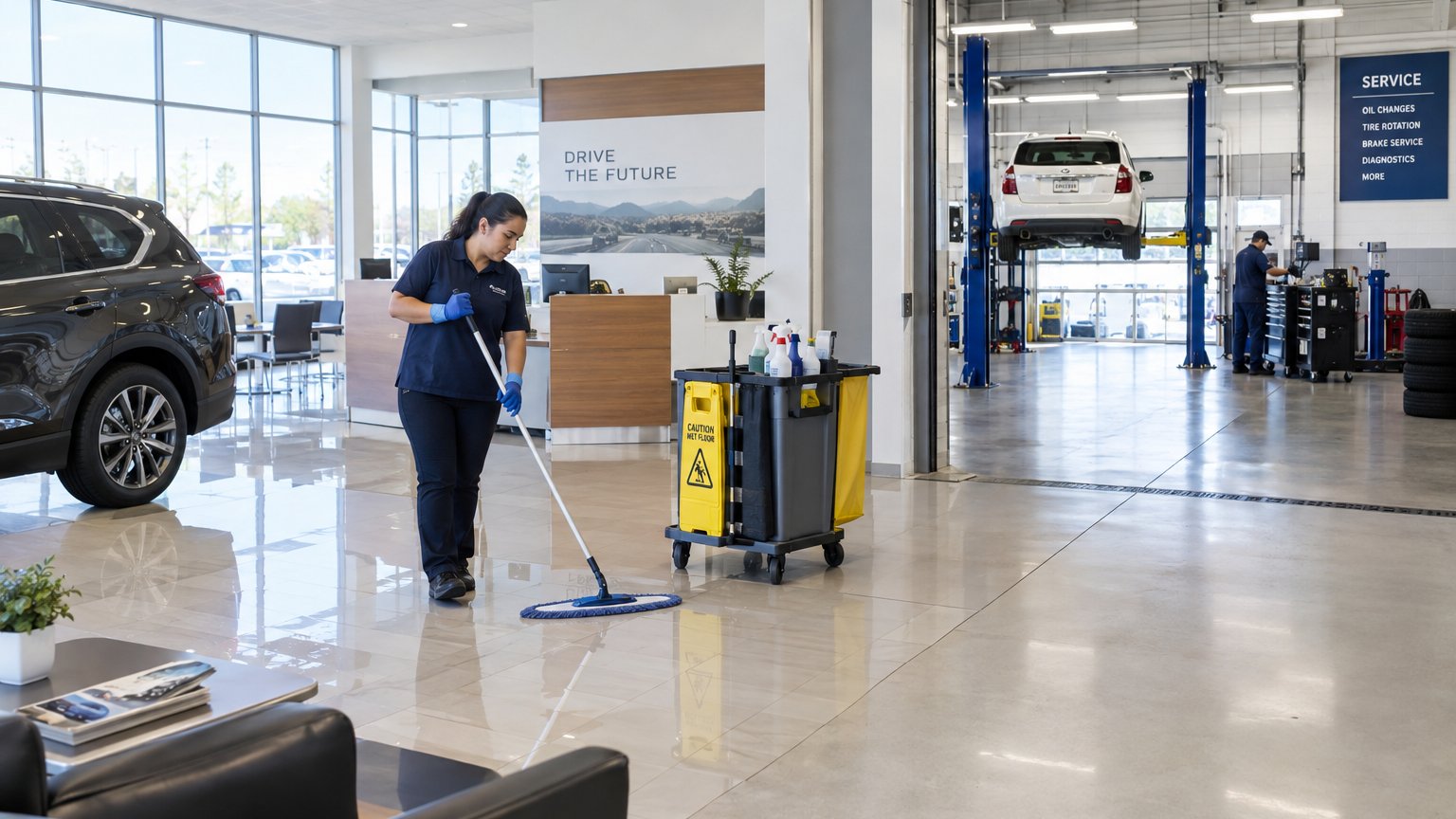
An automotive dealership has two very different public faces: the polished showroom where buyers inspect vehicles and the service department where technicians, customers, parts, oils, and tools move through the same property. A cleaning plan must respect vehicle finishes, repair operations, customer traffic, and the dealership’s environmental and safety procedures. This guide explains how to scope dealership cleaning services in New York, New Jersey, and Connecticut, where to draw the line between janitorial work and shop cleanup, and how to evaluate a vendor. GreenPoint Maintenance Services offers fixed-price commercial cleaning with site-specific verification. To schedule a dealership walkthrough or request a quote, call 347-332-9348.
Separate Showroom Standards From Shop-Floor Work
Showrooms need consistent presentation: dust-free display surfaces, clean entrance glass, streak-free interior glass, vacuumed carpet or dust-free hard floors, clean customer restrooms, and refreshed sales desks. Avoid spraying or wiping vehicles unless the dealer explicitly includes detailing in the contract and supplies approved methods. Sales staff may relocate cars throughout the day, so define vehicle-free access windows and areas that remain off limits. GreenPoint’s scope identifies what surfaces are cleaned, when sales staff must clear a desk, and who reports a scratch, spill, or suspected vehicle-fluid issue.
The service department needs a separate risk assessment and approval from the fixed-operations manager. A janitorial contractor should not treat oil, coolant, fuel, brake fluid, battery chemicals, or unknown spills as routine floor soil. Dealership staff should isolate and respond under the site’s spill plan and applicable safety procedures; GreenPoint can clean only within the authorized scope after the hazard is addressed. Keep the boundary explicit in writing so a proposal does not imply that ordinary floor care includes hazardous-waste handling or mechanical shop cleanup.
Map Zones From Customer Arrival to Vehicle Delivery
Break the property into arrival vestibules, showroom, reception, sales offices, finance offices, customer lounge, service write-up lane, parts counter, staff rooms, restrooms, and approved service corridors. Each zone has a different soil pattern and access rule. A 25,000-square-foot dealership might have only a fraction of that area open to routine janitorial service because service bays, storage, and vehicle staging are restricted. A marked site plan can distinguish daily cleaning areas, periodic floor work, and spaces requiring a dealer escort.
Local dealership layouts vary: Manhattan and Bronx operators may have compact urban footprints, while Queens facilities near Jamaica or Long Island City and Westchester dealerships near White Plains often combine larger lots with customer lounges. New Jersey sites around Newark, Jersey City, and Paramus, and Connecticut locations in Stamford or Bridgeport, may have different loading and parking access. GreenPoint records alarm instructions, contractor entry, key control, and customer-facing hours for each location. Buyers can request a walkthrough at 347-332-9348.
Set a Schedule That Matches Sales and Service Hours
Customer-facing tasks often need nightly service plus a rapid response plan during business hours. The entry, showroom glass, waiting-room tables, customer restrooms, and beverage area should be inspected before opening. Daytime touch-ups can address visible spills, overflowing bins, and restroom supplies without interrupting sales meetings. Service-lane floors may need frequent spot response, but any active repair area remains under the service department’s control. Specify who authorizes entry when a vehicle is on a lift or technicians are working nearby.
List routine and periodic work separately. Daily tasks may include trash, restroom sanitation, floor vacuuming or dust mopping, and approved desk surfaces; weekly tasks can include edges and low ledges; periodic work may include carpet extraction, interior glass, or hard-floor finish maintenance. A dealership that closes at 7 p.m. needs a different service window from a 24-hour service operation. GreenPoint can tailor fixed-price coverage to the sales calendar and maintenance downtime, rather than billing open-ended hourly visits. Compare the framework with commercial cleaning frequency standards and VCT floor care methods.
Control Chemical, Slip, and Equipment Risks
OSHA’s walking-working surfaces rule requires employers to maintain clean, orderly, sanitary surfaces and keep floors clean and, to the extent feasible, dry. See 29 CFR 1910.22. A dealership plan should stage signs and barriers before wet mopping, avoid blocking service traffic, and use a floor product compatible with tile, sealed concrete, or showroom finish. Do not use automotive solvents as janitorial cleaners or assume that a degreaser is suitable for every surface.
The dealer should provide current site hazard information, emergency contacts, designated chemical-storage locations, and any restricted areas. The cleaning vendor must train staff on labels and safety data sheets and keep secondary containers properly labeled. OSHA’s Hazard Communication requirements are a useful reference for written chemical communication; see OSHA’s cleaning chemical safety guidance. GreenPoint reviews the approved chemical list and uses Green Seal-certified products when they fit the specification, while avoiding claims that a certification makes a product appropriate for every automotive surface.
Handle Floor Care and Customer-Experience Details
Showroom floors are part of the product presentation, but excessive gloss or residue can create slip concerns. Select a method based on the floor manufacturer’s instructions, existing finish, soil, and customer-use pattern. Use clean equipment, controlled moisture, and an agreed test area before changing chemistry or finish. Entry matting, snow and salt management, and scheduled inspection during wet weather can protect both appearance and floor life. Record damaged grout, loose transitions, or cracked concrete as a maintenance issue for the dealer, not something to hide under polish.
Customer lounges and finance offices deserve special attention because customers may sit for an extended period or discuss financial information. Do not move documents or personal items; clean only approved surfaces and report unattended sensitive papers to the designated dealership contact. A quiet, low-odor approach is important during business hours. GreenPoint can set a visible pre-opening checklist for the lounge, beverage counter, and restroom, then record completed tasks in JaniTrack. The dealer receives evidence of the service without allowing routine photos to capture customer information or vehicle identifiers.
Compare Bids and Calculate the True Service Scope
A dealership RFP should list all buildings, service windows, square footage by room type, restrooms, floor materials, access rules, day porter needs, supplies, periodic projects, and exclusions. Ask whether a vendor’s price includes the showroom, service reception, parts counter, customer lounge, and any office areas. Request a clear process for storm response, urgent spills, dealership events, and scope changes. GreenPoint uses fixed pricing with no hourly billing or hidden fees in its stated program, but the buyer should verify every line against the final written scope.
A square-foot estimate is only a starting point because a carpeted sales office and active service corridor have different task times and safety constraints. BLS reported 2,199,900 U.S. janitors and cleaners (excluding maids and housekeeping cleaners) and a $37,460 annual mean wage in May 2024; see BLS occupational data. The national wage is not a dealership quote, but it helps explain why a bid that cannot support its listed labor and supervision may be unrealistic. Schedule a GreenPoint walkthrough at 347-332-9348 to receive a site-specific proposal.
Verify Results With a Defined Quality Program
Dealership management should agree on what “ready for customers” means: clear glass, clean floor edges, empty waste, restroom supply levels, lounge presentation, and no blocked routes. Use a scorecard with location, task, inspection time, result, and corrective action. ISSA’s commercial Clean Standard provides subjective and objective approaches, including ATP ranges and audit tools; see ISSA’s facility standard. ATP is a residue indicator, not a pathogen test or vehicle-surface certification, so sample only approved points and interpret the results within a written program.
GreenPoint’s JaniTrack workflow can provide time-stamped, GPS-tagged task photos and live status for agreed zones. It can help a general manager see whether the customer lounge reset was completed, whether a service corridor was inaccessible, and which deficiency remains open. Establish a small monthly review with the dealership manager and vendor supervisor. Track repeat failures rather than relying on a single score, and route repairs to the correct department. GreenPoint’s 98% client retention is a company-reported metric; ask for a sample reporting view and confirm that it fits the dealer’s own vendor requirements.
A good transition plan begins before the incumbent vendor’s final night. Confirm who transfers keys, alarm credentials, floor-care schedules, product approvals, and open maintenance items; do not place sensitive codes or customer information in public task photos. Have the dealership manager walk the showroom and service reception with the new supervisor, identify surfaces that must never be moved, and mark restricted shop areas. Set a first-week check-in after opening so sales and service staff can report missed areas while the crew still has time to adjust. GreenPoint can make that launch checklist part of the agreed scope and track the resulting corrective actions. If a dealership has multiple rooftops or a separate used-car center, keep the location-specific contacts and floor methods in distinct site appendices. This prevents a product approved for a tile customer lounge from being assumed safe for sealed concrete, polished stone, or a technician work zone. Review those appendices whenever a showroom renovation changes the floor or access route, or when operating hours change.
FAQ: Automotive Dealership Cleaning
Q: Should a janitorial vendor clean automotive service bays? A: Only where the dealership explicitly authorizes the task and the work is within the vendor’s training, equipment, and chemical scope. Unknown or hazardous spills should follow the site’s spill-response process.
Q: How often should a dealership showroom be cleaned? A: Most require daily pre-opening readiness, with daytime response based on traffic and weather. Floor and glass frequency should reflect actual soil and the surface manufacturer’s recommendations.
Q: Can cleaning staff wipe vehicles in the showroom? A: Not by default. Vehicle cleaning or detailing should be separately authorized and performed with approved products and methods to avoid paint, trim, or display damage.
Q: What should a dealership cleaning quote specify? A: Included rooms, exclusions, service windows, floor methods, supplies, emergency response, access controls, quality records, and the recurring price.
Q: How do I request a GreenPoint quote? A: Call 347-332-9348 to schedule a walkthrough for a dealership in New York, New Jersey, or Connecticut.
For a dealership walkthrough and fixed-price cleaning quote, contact GreenPoint Maintenance Services at 347-332-9348 or info@greenpointms.com. GreenPoint uses JaniTrack to document approved tasks with time-stamped, GPS-tagged photos and a live dashboard, while restricted service-bay hazards remain under dealership control.