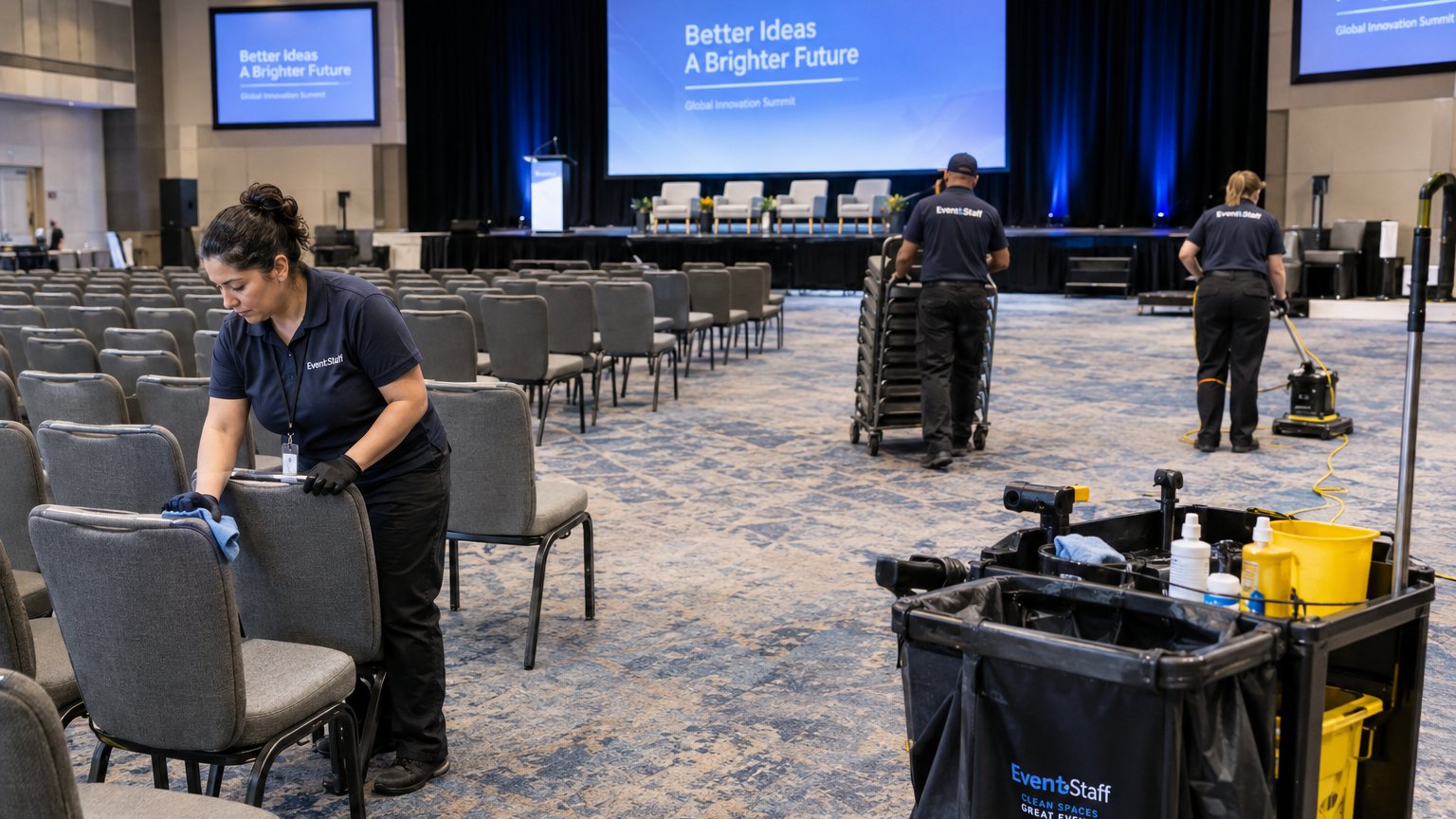
Convention centers, hotels, conference facilities, and cultural venues can move from a busy public event to a room reset in a few hours. The cleaning plan has to coordinate with the event schedule, security, loading docks, vendors, fire exits, and the next tenant’s setup. A generic nightly checklist cannot cover a 900-person reception, a breakout-room conference, and a weekend exhibition equally well. This guide gives venue operators a practical framework for defining event cleaning services in New York, New Jersey, and Connecticut. GreenPoint Maintenance Services builds fixed-price scopes around the venue calendar, defined service windows, and documented quality checks. To arrange a site walkthrough, call 347-332-9348.
Start With the Event Calendar and Reset Window
The first planning document is the venue calendar, not the cleaning checklist. For every event, capture room occupancy, doors-open and close times, expected attendance, food and beverage service, floor protection, exhibitor load-in, and the next scheduled use. A ballroom used for a 1,000-person trade show may require a quick litter sweep during doors-open, a full post-event reset, and a separate detail before the next booking. Define whether the customer expects a 60-, 120-, or 240-minute turnaround and identify which tasks can happen while another room remains occupied.
GreenPoint asks the venue to identify the event manager, security contact, facilities lead, and person authorized to release rooms. A shared run-of-show should include access windows, elevator reservations, noise restrictions, waste staging, and escalation numbers. Without this coordination, crews can be ready but unable to enter, or furniture can be moved before the event team documents its layout. GreenPoint can quote recurring base service separately from event-specific labor, so an unusually large conference does not silently consume the daily budget. Call 347-332-9348 to discuss a calendar-driven service plan.
Zone Public Areas, Meeting Rooms, and Back of House
Divide the facility into repeatable work zones: lobbies and registration areas, exhibit halls, meeting rooms, restrooms, food-service common areas, green rooms, offices, corridors, elevators, and loading docks. Each zone needs a task owner, tool set, and release condition. For example, a 50,000-square-foot exhibit hall can be mapped by aisle and booth perimeter, with waste collection at assigned points and a final sweep after dismantle. This is an operational planning unit, not a universal staffing ratio; ceiling height, furniture, event debris, and floor access change the actual work.
High-touch public points include door pulls, registration counters, elevator buttons, shared tables, and accessible restroom fixtures. Back-of-house rooms may require separate permissions because they contain event inventory, client materials, or vendor equipment. GreenPoint uses color-coded tools and written zone boundaries to reduce cross-use between restroom and public areas. The site map should also mark locked rooms and spaces that require a venue escort. A clear map speeds deployment and gives supervisors a common reference when an event changes at short notice.
Set a Practical Turnover Sequence
A reliable reset is sequenced: remove loose waste, collect recycling under the venue’s sorting rules, clear visible debris, spot clean surfaces, clean restrooms, then address floors and detail work. In meeting rooms, confirm furniture layout before vacuuming beneath tables or resetting chairs. In exhibition halls, coordinate with decorators and freight operators to avoid cleaning under active forklifts or electrical work. For a 30-minute break between sessions, limit the promise to safe, high-impact tasks rather than attempting a complete deep clean in a live room.
Build three service levels into the event plan. A “refresh” can cover litter, restroom replenishment, and visible spills; a “reset” can add full room and floor cleaning after guests depart; and a “detail” can include edges, glass, carpet spotting, and periodic floor care. Keep event-specific add-ons in a written work order with approval and price. GreenPoint can map service levels to event types and use JaniTrack task assignments to show which zones are complete. For frequency planning across spaces, see cleaning frequency standards by facility type and quality assurance for commercial cleaning programs.
Protect Egress, Worker Safety, and Public Access
Venue cleaning cannot block an exit route, accessible route, or fire-protection equipment with carts, bags, cones, or stored furniture. OSHA’s general-industry rule requires exit routes to remain unobstructed; the OSHA exit-route standard is a practical reference for setting cart staging locations and work boundaries. Local fire and building codes may impose additional venue-specific requirements, so the operator should share the approved emergency plan and event occupancy procedures with the contractor.
Wet-floor work should be isolated, signed, and sequenced to keep guest routes dry where feasible. OSHA’s walking-working surfaces rule calls for clean, orderly, sanitary conditions and floors kept clean and, to the extent feasible, dry; see 29 CFR 1910.22. Before doors reopen, the supervisor should confirm the route is dry, signs are removed only when appropriate, exits remain clear, and hazards such as loose carpet edges or broken thresholds are reported to venue management. GreenPoint includes these hold points in its venue-specific startup plan.
Coordinate Waste, Products, and Event-Specific Risks
Waste volume is driven by the event’s service model. A catered reception, convention expo, and public performance generate different combinations of food waste, cardboard, packaging, and general trash. Ask the venue about its recycling streams, compactors, allowable waste staging, and pickup cutoff. For food-service zones, distinguish general housekeeping from food-safety cleaning: the caterer and venue’s person in charge must define responsibility for food-contact surfaces and sanitizing procedures. GreenPoint does not assume access to kitchen equipment or food prep areas without written authorization and approved methods.
Product selection should account for surface compatibility, occupant sensitivities, ventilation, and any venue green-purchasing requirements. Maintain current safety data sheets, labeled secondary containers, dilution controls, and staff training. Avoid overspraying around audiovisual equipment, exhibit materials, and electronic ticketing stations. Use a floor method that matches stone, terrazzo, vinyl, carpet, or temporary protective covering. GreenPoint can specify low-odor, Green Seal-certified products when they are appropriate for the task and the contract, while following required product-label instructions and site policy.
Build a Bid and Budget That Reflect the Schedule
A venue janitorial proposal should separate base building service, planned event coverage, overnight reset, day porter response, and periodic projects. Require bidders to state expected crew size by event type, start and stop windows, supervisor coverage, equipment access, storage, consumable responsibility, overtime triggers, and exclusions. Compare the same run-of-show scenario across vendors rather than comparing a nightly office-cleaning rate with a full event turnover. GreenPoint provides fixed pricing with the agreed service scope visible, not an open-ended hourly bill with hidden assumptions.
Staff planning should be validated by a walkthrough and a sample reset, not a square-foot formula alone. A 20,000-square-foot classroom building and a 20,000-square-foot exhibit hall are not equivalent: room density, public traffic, food, floor type, and debris affect labor. For context, BLS reported a national annual mean wage of $37,460 for janitors and cleaners excluding maids in May 2024, but a wage statistic is not a contractor’s delivered price; see BLS occupational employment and wage data. To request GreenPoint’s walkthrough and quote, call 347-332-9348.
Document Turnover Quality and Exceptions
The handoff should record room status, scheduled tasks, exceptions, and release time. A photo of the reset room can help confirm a furniture layout, but should avoid attendee faces, badge data, or confidential event materials. JaniTrack allows GreenPoint to assign tasks by zone and provide time-stamped, GPS-tagged completion photos through a live dashboard. A venue manager can see the status of restrooms, lobby, and hall without waiting for a paper binder. This is service evidence, not a substitute for the venue’s safety inspection or a guarantee that every surface is microbiologically safe.
A venue quality scorecard can track completed resets, missed access windows, restroom call-backs, spill response, damaged equipment reports, and event-team feedback. Review trends monthly and assign an owner and due date to recurring issues. ISSA describes objective and subjective assessment methods for commercial cleaning, including ATP-based measures and traditional audits; its Clean Standard overview can inform a measurement framework. GreenPoint can pair visual checks with periodic ATP sampling where the customer defines locations and corrective thresholds. Ask for a sample reporting workflow at a walkthrough or by calling 347-332-9348.
A tabletop turnover exercise can uncover schedule gaps before a major booking. Select one representative event, walk the route with venue operations, and simulate the time between guests leaving and the next setup crew entering. Note the location of waste carts, spare liners, floor signs, radios, and replacement consumables; confirm which doors the cleaning crew may use and whether an escort is required. Keep a contingency for late teardown, an extended program, or a room that cannot be released on time. GreenPoint can document the agreed handoff and revise the service window after the exercise, reducing avoidable overtime and protecting the venue’s promised room-release time. For a 3-room conference sequence, test whether the same crew can reset all spaces without crossing an active registration line. Record the actual release and completion times so the next quote uses observed turnaround data rather than an optimistic assumption.
FAQ: Convention and Event Venue Cleaning
Q: How soon can an event venue be reset? A: It depends on the room, debris, floor method, access, and next-use deadline. Define the turnaround window and minimum reset standard in advance, then validate it at a walkthrough.
Q: Should event cleaning be priced hourly? A: Buyers can request an agreed fixed price by service level or event profile, with clearly defined add-ons for scope changes. The quote should disclose assumptions rather than hiding labor and access risks.
Q: Can cleaning happen while guests are present? A: Some low-noise touch-ups can be planned during events, but wet-floor work, cart movement, and back-of-house access need venue approval and safe separation from guests.
Q: What records should a venue receive? A: A task completion log, exceptions, approved photos, timestamps, and follow-up notes are useful. Keep personal data and confidential event materials out of routine cleaning images.
Q: How do we start with GreenPoint? A: Share an event calendar and floor plans, then schedule a site walkthrough. Call 347-332-9348 for a fixed-price proposal for a venue in NY, NJ, or CT.
Schedule a convention-center or event-venue walkthrough with GreenPoint Maintenance Services at 347-332-9348 or info@greenpointms.com. GreenPoint supports fixed-price, calendar-based service and JaniTrack task records with time-stamped, GPS-tagged photos and live status reporting.