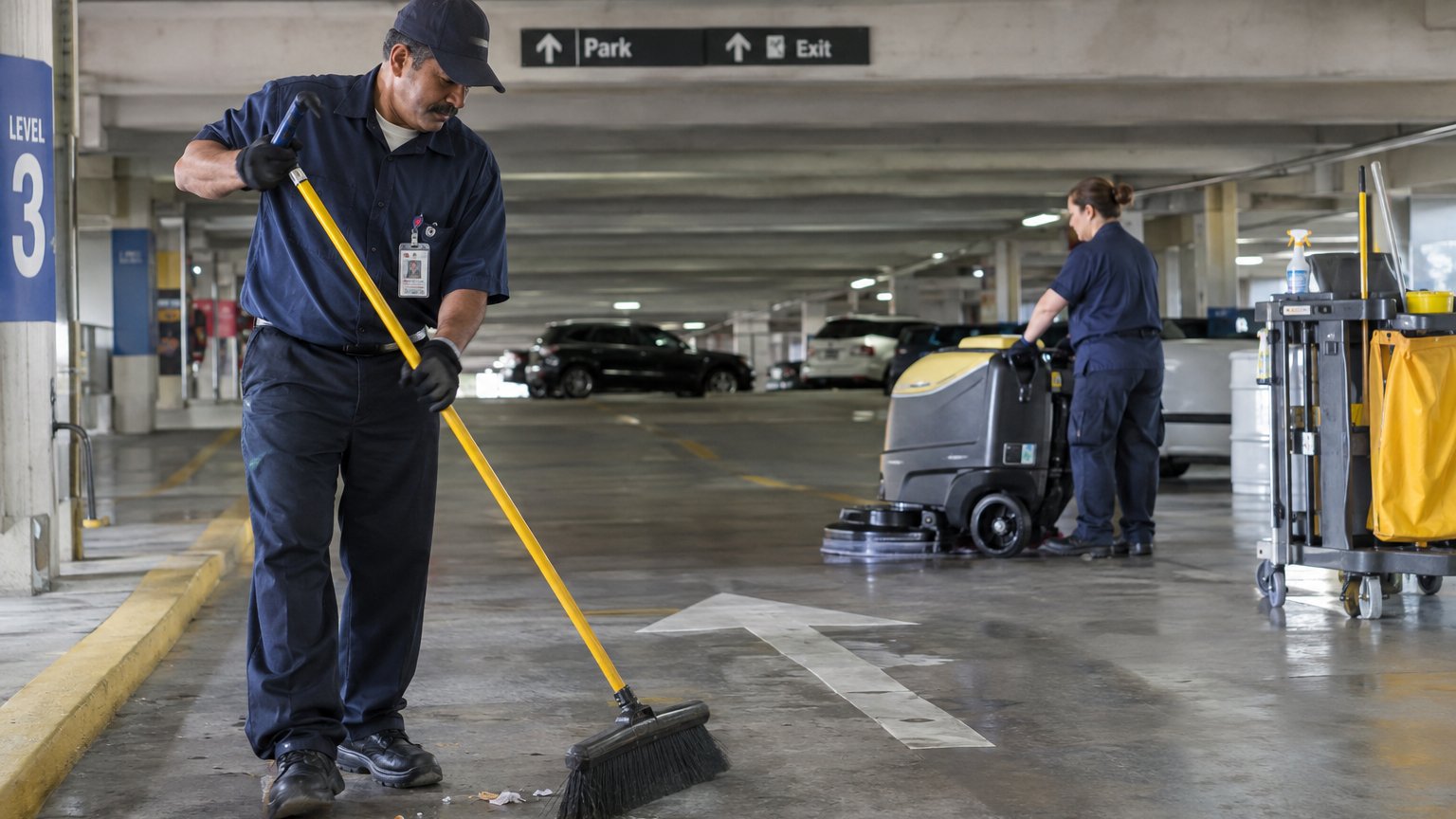
Parking garages collect road salt, sand, leaves, tire dust, litter, fluid leaks, and standing water while vehicles and pedestrians continue to move through the property. Cleaning must improve visibility and appearance without creating a new slip hazard, blocking an exit, or washing contaminants into a drain. This guide helps owners and property managers scope parking garage cleaning services in New York City and the tri-state region, set safe work windows, and distinguish janitorial work from engineering inspections or hazardous spill response. GreenPoint Maintenance Services builds fixed-price facility plans with defined zones and documented checks. Call 347-332-9348 to request a site walkthrough.
Define the Garage Type and Service Boundary
Start by describing whether the facility is enclosed, open-sided, attached to a building, below grade, or a surface lot. Record the number of levels, approximate cleanable square footage, ramps, stairs, elevators, payment areas, pedestrian paths, drains, and mechanical rooms. A 400-space garage with two ramps and a busy pay station is not equivalent to an open lot with a single entrance. The scope should specify which floors, walls, columns, stairwells, elevators, and exterior sidewalks are included, and which are managed by a separate maintenance contractor.
A cleaning contract is not a structural inspection, repair plan, oil-water separator service, or hazardous-material response. Cleaning staff should report cracks, spalls, exposed reinforcement, persistent leaks, and unknown spills to the owner’s designated contact. In New York City, qualifying parking structures are subject to a periodic inspection program conducted by a qualified parking structure inspector; the NYC Department of Buildings parking-structure guidance describes the owner’s inspection responsibilities. GreenPoint’s scope can support housekeeping and issue reporting but does not replace the licensed engineer’s assessment.
Schedule Work Around Vehicle and Pedestrian Flow
Choose work windows from actual traffic counts and tenant schedules. A garage serving a hospital or apartment tower may never close completely, while a commuter garage near Grand Central, Penn Station, or the Port Authority may have a sharp overnight lull followed by a morning rush. In Brooklyn, a Downtown Brooklyn or Atlantic Terminal facility may have event peaks; in Queens, garages near LaGuardia or Long Island City can have irregular traffic. For Newark, Jersey City, Stamford, or White Plains, coordinate with property operations and local event calendars.
Use a written traffic-control plan for each cleaning period. Identify the work zone, alternate vehicle path, pedestrian route, spotters if needed, warning signs, cones, communication method, and stop-work condition. Clean one lane or section at a time where the design permits and never stage carts in exit access, stair landings, or fire-protection equipment areas. OSHA requires exit routes to stay unobstructed under 29 CFR 1910.37. GreenPoint reviews access plans at a walkthrough and confirms who can authorize temporary closures.
Use a Debris-First, Drain-Aware Cleaning Method
A practical sequence begins with visible litter pickup and dry sweeping or vacuuming before any water is introduced. Remove loose leaves, grit, and packaging from corners and stairwells; then spot clean approved surfaces and address drains only within the written scope. Dry removal reduces the chance of pushing solids into a trench drain. If wet cleaning is appropriate, use controlled water volumes, capture or contain runoff where required, and follow the property’s stormwater and wastewater procedures. Never pressure-wash a garage by default or route contaminated wash water to a storm drain without authorization.
Identify drains, sump pits, oil-water separators, and protected areas on the plan. The owner should confirm local sewer authority requirements, stormwater permits, and discharge approvals before selecting a wet method. The cleaning contractor can follow those instructions but should not infer compliance from a drain cover or floor slope. GreenPoint can specify dry sweeping, low-moisture spot work, and periodic machine scrubbing with the site’s approved discharge controls. A seasonal cleaning checklist is available in winter facility maintenance for Northeast properties and commercial pressure washing guidance.
Respond Safely to Leaks and Unknown Spills
Oil, fuel, coolant, battery fluid, and other unknown liquids must be treated as a hazard, not ordinary dirt. The garage owner should provide spill-response procedures, absorbents, emergency contacts, and a list of authorized responders. If a cleaning employee discovers a leak, the procedure should be to protect people from exposure, keep vehicles from tracking it, notify the designated site contact, and avoid mixing products or washing the substance toward a drain. GreenPoint can document and escalate the event; cleanup beyond the approved janitorial scope requires trained, authorized personnel.
OSHA’s general-industry walking-working surfaces rule requires employers to keep floors clean and, to the extent feasible, dry, and to address leaks, spills, snow, and ice as hazards. Review 29 CFR 1910.22 when writing the site’s housekeeping and work-zone rules. A wet floor sign alone does not control vehicle traffic or prevent a pedestrian from entering a ramp. Use barriers, detours, communication, and a documented reopening check before removing a work zone.
Build Seasonal and Level-by-Level Frequencies
A recurring schedule should identify daily or shift-based litter patrol, weekly corner and stair detail, monthly machine cleaning where the surface and discharge rules permit, and seasonal salt and leaf removal. After snow events, increase entry and ramp inspections because tracked salt and meltwater can create residue and slick conditions. The exact cadence depends on garage occupancy, weather, ventilation, and owner priorities; avoid unsupported claims that a universal cleaning interval is required by code. GreenPoint can structure the schedule by level and high-soil zone, then adjust based on photo records and manager feedback.
Every level should have an inspection route covering drive lanes, ramps, elevator lobbies, stair towers, pay stations, accessible parking, and exit discharge paths. A 100,000-square-foot garage might be divided into 5,000- to 10,000-square-foot zones for manageable assignment, but the work order should reflect actual travel distance, columns, slopes, and traffic control. The figure is a planning example, not an industry productivity promise. GreenPoint can map zones during a walkthrough and quote periodic deep cleaning separately from everyday patrols.
Coordinate Local Rules and Building Operations
A tri-state garage serves different owners and authorities. In NYC, Local Law 126 and Administrative Code requirements govern periodic condition assessments for covered parking structures; those engineering assessments must not be confused with janitorial inspections. Owners should check the applicability and filing cycle for each property with a Qualified Parking Structure Inspector. In New Jersey and Connecticut, the owner should confirm local fire, building, sewer, stormwater, and workplace procedures that apply to the site. GreenPoint follows written site rules and routes structural or environmental concerns to the owner’s professionals.
Garages near the Bronx Zoo, Yankee Stadium, Barclays Center, Newark Penn Station, or Stamford Transportation Center may see event surges that require a pre-event litter pass and a post-event reset. Property managers should coordinate with parking operators, security, transit, and retail tenants before closing a ramp. Include a communications plan for temporary closures, accessible parking relocation, tenant notices, and emergency vehicle access. Call GreenPoint at 347-332-9348 to schedule a walkthrough for a NYC, Westchester, Long Island, New Jersey, or Connecticut garage.
Price the Scope and Confirm Equipment
A garage quote should include levels and areas, cleaning frequency, traffic-control requirements, shift window, equipment, water access, drain restrictions, waste disposal responsibility, mobilization, and exclusions. Clarify whether sweeping, litter pickup, machine scrubbing, stairwell cleaning, elevator cleaning, salt removal, and spill response are separate line items. Ask how the vendor handles a blocked lane, a special event, or an inaccessible area. GreenPoint uses fixed pricing for the agreed scope rather than an hourly bill that shifts with crew speed, and any new task should be approved in writing.
Do not compare price per square foot without checking how the vendor calculated cleanable area and traffic-control time. BLS reported 2,199,900 janitors and cleaners, excluding maids and housekeeping cleaners, and an annual mean wage of $37,460 nationally in May 2024; the BLS occupational table provides the data. It is labor context, not a local garage rate. Ask bidders to show the assumed crew, equipment, and work window, then request GreenPoint’s fixed-price walkthrough quote at 347-332-9348.
Document Work and Escalate Conditions
A garage cleaning record should show the zone, task, start and finish time, traffic restrictions, hazards found, photos where allowed, and follow-up owner. Do not photograph license plates, payment screens, or identifiable people unless the owner has approved the method and privacy controls. JaniTrack can give GreenPoint managers a live view of assigned tasks, time-stamped GPS-tagged photos, and exceptions. A photo can support evidence that a zone was swept; it cannot establish structural safety or prove that a surface is free of every contaminant.
Monthly review should distinguish service defects from maintenance issues: repeated debris at the same stair landing may indicate a frequency problem, while standing water may require a drain repair. ISSA’s commercial cleaning standard describes audits and objective measurement as tools to evaluate cleaning performance; see ISSA’s Clean Standard overview. GreenPoint can document open items and corrective actions in its dashboard. Ask how the supervisor closes a repeat issue and schedule a walkthrough at 347-332-9348.
Before the first scheduled service, conduct a joint orientation with the parking operator, building manager, security, and cleaning supervisor. Walk each level, test radio or phone coverage, locate the approved supply area, mark the safe pedestrian route, and record which gates or ramps must stay open. Confirm how to pause work if a vehicle enters a closed section, a drain is blocked, or an unknown liquid is found. A brief sign-off after the first shift can verify that the zone map matches actual traffic and that no exit or accessible route was restricted. GreenPoint can update the task records after the owner approves those operational changes.
FAQ: Parking Garage Cleaning Services
Q: How often should a parking garage be cleaned? A: Set a routine litter and safety inspection cadence based on traffic and weather, then schedule deeper work by soil load and surface condition. There is no single frequency that fits every garage.
Q: Can a cleaning vendor pressure-wash the garage? A: Only after the owner confirms approved water use, runoff capture, discharge rules, equipment access, and traffic closure requirements. Dry soil removal is often the first step.
Q: Does garage cleaning include structural inspection? A: No. NYC and other jurisdictions may require qualified engineers to assess covered parking structures. Janitorial staff should report observed defects but cannot replace that assessment.
Q: What should happen when a worker finds an oil or fuel spill? A: Follow the property’s spill plan, protect people, notify the authorized site contact, and do not wash the unknown substance toward a drain.
Q: How do I get a GreenPoint quote? A: Call 347-332-9348 to schedule a garage walkthrough and confirm the service area, work windows, drainage rules, and fixed-price scope.
Request a parking-garage walkthrough and fixed-price scope from GreenPoint Maintenance Services at 347-332-9348 or info@greenpointms.com. GreenPoint can document assigned cleaning zones in JaniTrack with time-stamped, GPS-tagged photos while keeping structural inspections and hazardous spill response with qualified, authorized specialists.