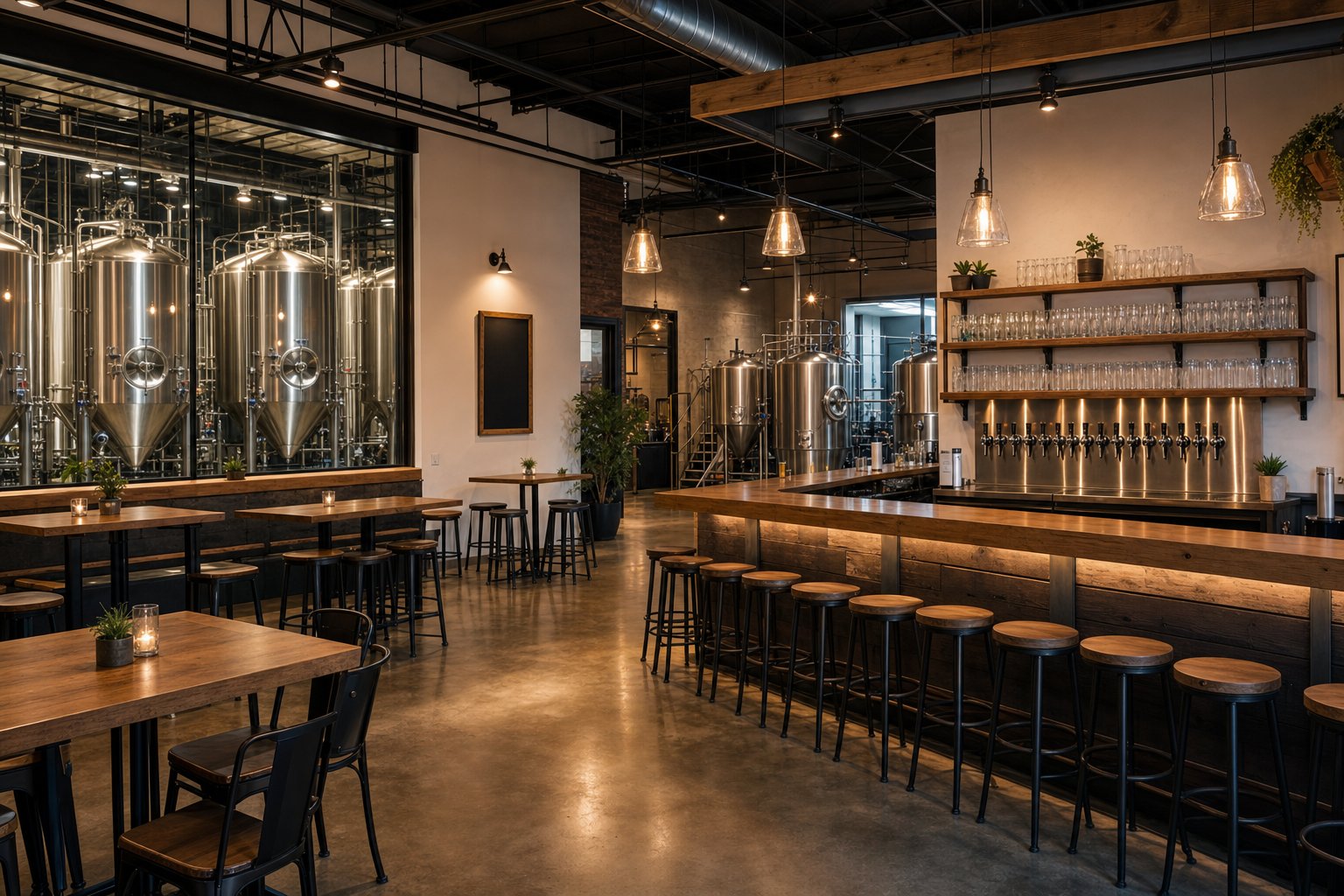
If you run a brewery or taproom in the tri-state area, you already know cleanliness isn’t cosmetic—it’s brand protection, employee safety, and a direct driver of guest reviews. A single sticky floor in the tasting room, fruit fly activity near drains, or a sour odor near the mop sink can undermine months of careful recipe work. GreenPoint Maintenance Services builds brewery-specific cleaning programs for New York City, North Jersey, and Connecticut accounts that need food-safe sanitation, predictable results, and documentation you can show to ownership or inspectors. Call 844-814-0810 to schedule a walkthrough and get a fixed-price scope that matches your production schedule.
Why brewery cleaning is different from standard janitorial
Breweries combine industrial surfaces, wet-process soils, and customer-facing hospitality—often in the same footprint. In production zones you’re managing yeast residue, sugars, spent grain dust, caustic/acid exposure, and constant moisture around drains. In the taproom you’re managing high-touch surfaces, restrooms, glass break risks, and the expectations of diners who equate cleanliness with product quality. GreenPoint designs the program so the “front of house” stays guest-ready while the “back of house” meets sanitation and safety requirements without interrupting brew days. If you want a brewery-trained crew and a documented quality system, call 844-814-0810 for a walkthrough.
Tri-state realities: NYC regulations, tight footprints, and transit-heavy traffic
NYC brewery spaces frequently sit in mixed-use buildings or older industrial properties—think Greenpoint/Williamsburg, Long Island City, Gowanus, Red Hook, or Jersey City waterfront areas. That means narrow service corridors, shared loading docks, and heavy foot traffic from subways like the L, G, 7, and PATH. A practical plan accounts for mud and salt in winter, humidity in summer, and the fact that taprooms often flip quickly between lunch, events, and evening rush. GreenPoint Maintenance Services scopes cleaning around your operating hours, includes entry matting and floor protection strategies, and uses fixed pricing so you don’t get hit with surprise “extra hours” after a weekend event. See our detailed guide on [color-coded microfiber systems](/blog/color-coded-microfiber-systems-guide/) for the full protocol.
A brewery sanitation map: zones, tools, and chemical safety
The fastest way to reduce cross-contamination and odors is to map the facility into zones: (1) production floor and drains, (2) cold room and keg storage, (3) taproom/dining, (4) restrooms, (5) offices and break areas, (6) trash staging and loading. Each zone gets its own color-coded microfiber and dedicated tools to prevent transferring soils from restrooms to hospitality surfaces. GreenPoint’s crews follow OSHA-aligned chemical handling practices: labeled secondary bottles, SDS access, correct dilution control, and training for eye/skin protection where needed. For a safety-first cleaning plan that still moves fast, call 844-814-0810.
Floors and drains: where breweries win or lose the “clean smell”
Most “brewery smell” complaints aren’t the beer—they’re microbial growth and trapped soils in drains, grout lines, and textured floors. A strong plan combines: daily squeegee routines, targeted degreasing in traction zones, and a scheduled drain maintenance rotation. On many accounts we also recommend a monthly deep-clean cadence for drains and floor edges, because yeast and sugar residue can build up quickly. GreenPoint uses verification steps (including photo documentation where allowed) so the drain and floor program stays consistent even when staffing changes. If your reviews mention odors, sticky floors, or “feels dirty,” schedule a walkthrough at 844-814-0810.
Taproom readiness: high-touch cleaning that protects your brand
Guests touch more than you think: bar rails, POS screens, menus or QR stands, door hardware, railings, and bathroom fixtures. GreenPoint’s approach is to define a top 25 high-touch list and clean it at a frequency tied to traffic, not a generic “nightly wipe down.” We also coordinate glass break response procedures and make sure floors are left dry and slip-resistant—especially important in spaces with concrete, epoxy, or sealed VCT transitions. If your taproom hosts events, we build in “event reset” options with clear pricing—call 844-814-0810 to plan it.
Restrooms: a predictable routine that avoids weekend surprises
In taprooms, restrooms are the cleanliness “truth test.” If they’re off, guests assume everything else is off. GreenPoint sets measurable restroom standards: stocked supplies, streak-free mirrors, disinfected high-touch points, and odor control with attention to floor edges and behind fixtures. We pair that with log-style checks and optional digital verification. For sites that want additional proof, GreenPoint can incorporate StockPoint—timestamped, GPS-tagged photos and optional ATP testing outcomes—so you have evidence of service delivery when management isn’t onsite.
Production-adjacent spaces: offices, break rooms, and employee welfare
Breweries are physically demanding workplaces, so employee areas need to be clean, stocked, and safe—especially around hydration stations, microwaves, lockers, and time clocks. A simple baseline is to treat break rooms and offices like high-touch environments and apply the same disciplined approach used in hospitality spaces. GreenPoint Maintenance Services uses Green Seal-certified products where appropriate and builds scopes that reduce irritants without sacrificing performance. If you’re standardizing cleaning across multiple locations, call 844-814-0810 for a multi-site plan. See our detailed guide on [food safety cleaning protocols](/blog/cleaning-frequency-standards-by-facility-type/) for the full protocol.
How much does brewery cleaning cost in NYC/NJ/CT? Practical benchmarks
Costs vary by square footage, operating hours, floor type, and how “wet” the process is, but most brewery/taproom programs land in a predictable range when scoped correctly. As a starting point, many commercial janitorial programs are discussed in cost-per-square-foot terms, but breweries often need additional drain/floor focus and event resets that change the math. GreenPoint scopes your facility as zones with defined task frequency and then prices it as fixed monthly service—no hourly billing and no hidden add-ons. For a sense-check on your current spend, compare with our cost guidance in [commercial cleaning cost per square foot](/blog/commercial-cleaning-cost-per-square-foot/) and request a walkthrough at 844-814-0810.
Proof beats promises: quality assurance with StockPoint verification
Breweries and taprooms often have lean management teams; you can’t be everywhere at once. GreenPoint’s quality assurance model is built for that reality: digital checklists, supervisor audits, and optional StockPoint verification (timestamped GPS-tagged photos plus an online dashboard). For accounts that want even more evidence in sensitive areas, we can integrate ATP testing to confirm that cleaning outcomes meet your baseline. If you’re tired of “it was done” with no proof, call 844-814-0810 and ask about our verification options.
Cleaning-in-Place vs Cleaning-out-of-Place: When Each Applies
Fermenters, brite tanks, and jacketed vessels typically use cleaning-in-place (CIP) with recirculating caustic and acid loops that the brewery's own cellar team runs. Fittings, gaskets, valve plugs, hoses, and shive tools are cleaned-out-of-place (COP) in a dedicated wash sink or parts washer. GreenPoint Maintenance Services scopes janitorial and sanitation contracts around this boundary: our teams handle the taproom, restrooms, brewhouse floors, drains, exterior tank surfaces, and hoist points, while your cellar operators maintain full ownership of internal tank surfaces. Blurring that boundary is a leading source of cross-contamination and audit findings, which is why we document the split in writing before any first-shift cleaning. See our detailed guide on [ATP surface testing](/blog/what-is-atp-bioluminescence-testing-cleaning/) for the full protocol.
For a 15-barrel production brewhouse in Brooklyn, our typical weekly scope covers 6,500 to 9,000 square feet of concrete floor (including trench drains, hose stations, and pallet zones), 800 to 1,200 linear feet of stainless exterior surfaces, and 4 to 6 restrooms shared between staff and taproom guests. Call 844-814-0810 for a walkthrough that maps out the CIP/COP boundary in writing.
Drain Hygiene: The Number-One Failure Point in Brewery Audits
Trench and floor drains in breweries collect yeast slurry, spent grain, sugars, and hop residue. Left untreated, they become reservoirs for Listeria monocytogenes, wild yeast, and lactic acid bacteria that can travel through drain aerosol and colonize packaging lines up to 20 feet away. GreenPoint Maintenance Services follows a three-step drain protocol on every brewery account: mechanical debris removal, foaming enzymatic cleaner with 15-minute dwell, and quaternary ammonium or peracetic acid sanitizer at label rate. Frequency is daily during shift-end cleanup and deep-scrubbed weekly with a rotating drain brush and biofilm-targeted product.
We log every drain cleaning in StockPoint with a timestamped GPS-tagged photo of the drain grate before and after, plus which chemical was used and at what dilution. Facility managers, TTB inspectors, and third-party auditors get a searchable record they can pull in seconds, which is critical when a brewery is pursuing SQF or BRCGS certification.
Chemical Compatibility with Stainless, Aluminum, and Copper
Not every commercial sanitizer is safe on the alloys found in a working brewhouse. Chlorinated products at concentrations above 200 ppm free chlorine will pit 304 and 316 stainless over time, and copper hop-back surfaces or brass fittings can discolor rapidly when exposed to strong caustic or acidic residue. GreenPoint teams use no-rinse peracetic acid at 80 to 200 ppm for stainless sanitation, quaternary ammonium at 200 to 400 ppm for floor and drain applications, and neutral-pH detergents on any surface with mixed metal exposure. Our Green Seal certified product line covers 90 percent of brewery sanitation needs without the corrosive risk profile of legacy chemistries.
Allergen and Adjunct Cross-Contact Protocols
Breweries that produce fruited sours, hazy IPAs with lactose, coffee stouts, or gluten-reduced beers must document allergen changeover cleaning between batches. The FDA Food Safety Modernization Act (FSMA) and TTB labeling rules require verifiable prevention of undeclared allergens. GreenPoint Maintenance Services builds a color-coded microfiber system into every brewery contract: green for fermentation vessel exteriors, red for allergen-adjacent surfaces (lactose, coffee, fruit puree contact zones), blue for general food-contact stainless, and yellow for restrooms and non-production areas. This eliminates the most common source of cross-contact: a shared cleaning cloth.
FAQ: brewery and taproom cleaning in the tri-state area
Q: Do you clean during brewing or only after hours? A: Most breweries prefer after-hours or early-morning service for taprooms, but production-adjacent cleaning can be scheduled around brew days; GreenPoint scopes the plan around your actual workflow so we don’t interfere with operations. Q: Can a cleaning vendor handle drains and sticky floors safely? A: Yes, if the program includes the right chemicals, dilution control, PPE, and a repeatable drain/floor routine; GreenPoint trains crews for wet-process environments and documents completion. Q: Do you provide Green Seal products for customer-facing areas? A: Yes—GreenPoint Maintenance Services uses Green Seal-certified products where appropriate to reduce odors and harsh residues, while still matching the soil type and surface. Q: How do we verify cleaning when managers aren’t onsite? A: GreenPoint can use StockPoint verification—timestamped, GPS-tagged photos, plus optional ATP testing outcomes and a live dashboard—so you have evidence of service. Q: What’s the fastest way to improve guest reviews about cleanliness? A: Fix restrooms and floor edges first, then build a high-touch list for the taproom; many facilities also improve by using a documented frequency standard like those explained in [cleaning frequency standards by facility type](/blog/cleaning-frequency-standards-by-facility-type/).
Need a brewery-ready cleaning program in NYC, North Jersey, or CT? GreenPoint Maintenance Services (MBE-certified) delivers fixed-price janitorial with documented verification and 98% client retention. Call 844-814-0810 or email info@greenpointms.com to schedule a walkthrough and get a scope tailored to your brew schedule and taproom traffic.