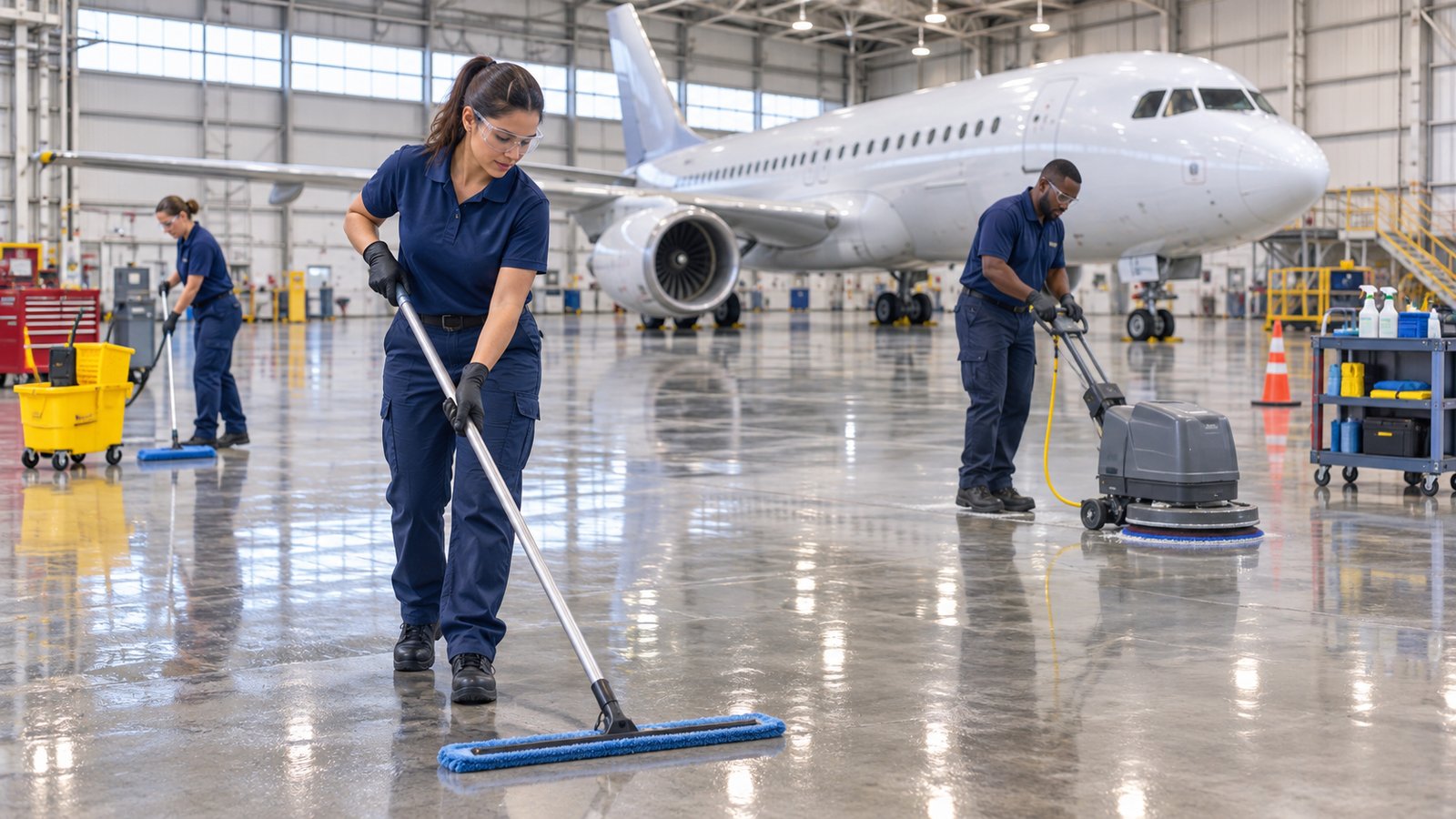
Commercial cleaning for an aircraft hangar or fixed-base operator (FBO) requires tight coordination with airport access, aircraft movement, maintenance schedules, and foreign-object-debris controls. A vendor may be asked to clean offices, crew rooms, restrooms, terminal lounges, and support corridors, while aircraft interiors and maintenance spaces may have separate authorization rules. GreenPoint Maintenance Services Corp helps facilities define a written building-cleaning scope, with documented checks and fixed pricing. For a New York or New Jersey site walkthrough, call 347-332-9348.
Separate building cleaning from aircraft servicing
Begin by marking areas where a janitorial crew can work without entering aircraft, maintenance bays, fueling zones, or controlled ramp areas. Typical building scope may include the FBO reception and passenger lounge, dispatch offices, staff break rooms, conference rooms, restrooms, and interior glass. Aircraft cabin cleaning, component cleaning, maintenance support, fuel-area work, and ramp sweeping need explicit review by the owner, FBO, airport operator, and insurer. GreenPoint recommends describing each space in the contract by boundary, access level, equipment, and authorized task.
This distinction matters because the FAA's airport compliance guidance says aircraft owners and operators may perform self-service tasks such as cleaning their own aircraft, but self-service activities generally may not be contracted to a third party. In certain long-term-lease situations, the owner or operator must retain sufficient control over contracted personnel, including assignment and termination. Do not assume a routine building janitorial contract permits work on an aircraft. Confirm the arrangement in writing with the airport sponsor and aircraft operator before any vendor enters or touches an aircraft.
For procurement, put that boundary in both the RFP and the site orientation. State whether the vendor's assignment ends at the hangar office door, whether it may clean common building corridors, and who must approve any proposed change. If an aircraft owner later asks a cleaner to enter a cabin or wipe a component, the worker should pause and refer the request to the authorized airport and operator contacts. A clear written boundary protects the contractor, the aircraft owner, and the airport from confusion about who has control of the work.
Design a scope around hangar doors, work zones, and FOD
Foreign object debris can damage aircraft and create operational risk, so a housekeeping plan should identify what can become loose, where it may travel, and how it is removed. Use approved closed containers for trash, inspect equipment before bringing it near a hangar, and keep mop heads, fasteners, cloths, and machine accessories accounted for. The airport or tenant should specify whether any cleaning is permitted near the aircraft apron or movement area. A building-only cleaning route should stop at a clearly marked line unless the operator authorizes additional work.
Map door-open hours, aircraft towing paths, floor drains, maintenance stands, parts benches, and staging locations. A proposed 60,000-square-foot hangar might include office pods, a parts room, restrooms, and a wide concrete floor, but the square footage does not reveal which zones are accessible during active maintenance. GreenPoint can list separately the approved office route, interior glass, floor dust control, and periodic detail service. The warehouse and industrial cleaning best-practices guide offers useful questions for high-bay layouts, though aircraft-specific access must come from the airport and tenant.
Plan safe floor care for concrete and hangar finishes
Hangar floors may contain tire marks, dust, small debris, or residues from maintenance activity. A cleaning plan should identify what materials may be present and which products, absorbents, vacuum filters, and floor machines are approved. Do not wet-mop an unknown fluid or push a spill toward a drain. Define who isolates the area and who contacts environmental health and safety. Routine cleaners should not handle fuel, oil, hydraulic fluid, solvents, or other maintenance chemicals unless the employer has separately authorized and trained the crew for that work.
For ordinary office and lounge floors, choose a method suited to the surface and available drying time. Keep wet-floor signs visible, work one side of a corridor at a time, and avoid leaving hoses across a walking path. OSHA's Hazard Communication Standard covers workplace information about hazardous chemicals, labels, safety data sheets, and training; host and contractor teams should agree how chemical hazards are shared. See the OSHA cleaning chemical safety and SDS guide and confirm airport-specific rules before introducing any product.
Coordinate credentials and service windows at regional airports
New York and New Jersey aviation properties range from major airports such as JFK, LaGuardia, Newark Liberty, and Teterboro to smaller general-aviation fields and corporate hangars. Each airport sponsor, FBO, tenant, or security program can have different badge, escort, vehicle, parking, and work-hour rules. A vendor should know which terminal entrance to use, where to stage equipment, how to report a lost badge, who escorts the crew, and whether a work order must be closed before doors are secured.
Schedule service around aircraft arrivals, maintenance shifts, charter departures, and parts deliveries rather than assuming a quiet overnight window. A crew arriving at 10 p.m. may still encounter a late aircraft movement or an active repair bay. The facility contact should be empowered to pause work and redirect staff. GreenPoint can document agreed office-route checks in JaniTrack, but GPS-tagged photos and timestamps do not replace an airport badge system, aircraft release, or FOD inspection. Request a walkthrough at 347-332-9348 to identify the right control points.
Keep a current roster of employees approved for each location, the badge sponsor, expiration date, escort requirement, and emergency contact. Remove access promptly when a worker transfers or leaves the account, and do not share badges to cover an absence. The airport or tenant should define how a crew member reports a lost credential, an unsecured door, or an unattended visitor. For sites near Teterboro, Republic Airport, Newark Liberty, JFK, or LaGuardia, the access process may differ even when the service tasks look similar. GreenPoint will follow the property-specific procedure instead of assuming one airport's credentialing rules apply across the region.
Set chemical, PPE, and incident rules before mobilization
Ask the airport or tenant to review the proposed product inventory, labels, safety data sheets, dilution, storage cabinet, spill procedure, PPE, and disposal route. A product suitable for a restroom may be inappropriate near aircraft finishes, sensitive instruments, or a floor drain connected to a regulated system. Workers need a written stop-work rule for fuel odor, smoke, leaking containers, damaged electrical cords, unsecured ladders, and any unidentified residue. OSHA's cleaning-industry material points employers toward chemical, PPE, bloodborne-pathogen, and slip-and-fall hazards.
Maintain a clean tool set with color-coded cloths and separate restroom equipment from crew-room and office tools. Use a daily equipment check so no loose parts or forgotten items remain in hangar work areas. GreenPoint can train its assigned personnel to follow the site-approved route, report hazards, and avoid touching aircraft, parts, and tools. The client should retain approval of all airside work, products, and access changes. That division keeps routine janitorial service separate from maintenance responsibilities and reduces uncertainty during an audit.
Compare FBO and hangar cleaning proposals
Ask bidders to list building areas, shift times, labor hours, backup staffing, floor equipment, consumables, access assumptions, and exclusions. A 20,000-square-foot corporate hangar with small offices may require a very different scope from a 100,000-square-foot maintenance facility with multiple staff amenities. A useful cost model is planned labor hours multiplied by a local fully burdened rate, plus supervision, materials, equipment, insurance, travel, and periodic work. Do not compare bids on square-foot price alone when one includes ramp work or aircraft access and another does not.
Request proof of insurance, training documentation, a sample inspection log, a corrective-action process, and a named account supervisor. Include a change-control clause for new secure areas or added shift coverage. GreenPoint offers fixed pricing rather than hourly billing, and its written quote identifies included work and assumptions. An ISSA-style cleanliness check can pair visual inspection with optional ATP readings on selected surfaces, but ATP does not prove an aircraft or hangar is sterile. Buyers can also read how to choose a commercial cleaning company and digital cleaning verification systems before requesting a quote.
A proposal should also state whether the price covers only scheduled janitorial visits or includes on-call response, snow-season entry mat service, high dusting, and floor restoration. Write the access assumption in plain language: for example, the client provides escort access to the approved office wing during a named two-hour window. If a hangar bay is unavailable because an aircraft is being moved or repaired, the work order should explain how that shift is handled. This detail makes a comparison between two bidders fairer and prevents a low base price from hiding unpriced access delays or unapproved airside tasks.
For a regional portfolio, request a separate scope for each airport or tenant instead of assuming one badge process and operating window applies everywhere. A corporate hangar near Teterboro may have a small crew and private access procedure, while a large New York airport tenant may require additional security coordination and longer equipment staging. List each location's contact, task schedule, approved products, and inspection method in the proposal. GreenPoint can quote the properties as a coordinated account while keeping site-specific exceptions visible to the buyer.
Aircraft hangar and FBO cleaning FAQs
Can a third-party cleaning company clean aircraft interiors? Do not assume so. FAA airport guidance treats aircraft cleaning as a self-service activity for the owner or operator and says self-service generally may not be contracted out; any proposed third-party arrangement needs review and sufficient owner/operator control.
What areas can a janitorial contractor typically include? A written building scope may cover an FBO lounge, offices, staff areas, restrooms, and approved common corridors. Hangar floors, ramps, maintenance bays, aircraft, and controlled spaces require specific authorization and task procedures.
How should an aviation property handle FOD prevention? The airport and tenant should define approved equipment, closed waste containers, tool accountability, debris reporting, access boundaries, and stop-work contacts. A vendor inspection log supports housekeeping but does not replace the operator's airfield safety program.
How can I arrange a GreenPoint walkthrough? Call 347-332-9348 or email info@greenpointms.com. GreenPoint Maintenance Services can scope approved building areas and document agreed checks with JaniTrack; the airport sponsor and aircraft operator retain authority over aircraft and airside access.
Need a commercial cleaning quote for an FBO, hangar office, or aviation support building in New York or New Jersey? Schedule a walkthrough with GreenPoint Maintenance Services Corp at 347-332-9348. Proof point: GreenPoint reports 98% client retention and offers JaniTrack timestamped GPS-tagged photos and live-dashboard service verification for agreed building tasks. Aircraft and airside work remain subject to airport and operator authorization.