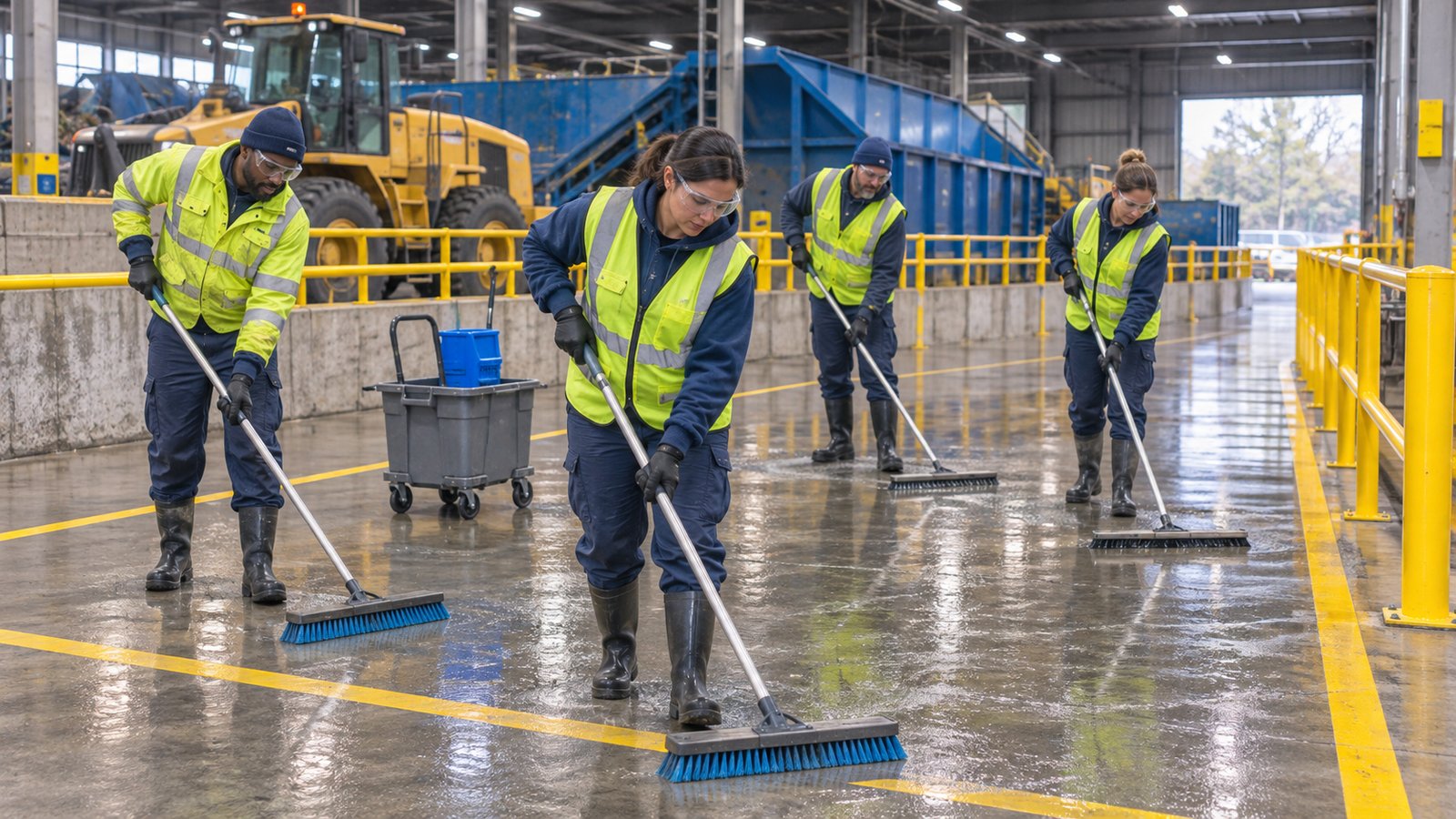
Commercial cleaning for a waste transfer station is not the same as sweeping a warehouse. A site may combine a tipping floor, vehicle lanes, scale house, driver facilities, offices, break rooms, and an exterior perimeter, each with different hazards and access rules. Buyers in New York and New Jersey should define exactly which spaces a janitorial vendor can enter and how spills, unknown materials, dust, and active equipment are escalated. GreenPoint Maintenance Services Corp provides commercial facility cleaning with fixed scopes and documented checks. To arrange a site walkthrough or quote, call 347-332-9348.
Separate routine janitorial areas from regulated operations
Divide the property into low-risk administrative rooms, controlled support areas, vehicle routes, and active waste-handling zones. An office, restroom, driver lounge, or scale-house entry may be eligible for routine cleaning when cleared by the operator. A tipping floor, compactor, conveyor, container, hazardous-waste area, or active spill zone should not be included by default. GreenPoint's first task is to walk the site with the facility manager, mark boundaries on a plan, and record lockout rules, equipment traffic, restricted spaces, washdown points, and the person authorized to release a zone.
Make the contract distinguish cleaning tasks from waste handling, industrial maintenance, environmental remediation, and emergency response. A janitorial crew should not sort waste, open containers, enter a confined space, operate processing equipment, or identify unknown substances unless the company is separately qualified and authorized for that work. The written scope should say when a worker stops and calls the operator. A preapproved escalation path protects the site and prevents an ordinary cleaning request from becoming an unplanned regulated activity.
Use New York and New Jersey rules as operator context
New York State DEC describes transfer facilities as sites where solid waste is received, consolidated, and transported elsewhere. Depending on the facility and its status, 6 NYCRR 362-3 can involve exemption, registration, or permit criteria; DEC also identifies operator requirements such as annual reporting and inspection records. A cleaning contractor should not promise to certify that a transfer station meets those requirements. The facility operator remains responsible for determining which rules apply and for explaining the approved work zones to vendors.
New Jersey's generic minor-transfer-station inspection checklist describes operator duties that include cleaning waste deposit or storage areas within each 24-hour period, controlling dust, and keeping surrounding property free of litter and debris. The checklist frames these as facility or operator obligations, not a contractor certification program. Before bidding in Newark, Jersey City, Elizabeth, Paterson, or a New York borough, ask the owner to provide the current permit conditions, site-specific operating manual, and contractor orientation. The New York transfer facilities overview and NJDEP minor station checklist are useful operator references.
Local authorities, permits, and site plans can differ by facility, so do not copy a procedure from another transfer station and assume it applies. Ask for the named permit contact and the approved route for questions about an inspection finding, waste classification, or a changed operating condition. A janitorial supervisor can confirm whether a room was serviced and report an exception, while the designated operator decides what corrective work or agency communication is required.
Build a safety plan for dust, traffic, and unknown materials
Before the first shift, identify pedestrian paths, reversing vehicles, blind corners, overhead work, traffic-control signals, and areas where hearing protection or high-visibility clothing is required. Define whether staff may use a hose, floor machine, vacuum, or compressed-air tool; do not assume a device is safe around process equipment or airborne dust. OSHA's cleaning-industry resources flag chemical exposure, protective equipment, bloodborne hazards, and slips and falls among topics for cleaning employers. The site should brief vendors on its own hazards and stop-work conditions.
Treat unknown liquids, sharps, chemical containers, suspected asbestos, batteries, medical waste, and uncontrolled leachate as exceptions, not as routine trash. The cleaner should isolate the immediate area from foot traffic when safe, notify the control-room or designated supervisor, and wait for an authorized response. The facility's emergency plan, SDS access, PPE requirements, and spill contractor list should be available before work begins. GreenPoint can document who was notified and when, but it should not represent routine JaniTrack logs as environmental sampling or regulatory clearance.
Include pre-shift checks for gloves, eye protection, footwear, cart wheels, caution signs, and any equipment assigned to an approved route. The site should identify the nearest eyewash or handwashing point and explain whether a cleaner may use a floor drain or hose bib. A supervisor should review any injury, near miss, chemical splash, or vehicle conflict before the next shift begins. These controls are especially important at municipal and private sites serving busy neighborhoods in Brooklyn, Queens, the Bronx, Newark, and Elizabeth, where deliveries, traffic, and worker access may converge at a compact entrance.
Specify a task schedule for offices, restrooms, and perimeter
A useful vendor scope covers administrative floors, staff restrooms, locker rooms, break areas, glass, interior entry mats, and designated walkways. It lists each task by room and frequency: daily waste removal in approved bins, restroom inspection at stated intervals, weekly high dusting, and scheduled detail work for floors or windows. For a 40,000-square-foot support building, the bid should still separate a 2,000-square-foot office wing from a heavily used driver area instead of assigning one generic production rate to every square foot.
Coordinate routine service with vehicle peaks, shift changes, scale queues, and delivery windows. A 24-hour operation may need more than one small service block rather than a single overnight visit. Define who supplies hand soap, liners, absorbents, and floor signage; say whether exterior litter pickup is included; and set weather-related exceptions for snow or runoff. GreenPoint's fixed-price proposal can list the covered square footage, scheduled visits, labor assumptions, and out-of-scope work so a facility manager can compare competing bids fairly.
Make the schedule resilient to process delays. If an inbound queue blocks the scale-house entrance or a maintenance shutdown closes a corridor, staff need an alternate approved route and a rule for recording deferred work. Set a minimum notice period for a planned shutdown, plus a same-shift contact for an unplanned closure. The scope can define which office tasks move to another hour and which must wait for an operator release. That simple contingency prevents a cleaner from entering a live traffic lane merely to meet a timestamp and helps the facility distinguish a legitimate access hold from a missed service.
Measure service completion without confusing it with compliance
Create a short inspection form for each approved zone. Record the area, task, timestamp, deficiency, correction, and supervisor review. GreenPoint uses JaniTrack for timestamped GPS-tagged photos and a live dashboard where the contract calls for those records; the client can decide which photos are appropriate in sensitive operational areas. A visual checklist verifies that assigned work appears complete, while ATP testing can measure residue on selected surfaces. Neither method proves the absence of every contaminant or replaces facility inspections.
The ISSA Clean Standard uses objective ATP readings alongside traditional audits in applicable institutional and commercial environments, but it is not an environmental compliance certificate for a transfer station. Use evidence to improve service: review missed tasks, repeat deficiencies, and supply gaps at a monthly meeting, then revise the schedule if operational conditions change. Buyers can compare this approach with digital cleaning verification systems and cleaning audit checklists for facility managers. Ask GreenPoint for a walkthrough at 347-332-9348.
Budget a transfer station cleaning contract by task
A simple monthly estimate begins with labor hours by task and visit, then adds supervision, equipment, consumables, travel, access time, and any agreed periodic work. For illustration, 180 scheduled labor-hours in a four-week cycle multiplied by a $17.71 national median wage reference equals about $3,188 in base wages, before payroll burden, benefits, supervision, materials, insurance, and margin. BLS's May 2025 median for janitors and building cleaners is national occupational data, not a New York or New Jersey contract price. Use local wage data and the actual approved scope when preparing a bid.
Do not compare a base janitorial quote with a competitor's price that includes tipping-floor washdown or industrial spill response unless the work and qualifications are identical. Ask each bidder to itemize included rooms, shift frequency, supplies, exclusions, emergency callouts, annual price changes, and service-level response. GreenPoint provides fixed pricing rather than hourly billing and can put assumptions and exclusions in writing. Schedule a walkthrough or quote at 347-332-9348 before using any per-square-foot shortcut to budget a high-risk site.
Use the site walkthrough to check the number and condition of restrooms, entry mats, office rooms, lockers, break areas, and designated walkways rather than counting only the tipping floor. Note the time needed for sign-in, PPE, equipment staging, and any escort. A 12,000-square-foot administrative wing can have more daily touchpoints per square foot than a large empty storage bay, so pricing should follow actual tasks and occupied hours. Ask the vendor to separate the recurring monthly service from optional floor restoration or extra event coverage.
Waste transfer station cleaning FAQs
Can a commercial janitorial contractor clean a transfer station tipping floor? Only if the operator has authorized the work, supplied a safe written procedure, and verified the contractor's qualifications and equipment for that specific task. Routine office cleaning should not be treated as industrial process-floor work.
Who is responsible for regulatory housekeeping requirements? The cited New York and New Jersey materials describe duties for the transfer facility or operator. A vendor may perform tasks under contract, but the operator should confirm applicable rules, provide site-specific instructions, and retain regulatory oversight.
What should a New York or New Jersey buyer include in an RFP? Include maps of authorized work areas, site rules, operating hours, traffic controls, chemical approvals, PPE, waste exclusions, spill contacts, frequencies, reporting, insurance, and a clear process for changes.
How do I request a GreenPoint transfer-station walkthrough? Call 347-332-9348 or email info@greenpointms.com. GreenPoint Maintenance Services will first define which administrative and support areas are suitable for its written janitorial scope; GreenPoint reports 98% client retention and can document agreed checks through JaniTrack.
Need a defined cleaning scope for a New York or New Jersey transfer station? Call GreenPoint Maintenance Services Corp at 347-332-9348 to request a site walkthrough and fixed-price quote. Proof point: GreenPoint reports 98% client retention and offers JaniTrack timestamps, GPS-tagged photos, and live-dashboard visibility for agreed work, while leaving facility compliance oversight with the operator.