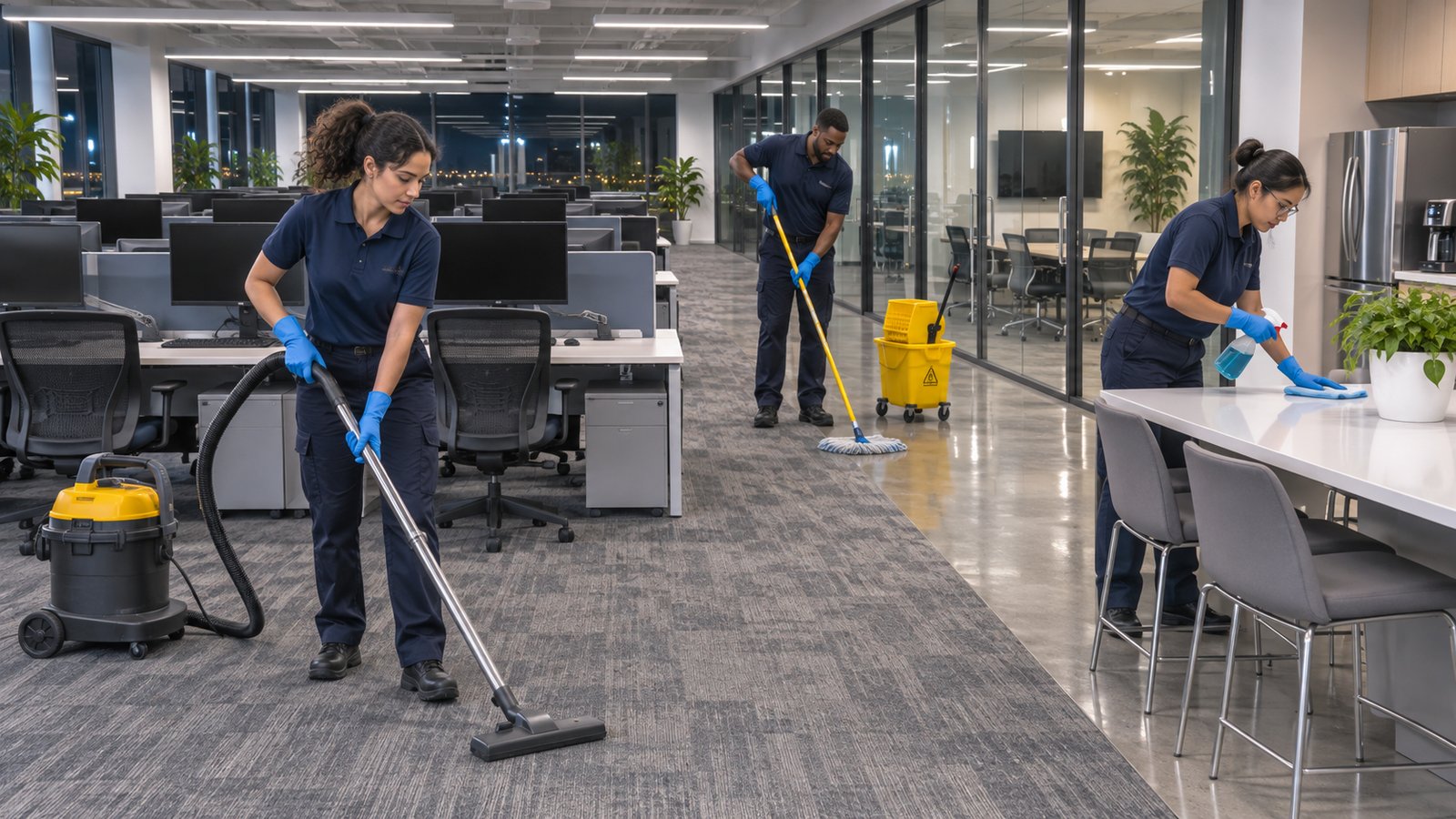
Cleaning a 24/7 call center takes more coordination than sending a crew after the office closes. Agents work overlapping shifts, supervisors need quiet rooms, IT teams protect equipment, and restrooms and break areas remain in use around the clock. Buyers comparing call center cleaning services across New York, New Jersey, and Connecticut should define what can be cleaned during live operations and how service is verified without disrupting calls. GreenPoint Maintenance Services Corp offers fixed-scope commercial cleaning with documented checks. To schedule a walkthrough or quote, call 347-332-9348.
Map the center by occupancy, not just floor area
A contact center may contain open agent rows, training rooms, quiet rooms, executive offices, server or network closets, kitchens, locker rooms, restrooms, and a lobby. Mark each area by operating hours, occupancy peaks, access restrictions, and whether staff can move or wipe equipment. A 40,000-square-foot center near Midtown Manhattan, Long Island City, Newark Penn Station, Jersey City's waterfront, or Stamford's downtown may have different commuter arrivals and building access windows. GreenPoint begins with seat counts, shift handoffs, touchpoints, floor types, and site security rules.
Do not use total headcount as a proxy for workload. For example, 300 agents may be split across three shifts, while a 150-seat training room is empty most nights. A better plan counts occupied stations by shift, restroom fixtures, kitchen use, square footage by floor type, and public routes. Identify which desks are assigned, shared, hot-desked, or unassigned. GreenPoint can record those zones in a room schedule and price recurring tasks separately from deep cleaning, carpet extraction, or move-in support.
Set a shift-based schedule that protects live calls
Divide work into daily tasks, between-shift resets, scheduled rounds, and periodic detail cleaning. During peak call periods, a day porter may respond to restroom supplies, spills, and kitchen waste while leaving agent stations untouched. A quieter interval can be used for approved vacuuming or hard-floor care. Put the task sequence in writing so a cleaner does not vacuum behind an agent during a customer call or block a supervisor's path during a live escalation.
A sample plan might inspect restrooms and break areas every 60 to 90 minutes during high occupancy, empty only designated waste at shift changes, and clean shared training rooms after scheduled use. These are planning examples, not a universal standard; the center should adjust intervals using use data, complaint logs, and site policy. Review cleaning frequency standards by facility type and cleaning staffing ratios by square footage as starting points, then validate them in a live walkthrough.
For a center with three eight-hour shifts, overlap periods are often the best time to restock shared spaces and empty designated waste while preserving uninterrupted desk work. Make the handoff explicit: the outgoing supervisor flags a spill or supply shortage, the incoming day porter accepts it, and the dashboard shows whether it was resolved. Add a short checklist for opening and closing a training room after a class or huddle. GreenPoint can help the facilities manager test the route for two weeks, compare actual traffic with the planned rounds, and adjust the schedule before the first monthly invoice is treated as the long-term baseline.
Protect workstations, headsets, and IT equipment
Shared headsets, keyboards, mice, touchscreens, desk phones, and badge readers need clear responsibility. The cleaning contract should state which surfaces the vendor can wipe, which remain with employees or IT, what product is compatible, and whether equipment must be powered down. Cleaners should not unplug devices, move confidential papers, open desk drawers, touch smart cards, or photograph screens. A center can supply an approved surface-care list and train supervisors to remove personal items before any workstation reset.
Use microfiber cloths and a controlled wetting method to reduce the chance of liquid entering electronics. Keep restrooms and food areas on separate tool sets, and change cloths between zones. If a device is damaged or a liquid spill reaches power or network equipment, stop work and notify IT rather than attempting a repair. GreenPoint can include workstation rules in its service plan and use JaniTrack for location-based proof of agreed tasks without capturing employee data or call content.
Manage restrooms, break rooms, and indoor air expectations
Restroom service should cover fixture cleaning, touchpoints, replenishment, waste, floor checks, and a documented response to a plumbing or odor issue. Break rooms need a separate plan for tables, sinks, appliance exteriors, refrigerator handles, and food waste. Clarify that cleaners do not handle open food or personal containers. A busy night-shift lounge may need more frequent checks than a conference room even if both occupy similar square footage.
For indoor air quality, use low-odor products where appropriate, store chemicals away from workstations, and coordinate vacuuming or floor refinishing with facilities so fumes and noise do not interfere with staff. GreenPoint uses Green Seal certified products where suited to the surface and scope. Certification does not replace checking the product label, ventilation, or employer policy. For buyers evaluating product criteria, the green cleaning for commercial buildings guide explains how to compare environmental claims and actual use instructions.
Coordinate access across tri-state office campuses
A center may operate from a Manhattan tower near Penn Station, a Queens office near the 7 train, a Newark campus near Broad Street, a Jersey City office near PATH, or a Connecticut location close to Stamford Transportation Center. Building management may set different freight-elevator hours, loading dock procedures, parking rules, badges, and visitor logs. Put those site-specific instructions in the work order. If staff are arriving and leaving at all hours, keep carts away from accessible exits and do not block emergency routes.
Agree on who opens locked suites, when alarms are armed, how keys are controlled, and which spaces require an escort. Set a backup contact for outages and severe weather, including snow tracked into entrances during a Northeast winter. OSHA's walking-working-surfaces standard requires employers to address workplace conditions such as clean and orderly areas and clear passageways; a vendor can support housekeeping but the client controls building access and emergency routes. Call GreenPoint at 347-332-9348 to schedule a site walkthrough and confirm the operating plan.
Measure cleaning quality with useful service evidence
Create a checklist by zone with completion time, assigned task, exception, and corrective action. Use a small sample of agent desks each shift rather than assuming every station receives the same attention. Track missed restocks, spill response, odor complaints, repeat soil, and client-reported interruptions. GreenPoint's JaniTrack platform can provide timestamped GPS-tagged photos and a live dashboard for agreed areas; configure it to avoid screens, employee names, call recordings, and other sensitive information.
ISSA's Clean Standard for institutional and commercial settings combines ATP readings with traditional audits. An ATP reading can help compare selected surfaces over time, but it is not a germ test, a guarantee of health, or a substitute for the center's own security and privacy review. Use trend information to adjust cloth changes, task timing, or supervisor checks. The commercial cleaning audit checklist and digital cleaning verification systems guide offer practical criteria for setting a monthly review.
Compare 24/7 cleaning bids and staffing continuity
A reliable proposal should list staffing by shift, relief coverage, supervisor availability, hiring and training assumptions, equipment, consumables, and periodic work. Calculate planned labor hours by day and zone, then apply local wages and the employer's fully burdened cost. BLS reports a May 2025 national median wage of $17.71 per hour for janitors and building cleaners in its occupational outlook data; local wages and an actual contract price will differ. A sample 240 labor-hours at that national wage equals about $4,250 in base wages before payroll burden, benefits, supervision, materials, insurance, and margin.
Ask how the vendor handles absenteeism, a call-volume spike, an office move, or a missed shift. GreenPoint offers fixed pricing rather than hourly billing, with task assumptions and out-of-scope work stated up front. Compare a 30,000-square-foot center with a 70,000-square-foot site only after matching operating hours, seat count, fixtures, floor care, and reporting. Schedule a walkthrough or quote at 347-332-9348; a measured work plan is more useful than a generic price per square foot.
Ask for a two-week pilot route in one representative zone before scaling to every floor. Use the pilot to check noise, badge access, task completion, communication with agents, and whether the actual work window fits call volume. Set a baseline inspection and agree on what qualifies as a correction. GreenPoint can review those findings with facilities and procurement, update the scope, and put the final fixed price in writing before a full rollout.
For a 90-day transition, set service checkpoints at launch, day 30, day 60, and day 90. Review attendance, complaint response, supply consumption, missed access, quality scores, and any changes in seat occupancy. If a new client campaign doubles overnight staffing or a training class adds evening traffic, issue a written change order that identifies the extra rooms and hours. This approach gives procurement a defensible record for price adjustments and gives the cleaning supervisor enough notice to add trained coverage instead of quietly stretching the existing team. GreenPoint can schedule the initial walkthrough at 347-332-9348.
24/7 call center cleaning FAQs
How often should a 24-hour contact center be cleaned? Use occupancy and use patterns to set restroom, kitchen, waste, and floor rounds. Many centers benefit from multiple daily checks, but the facility should set actual intervals from its own traffic and service records.
Can a cleaning crew disinfect every employee workstation? Not without an approved scope and compatible product. The center should decide which devices may be touched, what employees clear in advance, and whether IT or staff remain responsible for headsets and electronics.
What should a tri-state call center include in an RFP? Include shift patterns, seat count, controlled areas, access and parking rules, task frequencies, restroom and break-room coverage, product approvals, relief staffing, inspection evidence, privacy limits, and a fixed-price schedule.
How can a call center request a GreenPoint proposal? Call 347-332-9348 or email info@greenpointms.com to arrange a walkthrough. GreenPoint Maintenance Services reports 98% client retention and can provide JaniTrack timestamps and agreed location-based service records.
Need cleaning services for a 24/7 call center in New York, New Jersey, or Connecticut? Schedule a site walkthrough and fixed-price quote with GreenPoint Maintenance Services Corp at 347-332-9348 or info@greenpointms.com. Proof point: GreenPoint reports 98% client retention, with JaniTrack timestamped GPS-tagged photos and live-dashboard visibility available for agreed tasks.