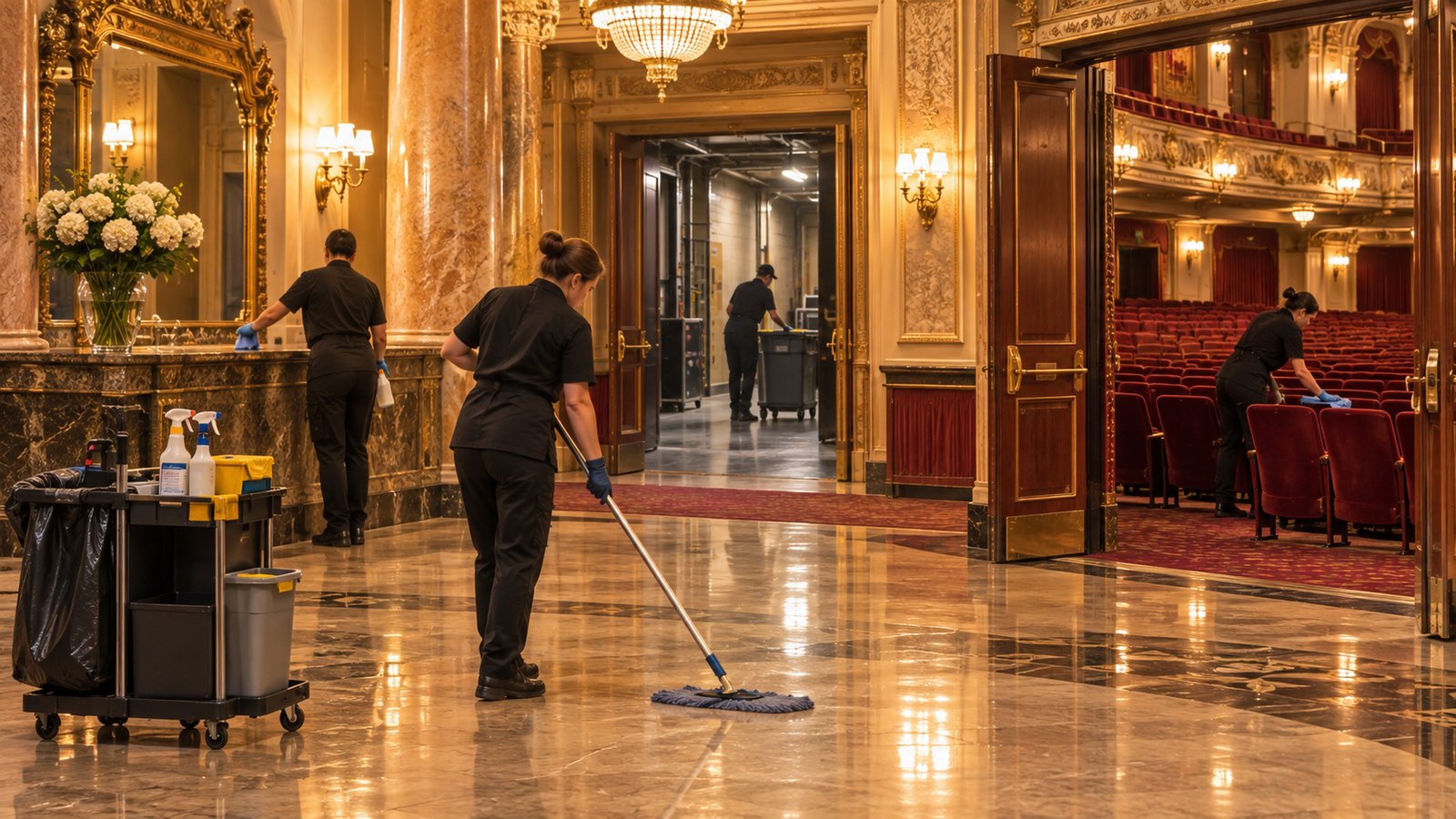
Performing arts centers in New York City can move from a quiet rehearsal to a sold-out performance in the same day. A cleaning plan must account for public lobbies, seating, restrooms, concessions, dressing rooms, backstage corridors, rehearsal studios, and loading areas without interfering with performers, stage crews, or audience access. The work also has a life-safety dimension: aisles and exit paths must remain clear, and combustible waste should not accumulate. GreenPoint Maintenance Services Corp designs commercial cleaning schedules around the venue calendar, room access, and documented closeout. This guide explains how theater operators can define the scope, coordinate fast turnovers, protect backstage privacy, and compare vendor proposals.
Map the venue by audience, performer, and production zones
A venue floor plan should identify the main entrance, box office, lobby, audience seating, balcony or mezzanine, restrooms, concession areas, rehearsal rooms, dressing rooms, backstage corridors, loading dock, offices, and waste staging. A 25,000-square-foot arts center may have thousands of seats and extensive circulation, while a smaller black-box theater may have more rehearsal and changeover work per square foot. The cleanable footprint and access permissions should be measured rather than estimated from a public listing. GreenPoint Maintenance records room-level tasks and identifies which spaces require escort or clearance from the production manager.
The scope should clarify what belongs to the cleaning contractor and what remains with stagehands, concession operators, wardrobe, or building engineering. Routine janitorial work can include litter removal, accessible surface cleaning, restroom sanitation, waste removal, spot cleaning, and floor care according to the venue's finish. It should not assume responsibility for rigging, lighting, sound equipment, costumes, set pieces, or hazardous materials. List restricted areas, rehearsal blackouts, quiet hours, photography rules, and approval contacts. GreenPoint Maintenance works from a room and responsibility matrix so one department does not accidentally move equipment or clean a surface with a product that damages it.
Schedule cleanings around performances and rehearsal calls
The operating calendar should drive staffing. A matinee and evening performance may require a full reset between audiences, while a single evening show may allow a pre-opening inspection and a complete overnight clean. Build a timeline backward from doors: restroom check, lobby finish, aisle sweep, seat and armrest spot check, waste removal, and supervisor sign-off. Define how late the crew can enter after a curtain call and how the venue confirms that a room is released. GreenPoint Maintenance can scope event support as a predictable service window, while late extensions and added performances follow a written approval process.
Transit and pedestrian flows shape the cleaning plan. A Midtown theater near Times Square or the Broadway corridor sees concentrated audience waves, while Lincoln Center on the Upper West Side and BAM in Fort Greene attract different schedules and access patterns. Queens Theatre at Flushing Meadows–Corona Park and the Lehman Center in the Bronx have their own parking, transit, and event logistics; venues near Newark, Jersey City, or Stamford may coordinate with PATH, NJ Transit, or Metro-North arrival times. These are not interchangeable service patterns. A walkthrough should note doors, loading routes, event duration, and the time available before the next audience enters.
Keep exits and production spaces clear
Cleaning carts, wet-floor signs, trash bags, and supplies should never be left where they restrict audience aisles, exit access, fire doors, or backstage travel. New York City's Fire Code includes housekeeping rules addressing combustible waste, and FDNY materials describe recurring theater inspection expectations; venue operators should review the rules applicable to their occupancy and plan with their fire-safety lead (NYC Fire Code, Chapter 3; FDNY theater inspection rules). A cleaning contractor supports orderly operations but does not replace required owner inspections, fire-protection maintenance, or an emergency plan.
Backstage areas may contain cables, set materials, paint, adhesives, props, and temporary storage. Only clean released floor space and surfaces identified in the approved scope; do not move or discard production materials. Assign a venue contact to identify wet work, special effects residue, and any material that requires a separate response. Keep the approved chemical list available and ensure employees can access Safety Data Sheets for hazardous products. OSHA's Hazard Communication Standard explains employer responsibilities for labels, SDS access, and training (OSHA 29 CFR 1910.1200). GreenPoint Maintenance uses product-specific procedures and Green Seal certified products where appropriate.
Set appearance standards for seats, lobbies, and restrooms
The audience experience depends on consistent visible details: entry glass, box-office counters, lobby floors, handrails, seat backs, armrests, cup holders, and restroom fixtures. Specify what gets cleaned after each performance and what is inspected only on a rotating detail schedule. Upholstery extraction, high-level dusting, stone polishing, and carpet restoration may require separate methods or downtime. A venue should document its seating layout, surface material, and the area that can be reached without moving fixed equipment. GreenPoint Maintenance can make the standard auditable with room-level checklists instead of relying on a general instruction to make the theater look good.
Restrooms can experience a short high-volume rush during intermission, so a single nightly service may not be enough for every event. Determine whether a restroom attendant or rapid-response check is appropriate for the audience size, show length, and interval. Track supply levels, visible soils, odor, and floor dryness, and coordinate any touch-up around audience movement. A 1,200-seat venue with a 20-minute intermission has a different crowd pulse from a 150-seat studio show. Use inspection data and incident reports to adjust coverage rather than adding unmeasured labor. For adjacent planning tools, see high-traffic restroom cleaning best practices and commercial cleaning audit checklists.
Price routine service separately from event turnovers
A transparent bid distinguishes base service from event-day coverage, intermission checks, post-performance cleanup, overnight floor care, seasonal deep cleaning, and one-off productions. It should state rooms, square footage, event count assumptions, number of performances per week, staffing windows, consumables, equipment, exclusions, and a process for added shows. A 5-night performance schedule is not equivalent to a dark week, so the proposal should explain how recurring work is balanced across the calendar. For pricing methodology and scope boundaries, use commercial cleaning cost per square foot and commercial cleaning contract key terms.
The BLS lists a May 2025 national median hourly wage of $17.71 for janitors and building cleaners; it is an occupational wage reference, not a vendor price for NYC venue service (BLS). A commercial quote also reflects local payroll expense, benefits, supervision, insurance, equipment, supplies, travel, event-hour coverage, and the need to staff a changing schedule. GreenPoint Maintenance quotes fixed pricing for the approved recurring scope, with no hidden fees or surprise hourly billing. Request written pricing for additional events before the season starts so the venue can forecast its operating budget accurately.
Verify work while protecting performers and patrons
Quality records should confirm which room was serviced and flag what needs a venue decision. GreenPoint Maintenance uses JaniTrack to support timestamped, GPS-tagged photos, ATP testing where specified, and a live dashboard. In a theater, images should be framed to show the floor, fixture, or surface without capturing patrons, performer schedules, scripts, dressing-room contents, or security details. Agree in writing on access permissions and data retention. A venue can require issue reporting through a production manager rather than direct contact with cast or crew, preserving privacy and the chain of command during rehearsals.
Track the outcomes the venue cares about: ready-to-open checks, restroom replenishment, missed rooms, repeat complaints, response time, and how often an issue returns after correction. Review performance after the first two weeks and again after the first busy weekend. GreenPoint Maintenance reports 98% client retention and can use JaniTrack records to help identify recurring conditions such as lobby salt, concession spills, or a restroom supply gap. Define a corrective-action owner and closeout date for each issue. The goal is not to collect the most photos; it is to make the facility manager confident that an agreed standard was met before the audience arrives.
Prepare a smooth venue transition
Before the first shift, hold a kickoff with venue operations, production, security, and the cleaning supervisor. Confirm badge access, keys, alarm procedures, approved storage, where waste is staged, room-release signals, event blackout times, and the emergency contact list. Walk the route at the time the crew will actually work, because a dock that is free at noon may be occupied after a show. Document existing stains and wear so the opening condition is not confused with missed service. GreenPoint Maintenance can stage a 30-day review to decide whether the staffing window, inspection sample, or task frequency needs an adjustment.
Ask for comparable venue references, insurance documents, supervisor coverage, a sample task schedule, and a sample quality report. GreenPoint Maintenance Services Corp is MBE/MWBE-certified in New York State, New York City, and NYC DOE and is registered in SAM.gov, which may support supplier-diversity procurement records. Credentials should complement, not replace, a clear scope and performance review. To request a performing arts center walkthrough or fixed-price proposal, call 347-332-9348 or email info@greenpointms.com. Share a sample event calendar and room plan so the vendor can price routine service and event coverage as separate, understandable commitments.
Frequently asked questions
Q: How soon should a theater be cleaned after a performance? A: Public areas should be reset within the time allowed before the next scheduled audience. The contract should define room release, staffing window, and sign-off rather than assume every venue has the same turnaround.
Q: Does a janitorial vendor inspect theater fire systems? A: Routine cleaning is not a substitute for required fire-safety inspections or maintenance. Cleaners should keep assigned routes orderly, report obstructions, and follow the venue's safety procedures.
Q: Should event turnovers be part of the base contract? A: Predictable performances can be included in a defined schedule. Additional shows, late events, and special productions should have written rates and an approval process.
Q: How can a venue request a quote? A: Arrange a walkthrough with GreenPoint Maintenance at 347-332-9348. Provide event frequency, access hours, a room list, and any backstage restrictions for a more accurate scope.
Schedule a New York City performing arts center walkthrough at 347-332-9348 or info@greenpointms.com. GreenPoint Maintenance offers event-aware fixed-price scopes and JaniTrack documentation, including timestamped GPS-tagged photos and ATP testing when specified; reported client retention is 98%.