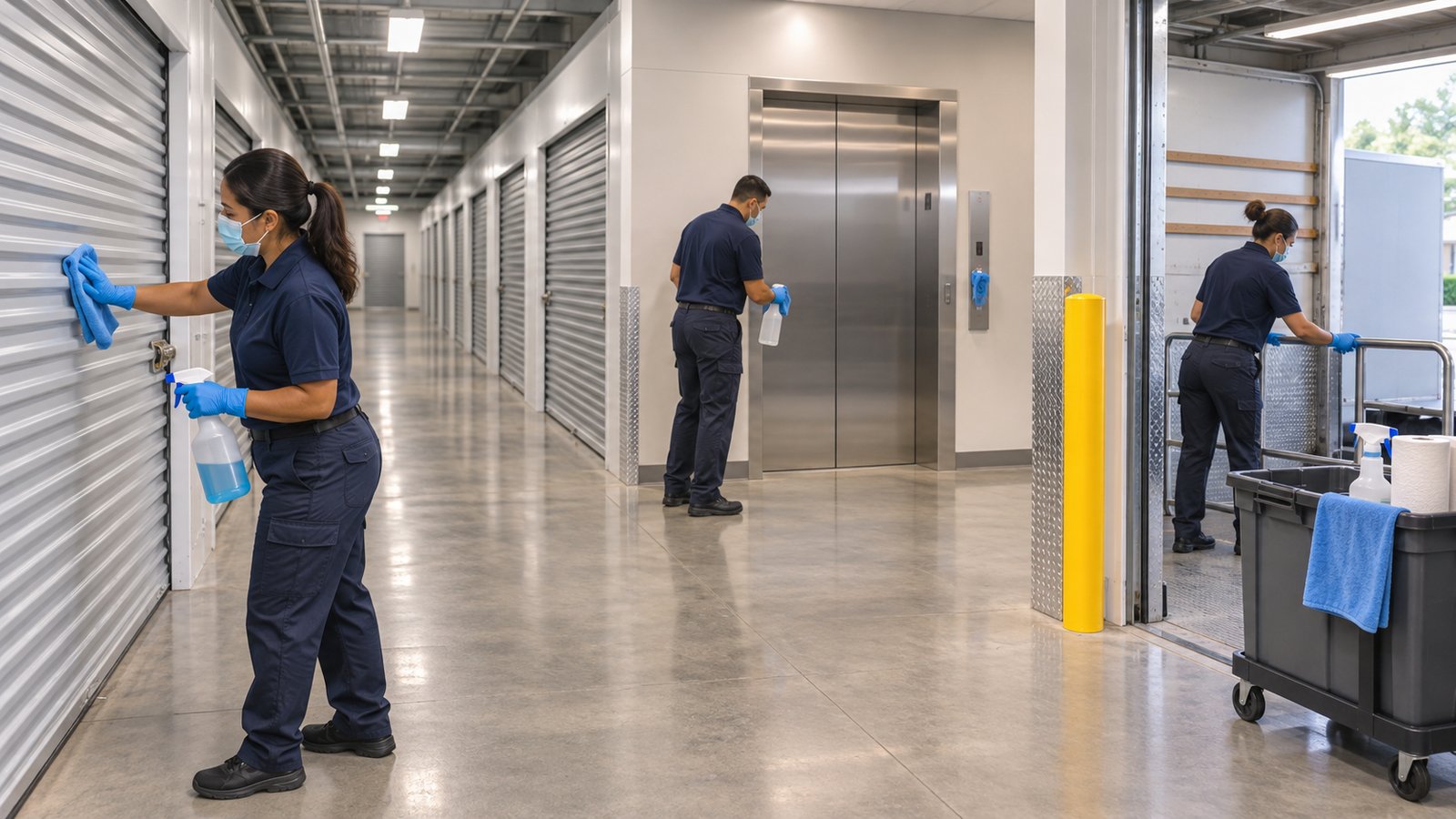
A self-storage property is a customer-facing operation with long corridors, elevator lobbies, loading zones, access gates, offices, restrooms, and sometimes climate-controlled floors with different occupancy patterns. Dust and tracked-in grit collect where carts turn, while delivery packaging, seasonal debris, and weather can affect the entrance and loading area. Commercial cleaning for self-storage facilities in New York and New Jersey should focus on common areas and staff spaces without disturbing customers' stored property or implying access to private units. GreenPoint Maintenance Services Corp builds a site-specific scope around access rules, traffic, surface types, and documented service checks. This guide helps owners and facility managers specify work, compare bids, and plan a dependable schedule.
Define the cleanable footprint, not rentable area alone
A facility advertised with 100,000 rentable square feet may have a much smaller cleanable common-area footprint, or it may have multiple floors, long corridors, and a large vehicle court that require substantial labor. Map the office, entrance, elevator cabs and lobbies, stairwells, shared corridors, restrooms, breakroom, loading areas, and exterior approaches. Record floor material, drain locations, ceiling height, access restrictions, and which rooms require an employee escort. GreenPoint Maintenance lists tasks by actual area so owners do not pay as though every storage unit is part of a janitorial route when units are not included.
State clearly that cleaners do not open, enter, or handle customer units or stored belongings. Establish where abandoned items are reported, who authorizes removal, how lost property is handled, and which staff member receives photos of an exception. A janitorial agreement should never turn an ambiguous object into permission to discard it. Keep keys, keypad codes, and access credentials on a controlled list, and make the closing procedure part of staff orientation. This protects customers and reduces disagreements between the facility operator, tenants, and vendor about who was permitted to touch an item.
Prioritize corridors, elevators, and loading areas
Corridors and elevator lobbies are the most repeated customer route, so a practical plan assigns litter pickup, dust removal, and spot cleaning at a frequency that reflects use. Carts transfer grit from loading doors to lifts, and elevator thresholds collect debris that can interfere with the visual standard even when the center of the floor looks clean. Include handrails, push plates, call buttons, mirrors, and door tracks in the checklist, with a compatible disinfectant only where the surface and use require it. GreenPoint Maintenance trains crews to clean around tenant movement and to report obstructions rather than repositioning customers' property.
Loading zones need weather-aware housekeeping. Rain, snow, salt, cardboard, and packaging debris move quickly through exterior doors and can make floors look dirty soon after a scheduled visit. Define which team handles snow and ice, who removes bulky discarded items, and whether the janitorial crew may clean only the floor or also the dock equipment and vehicle court. A simple daily log can record entrance condition, litter hotspots, and requests waiting for the property manager. For a related guide to industrial loading and debris controls, see warehouse and industrial cleaning best practices and commercial cleaning frequency standards by facility type.
Protect life-safety paths and storage operations
Do not allow cleaning carts, trash bags, floor signs, or supplies to block an exit route, fire door, electrical panel, or access to emergency equipment. New York City's Fire Code includes housekeeping provisions addressing combustible waste and maintenance of premises; facility operators should review the provisions applicable to their building with their fire-safety professional (NYC Fire Code reference). A janitorial scope can support orderly shared areas, but it does not replace the owner's code review, inspections, fire-protection maintenance, or site-specific emergency plan. In New Jersey, confirm current obligations with the Division of Fire Safety.
Storage properties may use floor scrubbers, detergents, glass cleaners, and other products in occupied spaces. OSHA's Hazard Communication Standard requires employers using hazardous workplace chemicals to maintain an appropriate program, provide access to Safety Data Sheets, and train affected employees (OSHA 29 CFR 1910.1200). GreenPoint Maintenance uses labeled containers, product instructions, and Green Seal certified options when suitable for the job. Ask the vendor how it controls dilution, prevents chemical mixing, stores products away from customers, and handles a spill or a locked-room access exception.
Set service frequency around customer volume
A smaller suburban facility with limited office traffic may need a different service cadence from a dense urban property where tenants visit from early morning through evening. Consider weekday and weekend access, move-in and move-out cycles, seasonal weather, and proximity to high-traffic roads. Maspeth and Long Island City properties, for example, can see frequent truck and delivery movement; Brooklyn Navy Yard and Sunset Park sites may have concentrated loading periods; Newark, Elizabeth, Secaucus, or Jersey City locations face their own commuter and warehouse schedules. These are planning examples, not a substitute for a walkthrough and observation of actual traffic.
A base plan might include regular service for the office, restrooms, entry, and high-use corridors, with additional inspections during peak move-in periods. Elevator surfaces, stairwells, and long corridors can be rotated for detail work if a documented inspection shows that the routine schedule maintains the required condition. Avoid promising a universal cleaning frequency based only on a facility's total area. GreenPoint Maintenance can build recurring tasks and approved periodic work into the quote, then review the results with a property contact after the initial service period. A short service calendar also helps staff explain which issues are included and when a separate request is needed.
Price by scope, access, and measurable labor
A useful quote separates rentable unit area from common-area cleaning and lists the estimated square footage for corridors, office, restrooms, stairs, elevators, and loading areas. It should show visit frequency, service window, consumables, equipment, access assumptions, periodic work, and exclusions such as snow removal, pest control, hazardous spills, or abandoned-property disposal. A 60,000-square-foot building with three floors and two elevators can require a different route from a larger single-level property with a small office. Compare the labor plan and task list rather than using one price-per-square-foot figure as the entire decision. See commercial cleaning cost per square foot for a fuller pricing framework.
Fixed pricing works when both parties agree on the scope and a change-control process. GreenPoint Maintenance does not bill by the hour for the contracted routine scope and does not add hidden fees; the quote identifies the service commitment and any approved add-ons. Ask what happens when operating hours change, a new building wing opens, or a tenant event creates extra waste. Ask also how wage, supply, and insurance assumptions are managed at renewal. The BLS reports a May 2025 national median hourly wage of $17.71 for janitors and building cleaners, which can inform labor discussions but is not a commercial service rate (BLS).
Verify every shift while protecting tenant privacy
A supervisor's inspection should confirm the route was completed and record problems that need the owner's decision. GreenPoint Maintenance uses JaniTrack for timestamped, GPS-tagged photos, ATP testing when included in the program, and a live dashboard that can make service records easier to review. In a storage property, photos should focus on common-area conditions and avoid capturing unit contents, access codes, paperwork, or identifiable customer activity. Agree on where the record is stored, who can view it, how long it is kept, and how corrections are documented. Evidence should answer a management question without creating a privacy problem.
Useful indicators can include restroom inspection completion, open corrective actions, recurring litter locations, elevator or threshold complaints, and response time for a reported issue. Review the indicators monthly rather than assuming that a dashboard automatically improves quality. GreenPoint Maintenance reports 98% client retention and uses a named service contact to review trends and resolve repeat issues. A facility can also compare before-and-after onboarding results: how many service exceptions remained open after one day, one week, and one month? For more on digital proof and audit procedures, see digital cleaning verification systems and cleaning audit checklists for facility managers.
Plan onboarding and tenant communication
Before service begins, hold a kickoff with the property manager, store or site manager, and cleaning supervisor. Review the route, security procedures, alarm contacts, approved closet, restroom supplies, restricted rooms, after-hours access, and emergency escalation. Post a discreet notice when a floor is wet or a route is temporarily closed, but do not let a sign obstruct an exit or wheelchair route. The first service should include a baseline review of existing damage, floor condition, glass, and odor complaints. That record helps separate an old condition from a new service issue and sets reasonable expectations for gradual restorative work.
GreenPoint Maintenance Services Corp is MBE/MWBE-certified in New York State, New York City, and NYC DOE and is registered in SAM.gov. For a multi-site operator, confirm which locations are in the proposed service area and identify a local contact who can reach the site promptly. GreenPoint Maintenance serves New York, New Jersey, Connecticut, Pennsylvania, and Florida, subject to the agreed service footprint and schedule. To request a self-storage walkthrough and fixed-price proposal, call 347-332-9348 or email info@greenpointms.com. The walkthrough is the place to identify every access restriction and decide whether daytime checks or an extra weekend visit are worth including.
Frequently asked questions
Q: Do janitorial cleaners enter storage units? A: No, not unless the property owner has separately authorized a specific, documented service with customer consent and appropriate controls. A common-area contract should state that units and tenant belongings are off limits.
Q: How often should a self-storage facility be cleaned? A: Set frequency by traffic, access hours, number of restrooms, floor count, loading activity, and weather exposure. Restrooms and entrances may need daily attention, while detail work can be scheduled according to inspection results.
Q: What should be included in a storage-facility cleaning bid? A: Request a map-based task list for corridors, elevators, office, restrooms, stairs, and loading areas, along with frequency, hours, exclusions, supplies, quality records, and access assumptions.
Q: Can GreenPoint Maintenance provide a fixed-price quote? A: Yes. GreenPoint Maintenance prices an agreed recurring scope without hourly billing or hidden fees. Schedule a walkthrough at 347-332-9348.
Schedule a New York or New Jersey self-storage facility walkthrough at 347-332-9348 or info@greenpointms.com. GreenPoint Maintenance provides fixed-price scopes, JaniTrack timestamped GPS-tagged photos, ATP testing where specified, and a live dashboard; its reported client retention is 98%.