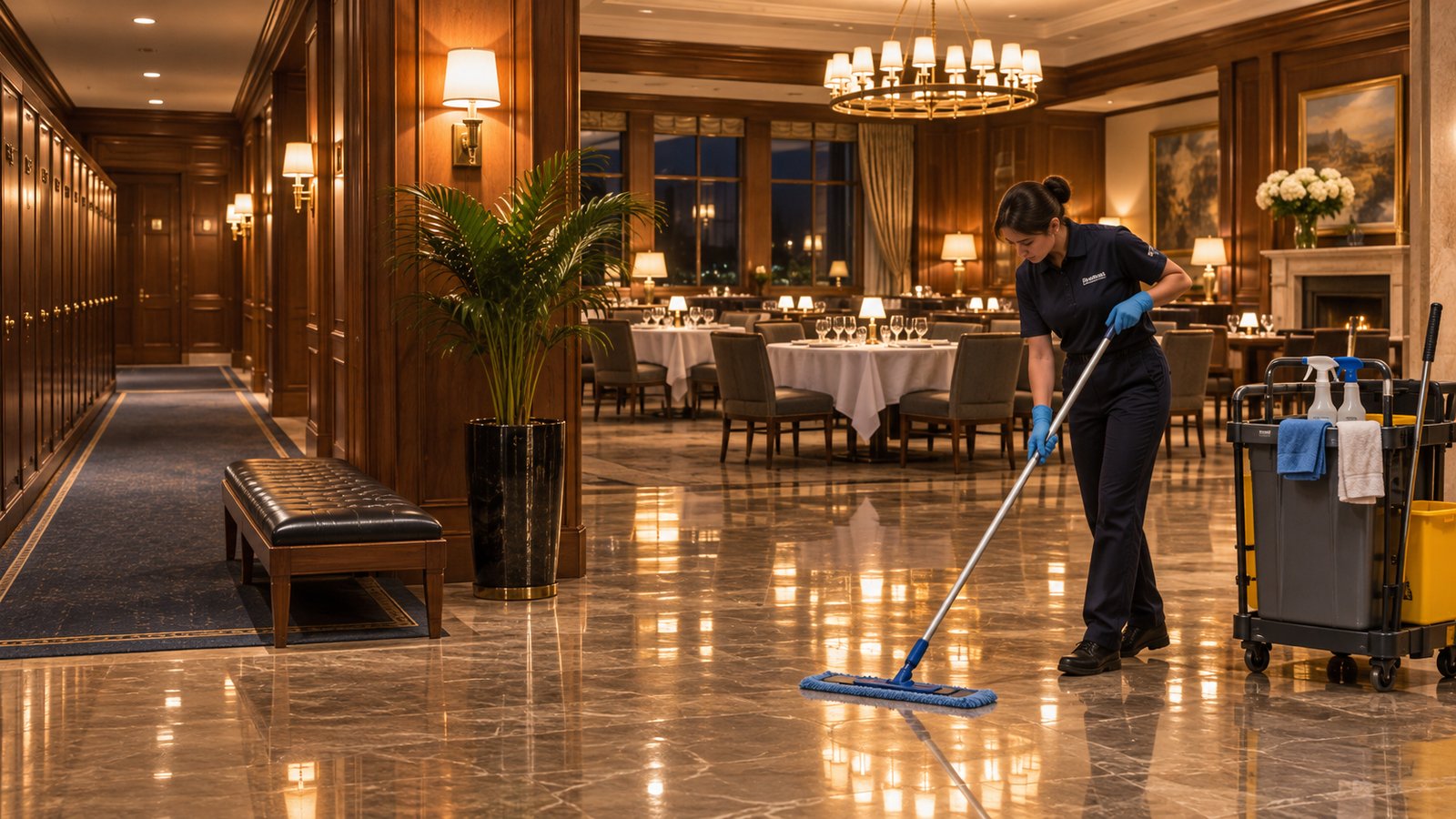
Private country clubs combine several facility types under one membership experience: a clubhouse, dining rooms, event space, locker rooms, fitness or pool areas, administrative offices, and service corridors. Cleaning has to protect the guest-facing standard while fitting around tee times, member dining, weddings, tournaments, and seasonal openings. A generic nightly office checklist rarely covers the operational detail. GreenPoint Maintenance Services Corp plans commercial cleaning around the club's event calendar, surfaces, staff access, and documented inspection needs. This guide covers how to define the scope, coordinate event resets, compare vendor proposals, and verify the work without disrupting members or the club's food-service and recreation teams.
Separate guest areas, staff areas, and specialty work
Begin with a room-by-room map that distinguishes public and member areas from back-of-house spaces. A 45,000-square-foot clubhouse might include a 7,000-square-foot ballroom and dining room, 9,000 square feet of lounge and reception space, 10,000 square feet of locker rooms and showers, 6,000 square feet of offices and meeting rooms, and the remainder in corridors and support spaces. The actual mix matters more than the total. GreenPoint Maintenance records each room's finish, access window, standard, and frequency so the club can see whether the quote covers the full membership experience.
List responsibilities that should remain with the club's kitchen, grounds, pool, or maintenance teams. Routine janitorial service is not automatically hood-exhaust cleaning, pool-water treatment, laundry processing, pest control, high-window access, or repair of stone and wood finishes. The vendor should know where a custodial task stops and a licensed or specialist service begins. Make the handoff explicit: who reports a leak, who removes event decorations, who clears food-service waste, and who approves a spill response. GreenPoint Maintenance uses a written responsibility matrix to reduce the familiar gap where each team assumes the other owns a room.
Create a reset plan for dining, banquets, and tournaments
A clubhouse's schedule can change by the hour. The plan may need a quiet pre-opening clean, a lunch-period restroom check, a ballroom reset after a reception, and an end-of-night floor and waste route. Ask the events director for a rolling calendar and agree on the time needed between room turnover and the next setup. A reset checklist should identify tables and chairs to be moved, who handles linens and food residue, which floors are damp-mopped, and how the room is signed off. GreenPoint Maintenance can price recurring event support separately from the base routine scope so event labor is visible instead of buried in an unclear monthly fee.
Tournament days and outdoor receptions create different entry conditions from a quiet weekday. Wet shoes, grass, soil, and beverage spills can travel from the patio and golf operations into the lobby and locker rooms. Place matting at the routes members actually use, maintain a schedule for high-use restrooms, and assign a contact who can request a documented touch-up during a long event. In Westchester, clubs around Rye, Scarsdale, and Bronxville may have dense event calendars and varied building layouts; Nassau County locations near Garden City, Roslyn, or Old Westbury may have larger grounds and separate clubhouse entrances. Every plan still needs an on-site walkthrough.
Give locker rooms and restrooms a measurable standard
Locker rooms require frequent visual checks because towels, hair, moisture, and tracked-in debris accumulate quickly. Define responsibilities for benches, lockers' exterior surfaces, sinks, shower walls, partitions, mirrors, dispensers, and floors. Specify which items belong to club staff, such as towels and member property, and avoid moving personal belongings. Use a color-coded tool system and products appropriate for the surface, especially where natural stone, metal fixtures, or specialty coatings are present. A standard based on appearance and inspection points is more useful than a phrase such as clean thoroughly, which gives both the club and contractor too little to measure.
Restroom frequencies should follow occupancy and event timing. A single inspection before a 200-person banquet will not maintain service through dinner and a reception, so the schedule should reflect the expected duration and member traffic. Track restocking, visible soils, odors, floor dryness, and open corrective actions. GreenPoint Maintenance can set a simple checklist that club managers can review without interrupting the cleaning team. For additional scope ideas, see restroom cleaning best practices for high-traffic facilities and cleaning frequency standards by facility type.
Coordinate safe products, storage, and staff training
Country clubs often store cleaning products near kitchens, locker rooms, grounds equipment, and event supplies. Keep an approved chemical inventory, use labeled secondary containers, and separate cleaning materials from food, linens, and member supplies. OSHA's Hazard Communication Standard calls for appropriate workplace hazard communication, including labels, Safety Data Sheets, and training for employees who may be exposed to hazardous chemicals (OSHA 29 CFR 1910.1200). GreenPoint Maintenance reviews the product list, dilution instructions, PPE, and storage arrangements with the site contact before service begins.
Green Seal certified products can support a club's environmental goals when they are suitable for the surface and the cleaning task. The goal is not to choose a label and ignore performance, but to select products that meet the specification, use the correct dilution, and avoid damage to finishes. Agree on who may approve substitutions, how product safety data is made accessible, and what happens if a member reports an odor or sensitivity concern. GreenPoint Maintenance uses product-specific procedures and does not assume that a scented product is evidence of cleanliness. Clear training also reduces risky shortcuts such as mixing chemicals or using a restroom tool in a dining area.
Set staffing and pricing around the club calendar
A recurring contract should distinguish baseline cleaning from event resets, seasonal deep cleans, and specialty floor care. A 20,000-square-foot clubhouse used five days per week is not equivalent to a 20,000-square-foot club that hosts weddings three nights a week and opens locker rooms before dawn. Count active rooms, service hours, restroom fixtures, stairs, event frequency, and travel between buildings. The quote should list its assumed visits and labor windows, consumables, periodic services, and exclusions. For pricing context, compare the full work plan with the method in commercial cleaning cost per square foot rather than treating a single rate as a universal benchmark.
The BLS reported a national median hourly wage of $17.71 for janitors and building cleaners in May 2025; that is useful labor-market context, not the bill rate for a commercial contract (BLS Occupational Outlook Handbook). Contract pricing also includes supervision, payroll costs, insurance, equipment, chemicals, travel, training, and coverage for absences. GreenPoint Maintenance provides fixed pricing for the agreed scope, with no hourly billing or hidden fees. Ask how the vendor handles a schedule change, a new clubhouse wing, or an event request, and require written approval before any additional charge is incurred.
Use verification that respects member privacy
A quality system should show that the planned rooms were visited and note what requires a manager's decision. GreenPoint Maintenance uses JaniTrack for timestamped, GPS-tagged photos, ATP testing when included in the program, and a live dashboard. At a private club, photographs should avoid members, guests, sign-in sheets, locker contents, and private event details. The club and vendor should agree on the allowed camera angles, access permissions, retention period, and complaint procedure before the first shift. A dashboard is useful when it shows room-level completion and corrective actions, not when it collects more information than operations need.
Select a few indicators that correspond to the club's priorities: restroom readiness during events, time to close a cleaning request, missed-room frequency, floor complaints, and repeat issues after a corrective visit. Review them in a short monthly meeting with the facilities lead and event manager. GreenPoint Maintenance reports 98% client retention and uses supervisor follow-up to identify repeat conditions rather than treating each complaint as isolated. If the issue is a worn finish, failed grout, or ventilation problem, a cleaning contractor should flag it rather than claiming routine service can restore a surface that needs repair. A clear escalation log keeps quality discussions evidence-based.
Choose a vendor that can support multiple club locations
Tri-state operators should verify the staffing plan by site, not just the company-wide service map. A club in Greenwich or Stamford has different access, traffic, and weather patterns from a property in Short Hills, Summit, Paramus, or northern New Jersey. Ask who will supervise each account, what backup coverage is available, and how a late event request is communicated. Confirm insurance, references, background and access procedures required by the club, and whether the vendor can perform the schedule during its seasonal operating hours. GreenPoint Maintenance serves New York, New Jersey, Connecticut, Pennsylvania, and Florida, with scopes tailored to each property.
GreenPoint Maintenance Services Corp is MBE/MWBE-certified in New York State, New York City, and NYC DOE and is registered in SAM.gov. Those credentials can support supplier-diversity and procurement records, but the club should still review the service plan, supervision, and inspection process. During the first month, schedule a baseline walkthrough and a 30-day review; document open defects, adjust frequencies where traffic shows a real need, and lock in the recurring scope. To request a country-club walkthrough or fixed-price proposal, call 347-332-9348 or email info@greenpointms.com. The club can provide its event calendar in advance so the proposal addresses peak days as well as routine weeks.
Frequently asked questions
Q: Can one cleaning schedule cover a clubhouse, locker rooms, and event spaces? A: One contract can cover them, but the task list and frequency should be different by zone. Event resets and high-traffic locker-room checks should be visible line items.
Q: Should event cleaning be included in the base monthly price? A: It depends on the club's predictable calendar. Regular events can be priced into a defined scope; extra or late-added events should use an agreed rate and approval process.
Q: How can managers verify service without photographing members? A: Use room-level completion records, supervisor inspections, and carefully framed images of surfaces only when needed. Define privacy limits, access permissions, and record retention before work starts.
Q: How do I get a quote for a private club? A: Schedule a walkthrough with GreenPoint Maintenance at 347-332-9348. The quote can separate recurring janitorial service, event resets, and periodic floor care.
Book a tri-state country-club walkthrough at 347-332-9348 or info@greenpointms.com. GreenPoint Maintenance offers fixed-price scopes, event-aware scheduling, and JaniTrack service verification; the company reports 98% client retention.