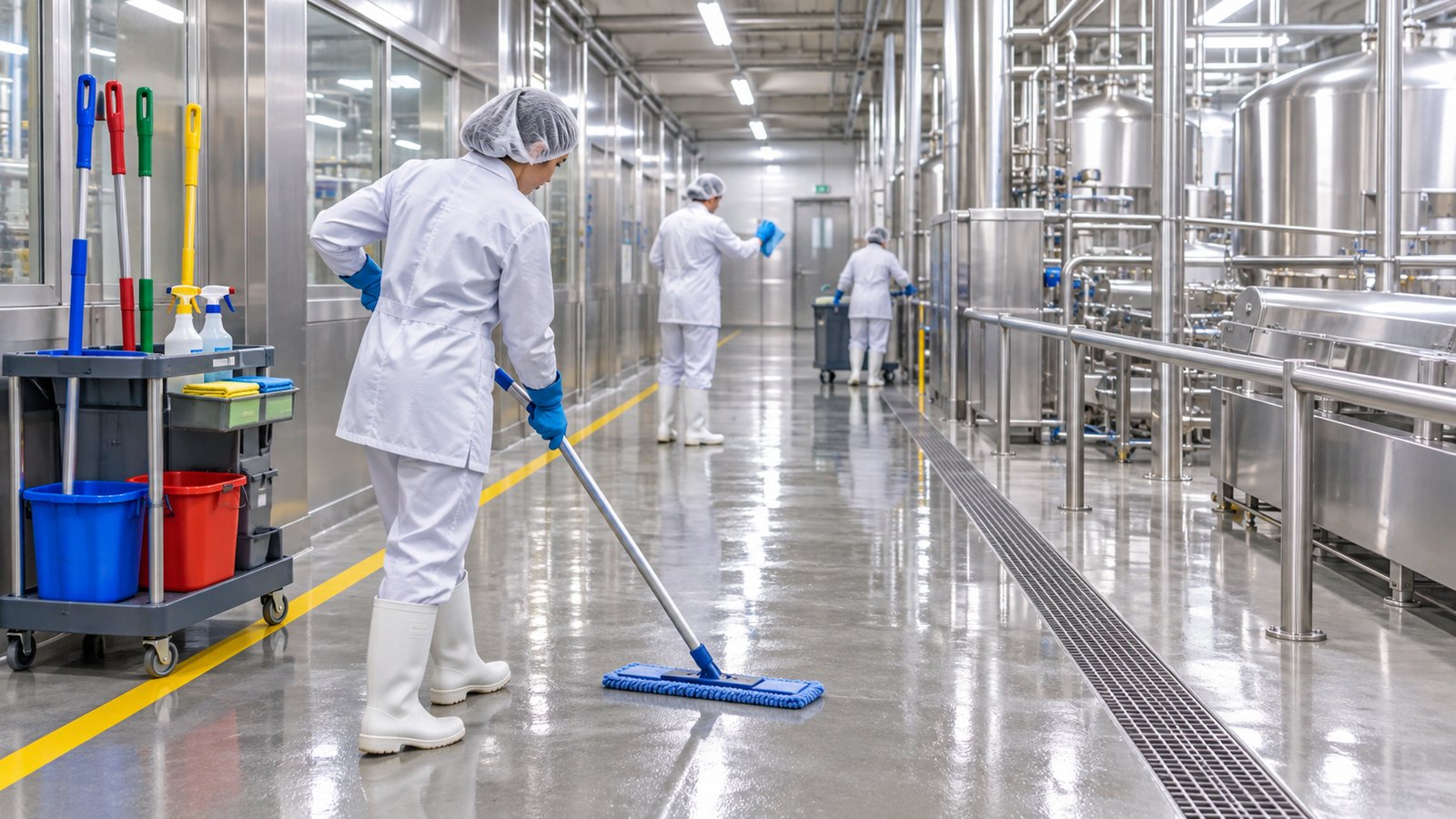
Food processing facility cleaning is not a generic janitorial service. Cleaning schedules, chemical controls, zoning, production windows, and verification can affect whether a plant maintains sanitary conditions and protects food from contamination. A buyer hiring a food manufacturing janitorial contractor in New York, New Jersey, or Connecticut must distinguish routine building cleaning from sanitation controls owned by the regulated food facility. GreenPoint Maintenance Services works with commercial and institutional clients across the Northeast and begins with a site walk, written boundaries, and owner-approved methods. This guide is for facilities near Hunts Point in the Bronx, Port Newark and Elizabeth, the I-95 corridor, Long Island, and Connecticut manufacturing markets that need a clear scope before selecting a cleaning company.
Separate janitorial service from food-safety controls
Begin by documenting which spaces are production, food-contact, packaging, raw-material, finished-goods, employee-support, office, loading, and exterior zones. The service contract should state whether the contractor may enter each zone, who releases it after production, what equipment is permitted, and which tasks remain under the facility’s sanitation program. FDA describes 21 CFR Part 117 as the rule covering current good manufacturing practice and hazard analysis and risk-based preventive controls for human food. Its requirements include sanitary operations, facility sanitation, equipment, and food-contact surface controls (FDA CGMPs for Food). The food business remains responsible for its regulatory compliance even when it hires a service provider.
Do not promise that a commercial janitorial crew will validate the plant’s hazard analysis, determine critical limits, release production equipment, or certify regulatory compliance unless those responsibilities are explicitly assigned to qualified personnel under the facility’s food-safety system. A contractor can perform an approved task and record completion; the facility’s quality or sanitation manager defines the procedure, approves products, evaluates deviations, and decides whether production can resume. GreenPoint puts task ownership into the scope so neither side assumes the other is responsible for a food-contact surface. For a plant receiving produce through Hunts Point Market or shipping through regional logistics corridors, use an annotated map and an access table to define clean/dirty traffic flows before requesting a quote.
Map zones, traffic, and allergen boundaries
A practical map marks production lines, high-care areas, raw-to-ready transitions, employee entrances, handwashing points, drains, forklift paths, waste rooms, locker rooms, and offices. For each zone, list floor type, drains, equipment clearance, overhead obstructions, approved access time, and whether dry or wet cleaning is allowed. A 40,000-square-foot bakery, a 40,000-square-foot refrigerated meal plant, and a 40,000-square-foot dry-goods warehouse have different soils and sanitation risks. Specify color-coded tools by zone and keep them physically separated to reduce cross-contact. GreenPoint can document the route and label equipment storage, but the plant must approve the color code and any allergen-specific controls. Include a changeover protocol for production runs involving different ingredients.
Food-contact surfaces require special control. FDA’s Part 117 guidance explains that facilities must clean food-contact surfaces as frequently as necessary to protect against allergen cross-contact and contamination; where required, wet-cleaned surfaces must be sanitized and thoroughly dried before reuse. Whether a contractor may handle those surfaces depends on the plant’s written procedures, training, and supervision. Routine service may instead cover floors, walls, restrooms, offices, drains, and non-product equipment exteriors. GreenPoint asks the buyer to identify each boundary during a walkthrough and list excluded or owner-only tasks. This is especially important in multi-tenant facilities near Port Newark, Elizabeth, and Long Island where separate operators may control docks, cold rooms, or shared waste areas.
Coordinate cleaning windows with production and sanitation
Map every shift, line change, sanitation window, receiving period, shipping peak, and maintenance shutdown. The schedule should show who opens each room, who confirms the line is released, what work can occur while food or packaging is exposed, and who signs off before restart. A plant operating two 10-hour shifts may have only a short window between sanitation and the next production start, so a vendor’s crew size and equipment setup time matter as much as the nominal cleaning hours. GreenPoint can separate daily building janitorial from production sanitation support and schedule each under the client’s production calendar. Set a contingency path for delayed release, equipment failure, or a spill that changes the planned route.
Use a task matrix that specifies method, frequency, responsible party, chemical, dilution, required dwell time when applicable, rinse or drying requirement, verification record, and escalation contact. Do not treat “sanitize” as a synonym for “clean”; soil removal and sanitizer application are distinct steps and products must be used according to their labels and the facility’s approved procedure. OSHA’s Hazard Communication Standard requires labels, safety data sheets, and appropriate training for workers exposed to hazardous workplace chemicals (OSHA Hazard Communication). GreenPoint will not substitute a cleaner or disinfectant in a food area without approval. Review green cleaning products for commercial buildings and cleaning audit checklists for facility managers when building procurement questions.
Set chemical, equipment, and worker-safety controls
Require a chemical register with product name, intended use, active ingredient where relevant, label directions, storage location, dilution control, container labeling, and current SDS. Confirm whether the facility requires products to be approved by food-safety, quality, EHS, or corporate procurement before they enter the plant. Include locked storage, secondary containment where needed, spill-response materials, eyewash access, PPE, and a process for removing unapproved chemicals. OSHA’s cleaning-industry guidance identifies chemical hazards as an area employers should address (OSHA Cleaning Industry Hazards). GreenPoint uses Green Seal certified products where appropriate to the task and client-approved list, but an ecolabel does not replace the food plant’s compatibility review.
Equipment selection depends on surface, moisture tolerance, sanitation boundary, noise, electrical risk, and whether recovery water can be contained. A floor scrubber may fit a warehouse aisle but be inappropriate in a dry production room or beside exposed packaging. Never route hoses through an uncontrolled production path or allow dirty water to reach a floor drain without the facility’s approval. List equipment dimensions, charging locations, maintenance responsibilities, and cleaning steps after use. GreenPoint trains supervisors to keep tools segregated, inspect them before deployment, and record defects. For NY, NJ, and CT facilities, identify local fire-code storage rules, building access, and wastewater requirements that apply to the site rather than assuming one municipality’s process covers every plant.
Build audit-ready records without overclaiming
An audit-ready cleaning file can include the approved scope, training acknowledgments, zone assignments, chemical list and SDS links, completed task logs, inspection results, corrective actions, equipment checks, and change-control approvals. The record should show who completed a task, when, where, against which instruction, and whether an exception was closed. JaniTrack can capture timestamped GPS-tagged photos, supervisor inspections, and corrective-action notes for permitted non-sensitive locations. It cannot certify food safety or replace environmental monitoring specified by the facility. GreenPoint can align the dashboard with the site’s record-retention rules and avoid photographing formulas, labels, batch sheets, or confidential production information.
Use a simple escalation table: missed cleaning window, failed visual inspection, wrong product, damaged tool, drain backup, suspected cross-contact, and production delay should each have an owner and response deadline. The regulated facility decides whether a deviation affects product or production; the cleaning contractor reports facts promptly and does not make a release decision outside its authority. GreenPoint’s fixed-price proposal can identify included routine tasks, periodic detail work, consumables, and separately priced emergency support. Ask for sample logs and a short mock audit before mobilization. This lets procurement judge whether the record is usable by plant leadership, an auditor, and the cleaning supervisor without creating a second paperwork system.
Compare food-plant proposals and protect continuity
Compare bids against the same zone map and task matrix. Ask each food processing facility cleaning company to show staffing by shift, supervisor coverage, relief plan, training approach, chemical approval path, equipment list, documentation samples, insurance, exclusions, and startup schedule. A price that omits line release delays, controlled access, or dedicated tools is not a comparable price. GreenPoint Maintenance Services provides fixed pricing with no hourly billing or hidden fees after scope confirmation; any change to hours, zones, or owner requirements is quoted transparently. Use measurable service levels, such as completion of scheduled tasks, inspection pass rate, and time to acknowledge a safety-related report, and define who can approve a credit or change order.
Mobilization should include a facility-led orientation, site map review, restricted-area list, badge and key handoff, chemical approvals, tool-color confirmation, emergency drill, and baseline inspection. Run a supervised trial on one shift or one non-product zone before expanding the contract. GreenPoint’s 98% client retention is a company-reported measure; the buyer should still check references and evaluate actual sample records. For a plant near Hunts Point, Newark, Elizabeth, Stamford, or Long Island, the walkthrough should include loading docks, employee entrances, waste movement, and seasonal delivery constraints. Call 347-332-9348 to schedule an assessment, or email info@greenpointms.com for a fixed-price quote tied to the documented sanitation boundary.
Frequently asked questions about food-processing cleaning
Q: Does FDA Part 117 require a plant to hire a specialized cleaning company? A: Part 117 establishes food CGMP and preventive-control requirements; the cited FDA page does not mandate one vendor type. The facility remains accountable for an effective program and should qualify contractors against its own procedures.
Q: Can a janitorial contractor clean food-contact surfaces? A: Only when the facility authorizes the task, defines the method and product, trains the workers, and provides appropriate supervision and verification. The contract should name owner-only responsibilities.
Q: What documents should a food plant request from a cleaner? A: Ask for task logs, approved chemical and SDS lists, training records, equipment controls, inspections, exception reports, corrective actions, and a clear record-retention plan.
Q: Are Green Seal products automatically approved for food production? A: No. GreenPoint uses certified products where appropriate, but the facility must approve products for the specific surface and use, and staff must follow label directions.
Q: How do I get a food facility cleaning quote in NY, NJ, or CT? A: Call GreenPoint Maintenance Services at 347-332-9348 or email info@greenpointms.com to arrange a walkthrough and confirm production access, zones, owner controls, and scope.
Schedule a food-processing facility walkthrough with GreenPoint Maintenance Services at 347-332-9348. Get a fixed-price scope with defined sanitation boundaries, approved-product controls, and JaniTrack task evidence; GreenPoint reports 98% client retention.