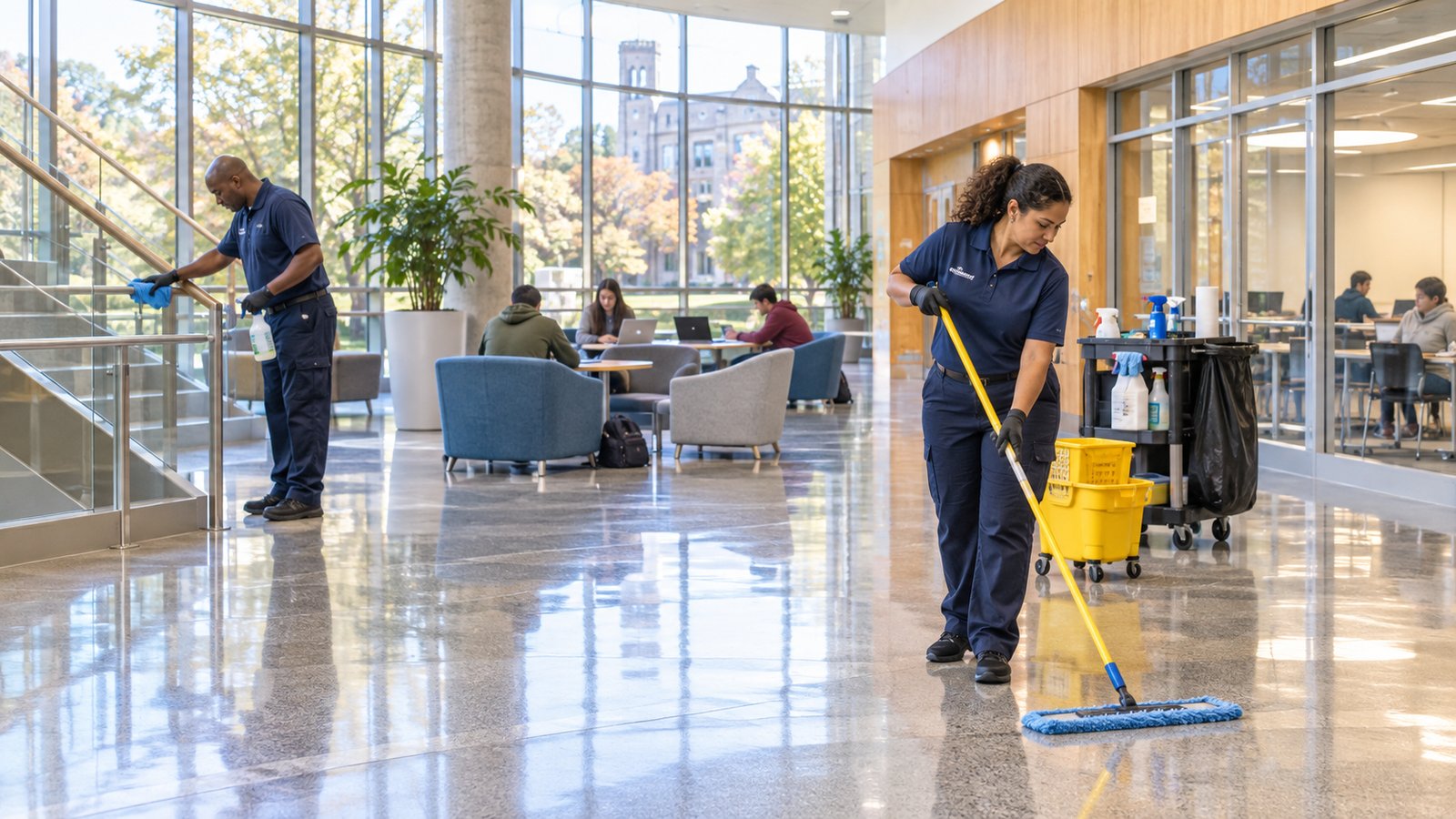
University campus cleaning services require one accountable program across buildings that operate on different calendars and serve different users. Classrooms, residence halls, libraries, athletic facilities, dining areas, clinics, research buildings, and administrative offices do not share one cleaning frequency or one risk profile. Buyers comparing a college janitorial contractor in New York, New Jersey, or Connecticut should build the scope around use, access, security, and evidence instead of square footage alone. GreenPoint Maintenance Services supports commercial and institutional facilities throughout the tri-state region. This guide is designed for campus teams near Columbia and NYU in Manhattan, Fordham in the Bronx, Rutgers in New Jersey, Yale and UConn in Connecticut, and regional colleges that need consistent work without ignoring each building’s operating rules.
Create a building and room inventory before bidding
List each building, room type, floor area, floor finish, fixture count, occupancy pattern, access window, and service frequency. A 12,000-square-foot library reading floor, a residence-hall restroom, a chemistry lab, and an athletic locker room demand different tools and supervision. Mark rooms that require escorts, key control, background checks, restricted access, or coordination with research staff. Include entrances, stairwells, elevators, loading docks, trash rooms, breakrooms, and exterior transition areas. GreenPoint can turn the inventory into a zone schedule and identify whether custodial coverage is needed overnight, during the academic day, on weekends, or during summer operations. A clean campus RFP starts with a verified room list, not a single gross square-foot number.
Separate regular-use buildings from seasonal and event-driven spaces. A Manhattan campus near 116th Street may have dense class changes and subway traffic; a New Brunswick campus may require shuttle and parking coordination; a New Haven campus may see event surges around athletic venues and commencement. Document when buildings close, when student moves occur, and who can approve after-hours entry. The same campus can have full occupancy in residence halls while teaching buildings are quiet during breaks. GreenPoint asks facilities teams to provide an academic calendar and event calendar before producing a fixed-price quote. Call 347-332-9348 to schedule a campus walkthrough and validate the room inventory with operations, housing, public safety, and procurement.
Set frequencies for classrooms, housing, libraries, and restrooms
Use risk- and traffic-based frequencies. Teaching rooms may need daily trash, desk and touchpoint cleaning, and floor care on a defined schedule; high-use lecture halls may need a between-class response when spills occur. Residence halls often need daily common-area service, restroom checks, and documented response to student reports, while private rooms follow the university’s approved access and privacy policies. Libraries need continuous attention to study spaces, shared keyboards, group rooms, restrooms, and food zones without disrupting quiet hours. Dining areas follow meal schedules. Athletic changing areas need moisture control, locker and shower protocols, and clear closure times. These are planning categories, not universal regulatory intervals; the institution sets them based on its program and current campus conditions.
Write frequency in measurable terms, such as one full service after the last class, restroom checks every 60 to 90 minutes during a peak day, or a weekly detail of high ledges and glass. Define what “clean” means for each room: bins emptied, visible soil removed, floors safe, supplies replenished, and approved touchpoints addressed. ISSA offers an institutional and commercial Clean Standard that uses objective and subjective assessments and corrective-action processes; its school-specific standards are separate and should not be treated as a university mandate (ISSA Standards). GreenPoint can tailor checklists to campus zones and align them to the university’s own inspection rubric. See cleaning frequency standards by facility type and school cleaning checklists for custodial staff for related planning.
Protect labs, clinics, and controlled-access spaces
Research and teaching labs need a written boundary between custodial service and lab operations. Identify surfaces that may be cleaned by a contractor, areas that require lab staff preparation, equipment that must not be touched, waste that is excluded, and how a room is released for service. University clinics and health centers may have infection-prevention policies, patient privacy rules, and facility-approved disinfectants. Computer rooms, archives, animal facilities, and cleanrooms can require specialized training or may be excluded from general janitorial work. GreenPoint will define these spaces separately and will not assume that a general cleaner can safely handle specimens, sharps, clinical waste, or sensitive research materials.
Require onboarding that covers chemical labels, SDS access, PPE, spill reporting, restricted keys, emergency contacts, and language-understood training. OSHA’s Hazard Communication Standard requires employers with hazardous chemicals to provide labels, Safety Data Sheets, and worker training (OSHA Hazard Communication). The campus should also specify who approves products for a clinic or lab and how changes are documented. GreenPoint’s supervisors can record authorized work and exceptions in JaniTrack using timestamps, GPS-tagged photos where appropriate, and corrective-action notes. Avoid photographing student records, research, patient information, or security systems. An institution can request medical-office cleaning requirements and OSHA considerations as a reference for clinic areas, then apply its own written controls.
Choose staffing and service coverage for a changing campus
Estimate staffing from the actual task list, not an industry average alone. Count restrooms, classrooms, residence-hall floors, trash points, stairwells, elevators, dining seating, shower rooms, and event spaces. Assign labor by shift and building, then price supervision, relief coverage, training, and seasonal reset work explicitly. BLS reports approximately 2.43 million janitors and building cleaners held jobs in 2025, with around 321,800 annual openings projected for 2025–2035, so a vendor’s hiring, retention, and backup plan directly affects continuity (BLS Occupational Outlook Handbook). GreenPoint uses a relief plan rather than assuming every scheduled cleaner will always be available.
Ask who supervises each campus cluster, how many inspections occur, how substitute staff receive orientation, and who approves a schedule change during exam weeks or a snow closure. A service-level table can define response targets for restroom supply issues, spills, room-access denials, and urgent public-safety concerns. For a campus connected to subway or commuter rail, such as Columbia’s 116th Street station, Fordham Road, Rutgers–New Brunswick, or Yale’s downtown setting, map entry points and delivery routes to avoid missed shifts. GreenPoint can provide a fixed-price model with no hourly billing or hidden fees, with separately approved pricing for extra events or expanded academic calendars.
Use verification that helps facilities act
The quality program should report completed routes, inspection results, repeat misses, service requests, supply outages, and corrective-action closure. JaniTrack can capture timestamped GPS-tagged photos, staff check-ins, ATP tests when the campus approves a sampling plan, and a live dashboard for designated users. ATP readings are an operational indicator of organic residue and must be interpreted against the selected method and threshold; they do not identify a specific pathogen or prove that a surface is sterile. CDC guidance on environmental cleaning emphasizes written procedures, staff training, and monitoring adherence to cleaning and disinfection protocols (CDC Environmental Cleaning). GreenPoint can align reporting with the university’s data-retention and privacy rules.
Make inspection results actionable. A failed room should trigger a named owner, a correction deadline, and a repeat check where appropriate. Trend results by building and task so a campus can tell whether a problem comes from staffing, supply stock, access, an outdated frequency, or a damaged fixture. Use separate dashboards for the facilities director and the building supervisor if they need different levels of detail. GreenPoint’s 98% client retention is a reported business metric; campus buyers should still review references and sample logs. The goal is consistent, explainable service rather than a photograph of every surface. Schedule a GreenPoint walkthrough at 347-332-9348 to define a scorecard that procurement and campus operations can both use.
Plan procurement, transition, and semester changeovers
A campus RFP should attach the building inventory, baseline frequencies, access rules, service calendar, supply responsibilities, safety requirements, inspection method, exclusions, and contract change process. Ask vendors to identify assumptions for utility closets, storage, equipment charging, keys, badges, and event access. Confirm insurance and any required background screening directly against institutional policy. For public institutions, the procurement office’s solicitation and vendor registration instructions control; do not assume that a certification or a relationship with another campus qualifies a contractor automatically. GreenPoint Maintenance Services is MBE/MWBE certified in specified New York programs and SAM.gov registered, but each buyer should verify credentials and requirements in the issuing registry.
Mobilization should start 30 to 45 days before the service date when the campus has multiple buildings, credentials, and staff orientation requirements. Include key transfer, room walks, supply inventory, equipment staging, training, baseline inspections, and a route rehearsal. Before summer break, agree on which spaces remain active and how deep cleaning will be prioritized; before move-in, specify residence-hall resets, elevator protection, and waste staging. GreenPoint can provide fixed pricing with no hidden fees once the calendar and scope are confirmed. Call 347-332-9348 or email info@greenpointms.com to request a campus cleaning walkthrough for a college or university in New York, New Jersey, Connecticut, Pennsylvania, or Florida.
Frequently asked questions about university campus cleaning
Q: How often should university classrooms be cleaned? A: Many campuses schedule routine service daily on teaching days, then adjust for room use, events, and academic breaks. The university should define touchpoints, floor care, and response coverage by room type.
Q: Can one vendor clean classrooms, residence halls, and labs? A: One contractor may cover multiple zones, but restricted labs, clinics, animal facilities, and cleanrooms need separate written boundaries, training, approval, and sometimes exclusion from the general scope.
Q: What should a campus cleaning contract measure? A: Route completion, inspection outcomes, urgent response, repeat deficiencies, supply availability, corrective-action closure, and attendance against the agreed service schedule.
Q: Does JaniTrack replace a campus inspection? A: No. GreenPoint uses JaniTrack for timestamps, approved photos, checklists, and corrective actions; the campus retains its own acceptance and safety oversight.
Q: How do I get a tri-state university cleaning quote? A: Call GreenPoint Maintenance Services at 347-332-9348 to schedule a walkthrough. The quote uses a building and room inventory, calendar, access rules, staffing plan, and approved scope.
Call GreenPoint Maintenance Services at 347-332-9348 to schedule a university campus walkthrough. Receive a fixed-price, multi-building scope with JaniTrack verification and clear access controls; GreenPoint reports 98% client retention.