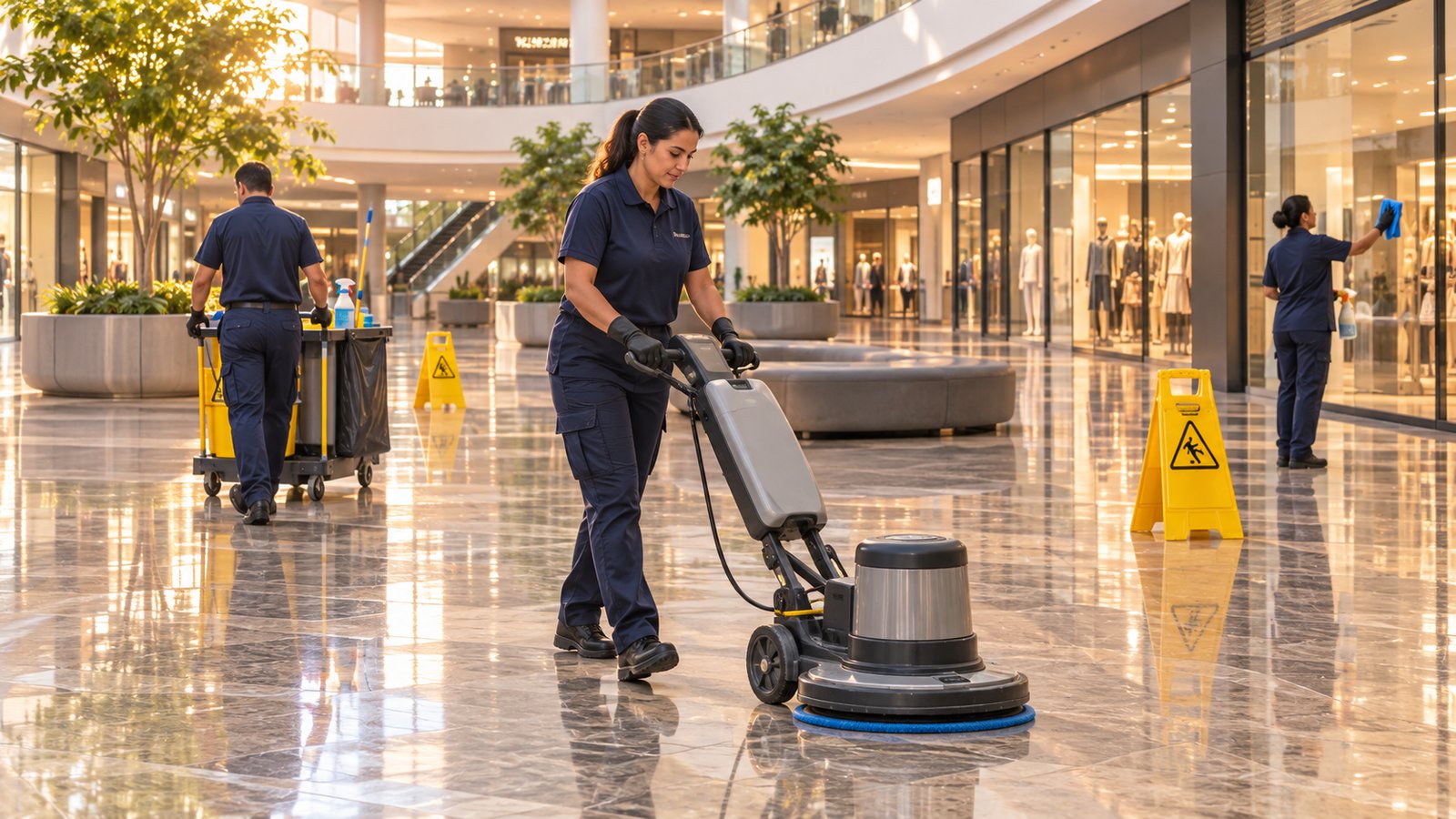
Shopping center cleaning services protect the customer experience while helping property teams manage a large, changing footprint. Entrances, food courts, restrooms, escalators, parking areas, loading docks, tenant corridors, and event spaces each create different traffic, soil, and response needs. A mall janitorial contractor should be evaluated on the route plan, day-porter coverage, event support, safety, wastewater controls, and evidence, not simply a price per square foot. GreenPoint Maintenance Services works with commercial facilities across New York, New Jersey, Connecticut, Pennsylvania, and Florida. This buyer guide covers practical planning for properties near Roosevelt Field, Garden State Plaza, American Dream, Stamford Town Center, and busy retail corridors in Manhattan, Brooklyn, Queens, and the Bronx.
Break the property into customer and back-of-house zones
Start with a property map that separates public entrances, interior concourses, tenant storefronts, food courts, restrooms, family rooms, elevators, escalators, stairs, parking decks, loading docks, management offices, and waste rooms. Record floor material, square footage, opening hours, cleaning frequency, fixture counts, event use, and whether tenants or the landlord own the task. A 100,000-square-foot open-air retail center with several entrances will not have the same route as an enclosed mall with a food court and parking structure. GreenPoint can walk the site with property management and convert the map into daily, periodic, and event-response tasks. The scope should also state which tenant areas are excluded unless a separate service order is approved.
Plan for local demand patterns. Roosevelt Field and Garden State Plaza draw regional visitors and weekend peaks; American Dream combines shopping with attractions and events; Stamford Town Center sits in a downtown transit and office environment. In New York City, properties near Atlantic Terminal, Queens Center, or the Bronx’s Fordham Road corridor may see commuter and pedestrian surges. Use parking counts, store hours, event calendars, and tenant move-ins to define staffing. A common approach is to schedule day porters during public hours, restroom checks every 30 to 60 minutes at peak, and deeper floor work after closing. These are starting examples, not fixed legal requirements. GreenPoint uses a walkthrough and usage pattern review before quoting a service schedule.
Set day-porter, restroom, and spill-response coverage
A mall day porter is an operational responder, not merely a visible cleaner. Define which areas they patrol, what checks they perform, how often they report, and which radio channel or work-order system they use. Include restroom condition, soap and paper, wet floors, trash overflow, food-court tables, elevator thresholds, glass touchpoints, and customer-reported spills. Set response priorities so a slip hazard outranks a cosmetic floor mark. GreenPoint can document route check-ins, time, permitted photos, corrective actions, and closure in JaniTrack. A service-level schedule might acknowledge a spill call within five minutes and dispatch a response immediately; the property should align any target with its staffing capacity and emergency plan.
Restroom scope should list each room, fixture count, check frequency, consumables, odor response, floor drying, accessible routes, and repair escalation. A property with a movie theater or attraction may need evening coverage after retail closing; an outlet center may need extra weekend checks. Food courts require table turnover, waste removal, floor spot cleaning, and coordination with food vendors; janitorial staff should not handle food preparation or enter tenant back rooms without permission. CDC’s general facility cleaning guidance advises using products only on surfaces and applications named on their labels (CDC Cleaning and Disinfecting a Facility). GreenPoint builds labeled product use and clear tenant boundaries into its work plan.
Coordinate cleaning with tenants, events, and opening hours
Retail operations create short work windows. Schedule overnight scrubber routes, early-morning glass work, daytime restroom checks, and event resets around deliveries, store openings, security patrols, and public access. The property should give the contractor a tenant contact list, event calendar, loading-dock rules, fire-lane restrictions, and notice requirements for noisy work. A holiday promotion at Garden State Plaza or an event at American Dream can shift pedestrian routes and waste volumes sharply. Include a separate event plan with crew size, hours, setup, post-event recovery, and approval deadlines. GreenPoint can price recurring service separately from after-hours event coverage so the property manager can see both costs and approve extra work in advance.
Set controls for wet-floor work, spill cleanup, glass, escalators, loading zones, and exterior surfaces. Specify barriers, signage, equipment routes, approved electrical connections, and who may operate specialized machinery. For pressure washing or exterior cleanup, require the vendor and property manager to confirm local discharge and stormwater rules before work; in New York City, certain wastewater discharges can require review under DEP’s Sewer Use Regulations, so the activity and discharge route should be evaluated rather than assumed to be exempt (NYC Industrial Wastewater Discharge Permit). GreenPoint can identify proposed equipment and collect site approvals before scheduling. See commercial pressure washing for properties and cleaning frequency standards when writing periodic scopes.
Price staffing, supplies, and seasonal work transparently
Ask bidders to disclose labor assumptions by shift, supervisor coverage, day-porter hours, event allowances, equipment, consumables, relief staffing, and periodic floor care. Square footage alone misses restroom count, escalators, parking levels, trash tonnage, food-court seating, glass, and seasonal entry soil. Define the property’s responsibility for liners, paper, soap, mats, water, electrical access, and storage. Compare fixed-price proposals only after normalizing scope and exclusions. GreenPoint uses fixed pricing with no hourly billing or hidden fees after the walkthrough. Change orders should identify the area, frequency, labor or material impact, start date, and approval authority rather than appearing as an unexplained monthly increase.
Seasonal planning is especially important in the Northeast. Rain, snow, salt, leaves, pollen, and holiday traffic affect vestibules, mats, parking entrances, and hard floors. In Florida, wind-driven rain, humidity, and storm cleanup may create other access and recovery needs. Define what is routine weather response, what is emergency work, and what equipment the property provides. GreenPoint can create a supply par for paper and soap, a replacement schedule for entry mats, and a post-storm inspection route. A 98% client retention rate is a GreenPoint-reported measure; buyers should still compare the proposed labor model and ask for references from properties with similar traffic and hours.
Verify service with practical inspections and corrective action
Use a scorecard that tracks route completion, inspection pass rate, restroom outages, spill response, complaint closure, repeat exceptions, supply shortages, and work-order age. Set inspection locations and cadence, then sample high-traffic and lower-traffic zones so the report reflects the property rather than a single showcase corridor. ISSA’s Clean Standard for institutional and commercial facilities combines objective measures with conventional inspections and corrective action (ISSA Clean Standard). GreenPoint’s JaniTrack can provide timestamped GPS-tagged photos, inspection notes, and a live dashboard for designated property contacts. Photos should avoid customers, license plates, tenant confidential information, and payment areas unless the property has approved a secure method.
A useful review explains why a miss occurred and who owns the correction. If the food-court floor repeatedly soils before the porter’s next route, the remedy may be a second shift overlap or a tenant waste change rather than a generic warning. If a restroom dispenser fails, assign a facilities work order and temporary supply response. GreenPoint documents corrective actions and closes them after a supervisor check; ATP testing may be included only where the property selects a sampling protocol and interprets results appropriately. ATP is not a pathogen test or a guarantee of sterility. Review digital cleaning verification systems to compare evidence methods and schedule 347-332-9348 for a scorecard walkthrough.
Write the RFP and transition plan for a live property
A strong RFP includes a site map, tenant boundary, opening calendar, room inventory, service frequencies, event schedule, safety plan, chemical approval process, equipment list, consumables, insurance requirements, training, inspection standards, reporting format, escalation contacts, and emergency work rates. Require the bidder to state assumptions and excluded tasks. Confirm that the janitorial contractor will not perform maintenance, pest-control, food-service, or security duties unless separately authorized and qualified. Include rules for keys, badges, loading docks, tenant requests, and incident reporting. GreenPoint Maintenance Services can provide a fixed-price proposal after confirming these details on site.
During transition, count opening inventory, inspect dispensers, tag floor defects, confirm mat locations, test radios, stage machines, and conduct a route rehearsal before the first public shift. A 30-day startup is a practical planning window for a multi-zone property, but larger centers may require more time for badging and tenant communication. Meet weekly with property management during the first month to correct route conflicts and document approved changes. Also record the baseline condition of stone, terrazzo, tile, carpet, and painted surfaces so later wear is not mistakenly attributed to the new cleaning team. Confirm who controls water shutoffs, loading-dock access, elevator reservations, alarm codes, and emergency notifications. These details can prevent a routine floor-care task from colliding with a tenant delivery or public event. GreenPoint serves shopping centers and commercial properties in New York, New Jersey, Connecticut, Pennsylvania, and Florida. Call 347-332-9348 or email info@greenpointms.com to schedule a mall cleaning walkthrough and receive a scope-based quote.
Frequently asked questions about mall cleaning services
Q: How often should mall restrooms be checked? A: The right interval depends on traffic, hours, fixtures, and event use. Many high-traffic sites plan checks every 30 to 60 minutes during peak periods, then adjust based on inspection and supply data.
Q: Should day porters be included in a mall cleaning contract? A: Include them when customer-facing areas need continuous response. Define their zones, route frequency, radio or work-order process, event coverage, and shift handoff.
Q: Does shopping-center cleaning include pressure washing? A: Not automatically. Exterior washing should be separately scoped with surfaces, access, water recovery, tenant coordination, and local discharge approvals.
Q: How does GreenPoint document mall cleaning? A: JaniTrack can record GPS-tagged timestamps, approved photos, inspections, exceptions, and corrective actions. Property management retains its own inspection and acceptance responsibilities.
Q: How can a property manager request a tri-state mall cleaning quote? A: Call GreenPoint Maintenance Services at 347-332-9348 to schedule a walkthrough. The quote will map zones, operating hours, porter routes, event support, and fixed-price assumptions.
Call GreenPoint Maintenance Services at 347-332-9348 for a shopping-center walkthrough and fixed-price service plan. JaniTrack documents routes and corrective actions, and GreenPoint reports 98% client retention.