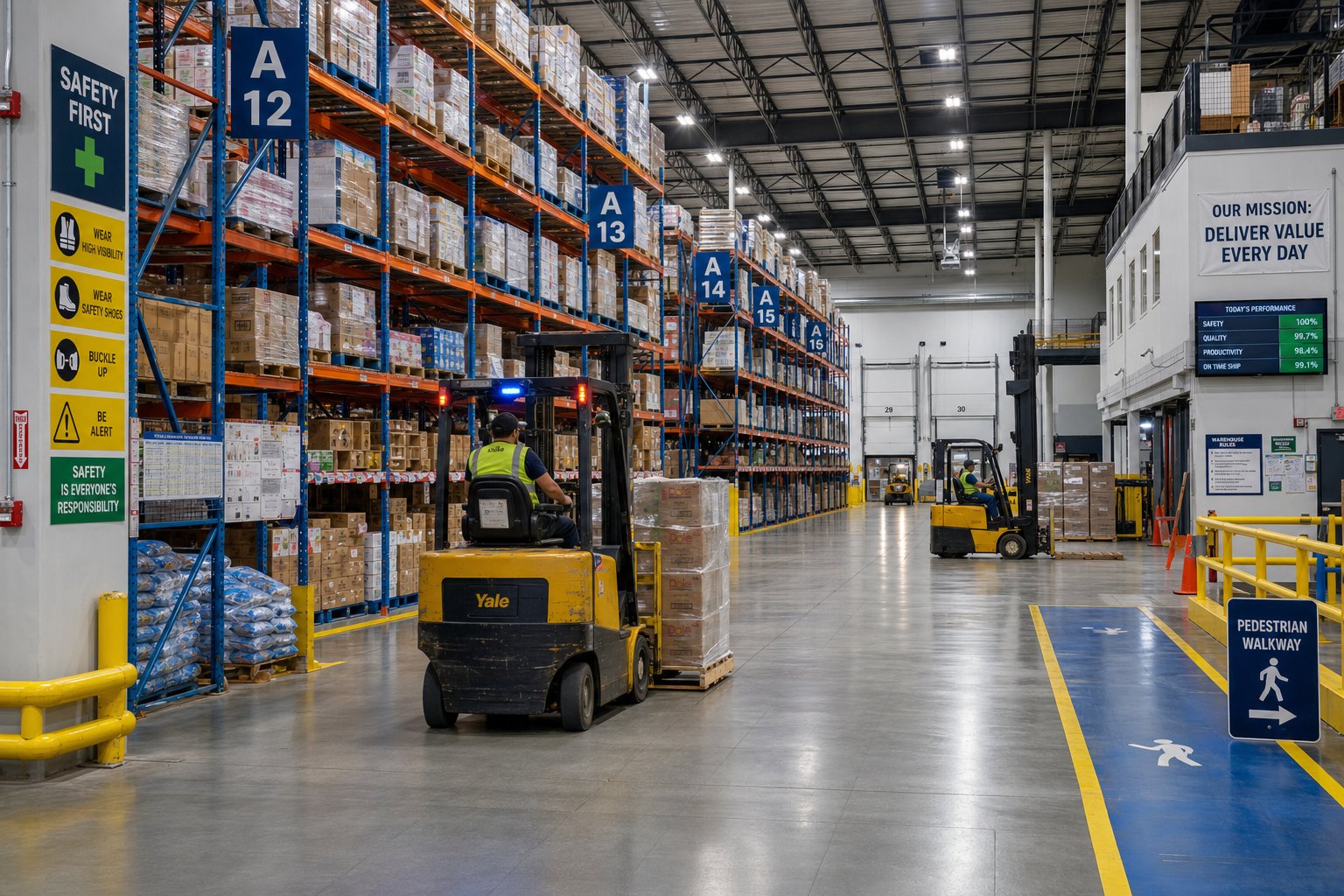
Fulfillment centers and 3PL warehouses don’t fail because the floors look a little dusty—they fail when cleaning conflicts with forklift traffic, safety markings disappear under soil, dock areas become slip hazards, or dust impacts inventory and air quality. GreenPoint Maintenance Services designs warehouse cleaning programs across the tri-state area (NY/NJ/CT) that prioritize OSHA-aligned safety practices, clear traffic control, and measurable outcomes verified with StockPoint (timestamped, GPS-tagged photos and live reporting). If you manage a distribution center near Newark, Elizabeth, Secaucus, Hunts Point, Maspeth, or the I‑95 corridor, call 844-814-0810 to schedule a walkthrough and fixed-price quote.
What makes warehouse cleaning different from office cleaning
A warehouse is a moving machine: forklifts, pallet jacks, conveyors, dock plates, stretch-wrap, and constant in/out traffic. That means cleaning must be planned around operational windows and safety zones. You can’t just “mop around” an active pick module. GreenPoint Maintenance Services starts with a traffic map (forklift aisles, pedestrian lanes, battery charging, docks, and staging) and builds a scope that prevents interference with operations.
The second difference is soil type. Warehouses accumulate rubber dust from tires, corrugate fibers, pallet debris, and sometimes powdery soils from inbound goods. If not managed, this degrades traction, obscures floor markings, and can increase slip/trip risk. For many sites, the ROI of cleaning is risk reduction and uptime protection—not aesthetics. If you want a proof-driven program with predictable pricing, call GreenPoint at 844-814-0810.
OSHA realities: traffic control, chemical safety, and incident prevention
Warehouse cleaning touches multiple OSHA-adjacent issues: keeping travel paths clear, using chemicals safely, preventing slips/trips/falls, and coordinating around powered industrial trucks (PIT). While your EHS program sets the policies, your cleaning vendor must operate inside them. GreenPoint trains crews on site-specific rules, keeps Safety Data Sheets available for products used, and uses color-coded tools to reduce cross-contamination between restrooms, breakrooms, and warehouse floors.
A practical best practice is to treat cleaning like maintenance work: define “lockout” style controls for zones. That can mean cones and signage for wet floor areas, scheduling scrubbers during low-traffic windows, and requiring spotters near docks. For chemical labeling and SDS readiness, see our facility safety guide on [OSHA cleaning chemical safety (GHS/SDS)](/blog/osha-cleaning-chemical-safety-ghs-sds/).
Forklift zones and pedestrian lanes: keeping markings visible
Floor markings are a safety system. When dust and tire residue obscure forklift lanes, crosswalks, and keep-clear boxes, risk rises. GreenPoint’s warehouse scopes include routine dust control (microfiber and HEPA filtration where appropriate) and periodic auto-scrubbing calibrated to your floor type. For many sites, a common cadence is: daily spot cleaning and trash reset; 2–4x per week auto-scrub main aisles; and monthly deep scrub of docks and staging areas.
If your site relies heavily on tape lines, the cleaning plan must preserve adhesive integrity—too much water or the wrong detergent will shorten line life. We typically recommend testing in a small zone first, then standardizing dilution ratios. GreenPoint Maintenance Services can capture “before/after” lane visibility with StockPoint photos as part of QA.
Dock areas, dumpsters, and compactor pads: where slips start
Docks concentrate hazards: rainwater tracked in, stretch wrap, pallet splinters, and occasional product spills. If the dock plate area is slippery, you get incidents fast. A strong dock scope includes: daily debris pickup, removal of stretch-wrap accumulations, spot degreasing when needed, and a weekly deep clean of dock edges and bumpers. For food or pharma-adjacent warehouses, pest pressure near dumpsters makes sanitation even more critical.
GreenPoint’s teams work from a zone checklist so nothing is “missed because it’s outside.” This is where fixed pricing helps: you’re buying the condition of the dock, not the number of minutes someone spent near it. For cost benchmarking, compare your current contract to [commercial cleaning cost per square foot](/blog/commercial-cleaning-cost-per-square-foot/), then call 844-814-0810 for a warehouse-specific scope walk.
Dust, IAQ, and inventory protection (why HEPA matters)
Dust isn’t just unpleasant—it can settle on inventory, interfere with scanners, and aggravate respiratory complaints in break areas. Many sites benefit from HEPA filtration in cleaning equipment to prevent re-aerosolizing fine particles. GreenPoint can deploy HEPA vacuums for pick modules and mezzanines, and coordinate high-dusting during off-hours to avoid product exposure. For the IAQ angle, see our explainer on [indoor air quality and commercial cleaning](/blog/indoor-air-quality-commercial-cleaning/) and our practical guide on [HEPA filtration in commercial cleaning](/blog/hepa-filtration-commercial-cleaning/).
Battery charging rooms and spill response: building a safe micro-scope
Battery charging and maintenance areas are their own risk category: electrolyte spills, corrosive residues, and frequent foot traffic. The cleaning scope here must be coordinated with your maintenance/EHS team and use the right neutralization and disposal practices per your site policy and product labels. GreenPoint scopes these rooms separately so the team uses dedicated tools and documented steps, reducing the chance of cross-contamination with other zones.
StockPoint verification for warehouses: proof of clean at scale
Large facilities create a QA problem: even good teams miss corners when supervisors can’t be everywhere. GreenPoint Maintenance Services uses StockPoint to verify completion with timestamped, GPS-tagged photos and zone checklists that align with your operational priorities (docks, high-traffic aisles, restrooms, breakrooms, and entry points). This verification supports vendor management, incident investigations, and multi-site consistency. If you’re building a QA program from scratch, our post on [quality assurance for commercial cleaning](/blog/quality-assurance-commercial-cleaning-program/) explains how to structure inspections, KPIs, and corrective actions.
Forklift aisle floor marking preservation: cleaning that respects safety infrastructure
OSHA 1910.176 requires clearly marked aisles wherever mechanized equipment operates, and the durability of that paint or tape is directly a function of how the floor is cleaned. Aggressive rotary scrubbing with the wrong pad can strip a $12,000 aisle marking project in a single Q4 peak season. GreenPoint Maintenance Services trains crews to identify epoxy-embedded, painted, and tape aisle markings and to select the correct pad aggressiveness for each (typically red or blue pads for maintenance, never black stripping pads over active markings). This is one of the details a warehouse general contractor never puts in a scope of work but that facility managers care about when their painted OSHA compliance is on the line.
For high-throughput fulfillment operations running 15 to 22 hours per day, we schedule aisle floor cleaning during the two-hour changeover window and specifically avoid recoating or high-alkalinity chemicals on any surface with visible aisle striping. The result is a floor that stays visually and functionally OSHA-compliant for 18 to 24 months between full re-striping, versus 6 to 8 months when the wrong crew and wrong pads are used. Call 844-814-0810 to walk your facility and get a written pad-selection matrix keyed to your specific striping method.
Battery room and charging station cleaning: hydrogen, corrosion, and OSHA 1910.178
Electric forklift charging areas are one of the highest-risk zones in a warehouse from both an OSHA and property-insurance perspective. Lead-acid batteries off-gas hydrogen; lithium-ion batteries create thermal risk if their vents are obstructed by dust and grit. Either way, OSHA 1910.178(g) and NFPA 505 impose specific ventilation, spill containment, and housekeeping requirements. GreenPoint's warehouse scope includes weekly wipe-down of charger cabinets with a non-conductive cleaner, monthly detailed cleaning of vent screens and battery-fill areas, and quarterly documentation of eye-wash and neutralizer availability.
Property insurers increasingly ask for photo evidence of battery-room housekeeping during renewal, and GreenPoint's StockPoint platform generates exactly that documentation with timestamped GPS-tagged images of each charger, wash station, and containment tray. Warehouse operators who have used this evidence in insurance disputes report faster claims processing and, in some cases, lower renewal premiums.
Loading dock and yard cleaning: winter salt, summer heat, and pest control
Loading dock aprons in the tri-state area take an unusual amount of chemical and physical abuse: rock salt in winter, thermal expansion in summer, and constant vibration from truck traffic year-round. Salt residue tracked into the warehouse creates the same [floor-damage cascade](/blog/vct-floor-care-strip-seal-wax-guide/) that affects retail and school facilities, only concentrated in the first 40 to 60 feet of the interior. GreenPoint schedules dock-apron pressure washing in April and October in the northeast, and integrates it with grease-trap and drain cleaning to reduce pest attractants.
For Amazon-tier and 3PL operations under tenant improvement letters that require monthly pest-control coordination, GreenPoint acts as the housekeeping partner to your pest-control vendor: our team removes the standing water, food debris, and cardboard nesting material that pest control cannot address, while pest control handles the bait and monitoring stations. This coordinated model has reduced rodent-activity findings by 60% or more in facilities that previously ran the two vendors independently.
Third-party logistics contract terms: cleanliness SLAs and what to negotiate
3PL operators competing for Amazon, Wayfair, or big-box retail contracts increasingly face customer-defined cleanliness SLAs — things like 'restrooms cleaned every 4 hours during operating shifts,' 'no visible standing debris in main aisles at any time,' and 'monthly ATP swab testing on food-adjacent surfaces with logs available on 24-hour notice.' GreenPoint Maintenance Services builds warehouse scopes that map directly to those customer SLAs, so the 3PL can pass through a document set to their customer without any translation work. When Amazon or a similar customer audits your facility, our StockPoint dashboard becomes the compliance artifact they ask for.
FAQ: fulfillment warehouse cleaning
Q: Can cleaning happen while forklifts are operating? A: Yes, but only with defined zones, traffic control, and scheduling—auto-scrubbing main aisles is usually best during low-traffic windows, while spot cleanup can happen with cones/signage and a clear right-of-way. Q: How often should we auto-scrub warehouse floors? A: Many fulfillment centers benefit from 2–4x per week in main aisles plus daily spot cleanup; high-volume docks may need more frequent attention. Q: Do you handle mezzanine high dusting? A: Yes, with HEPA tools and off-hour scheduling to reduce dust fallout onto inventory. Q: How do you price a warehouse cleaning contract? A: By scope, zones, and frequency—not by hours. GreenPoint provides fixed pricing tied to measurable tasks and outcomes. Q: Do you cover NJ and NYC logistics corridors? A: Yes—GreenPoint supports NY, NJ, and CT, including Newark/Elizabeth airport corridor, outer borough industrial zones, and I‑95 distribution clusters.
Want a warehouse cleaning plan that protects safety markings, reduces dock incidents, and produces audit-ready documentation? GreenPoint Maintenance Services delivers fixed-price scopes and StockPoint verification (timestamped, GPS-tagged photos). Call 844-814-0810 or email info@greenpointms.com to schedule a walkthrough and receive a proposal for your fulfillment center or 3PL facility.