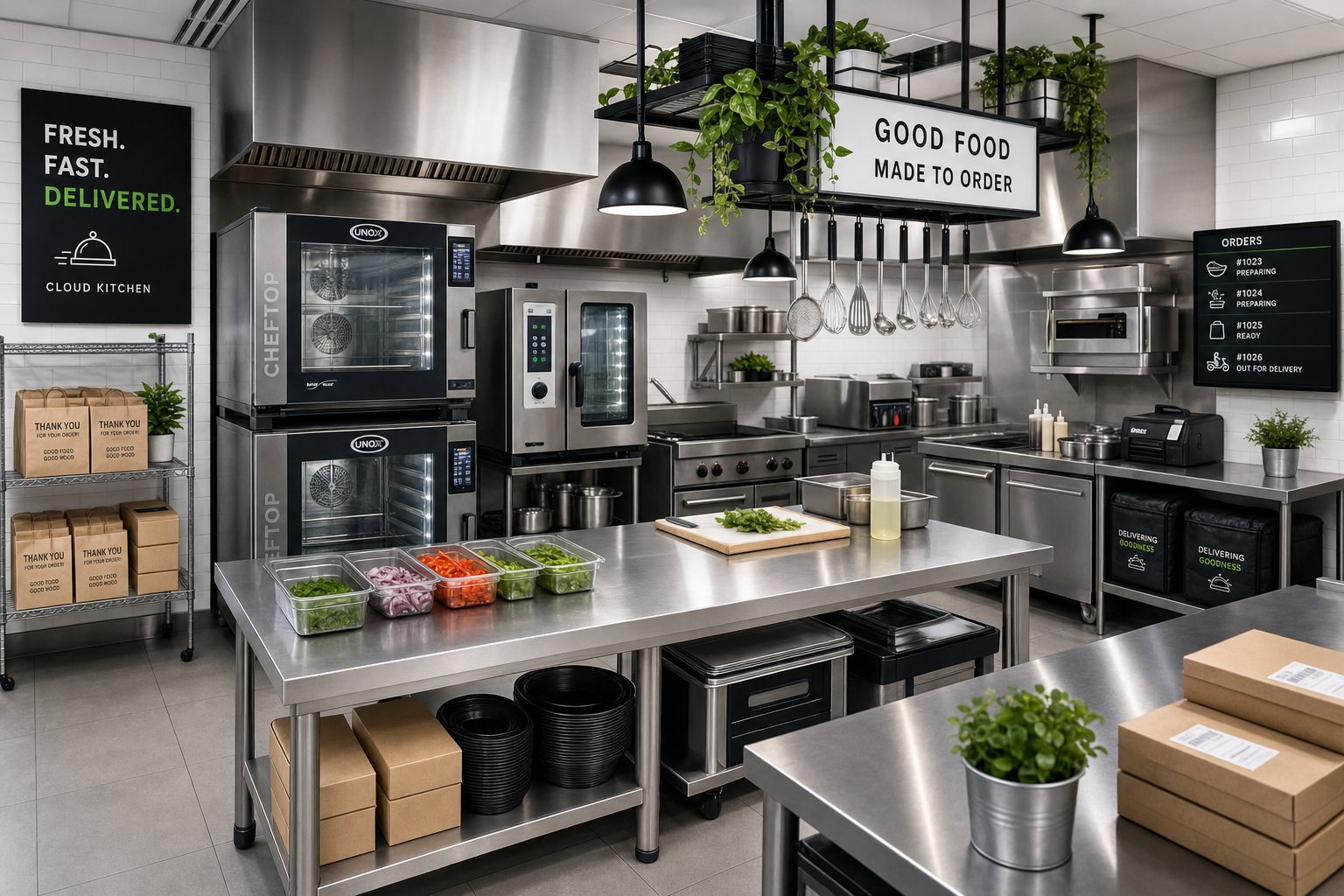
Ghost kitchens and cloud kitchens move fast: multiple brands, shared docks, and back-to-back prep windows. In NYC, that speed collides with food-safety expectations, pest pressure, grease build-up, and multi-tenant liability. GreenPoint Maintenance Services builds cleaning programs for commissaries and shared kitchens that are designed to hold up under inspection, protect brand standards, and document results with StockPoint (timestamped, GPS-tagged photos and optional ATP verification). If you operate a ghost kitchen in Manhattan, Brooklyn, Queens, the Bronx, or near major delivery corridors, call 844-814-0810 to schedule a walkthrough and fixed-price quote with GreenPoint.
Why ghost kitchens get dirty faster than traditional restaurants
A single storefront restaurant usually has one menu, one set of allergens, one storage plan, and one peak window. A cloud kitchen may run 6–30 brands under one roof, with different ingredients, packaging, and prep patterns. The result is higher soil load per square foot, more touchpoints, and more cross-traffic around sinks, walk-ins, dish, and trash rooms. GreenPoint Maintenance Services approaches this like an industrial process: map the flow, assign zones, measure outcomes, and verify execution in every shift with StockPoint checklists and photos.
From a risk perspective, the big three issues are grease (slips, hood performance, odor), moisture (biofilm in drains and behind equipment), and cross-contact (allergens and raw proteins). In fast-turn kitchens, “looks clean” isn’t enough; operators need a repeatable program that reduces hazard probability, not just appearances. If you want a program built around measurable steps and documented results, call GreenPoint at 844-814-0810.
NYC compliance realities: inspections, logs, and what gets operators in trouble
NYC food facilities operate under NYC Department of Health and Mental Hygiene (DOHMH) expectations for sanitary conditions, pest prevention, proper waste handling, and safe food contact surfaces. While cleaning vendors don’t replace in-house food-safety management, a strong janitorial program supports the fundamentals inspectors look for: clean and maintainable surfaces, no accumulation of grease or debris, and a facility that is not creating pest harborage. GreenPoint’s approach emphasizes visible, repeatable controls that an inspector can see: floor-to-wall junctions, under-equipment cleanliness, drain sanitation, and trash room condition.
Documentation matters. Many multi-tenant kitchens struggle to prove “who did what, when” after a complaint or an inspection. GreenPoint Maintenance Services uses StockPoint to capture timestamped, GPS-tagged photos for critical zones (trash room, dish area, hand sinks, walk-ins, restrooms, common corridors). For operators who want higher confidence, we can incorporate ATP testing for high-risk surfaces as a periodic verification tool, similar to the measurement mindset used in healthcare environmental services.
Zoning a shared kitchen: separating tenant bays, common areas, and landlord responsibilities
The most common operational failure in commissaries is unclear division of responsibilities. Tenant staff assumes the landlord cleans the corridor; landlord assumes tenants handle spill response; trash room becomes “everyone’s problem.” GreenPoint recommends a written zone map with three layers: (1) Tenant Bay (inside each line), (2) Shared Production (common prep, shared dish, shared storage), and (3) Building/Back-of-House (dock, corridor, trash room, exterior thresholds). Each zone should have an owner, a frequency, and a verification method.
For property managers and commissary operators, fixed pricing is typically the right model because it aligns the vendor to outcomes rather than hours. GreenPoint Maintenance Services operates on fixed, scope-based pricing—no hourly billing and no hidden “extra time” surprises. If you need a scope built around your specific square footage and turnover rate, schedule a walkthrough at 844-814-0810.
Grease, hood-adjacent soil, and slip prevention in high-turnover kitchens
Grease is not just cosmetic; it drives slips, attracts pests, and increases odor complaints that spill into neighboring tenants. The key is to control grease pathways: line fronts, floor edges, under fryers, around make-up air and return grilles, and in the trash room. A practical benchmark: high-output lines often need daily degreasing of line-front floors and weekly deep cleaning under and behind equipment, depending on volume.
GreenPoint uses color-coded tools and a defined chemical program (with Safety Data Sheets on file) so staff aren’t mixing products or using the wrong detergent on the wrong surface. For standards guidance and appearance outcomes, compare your program to ISSA’s cleaning principles and appearance levels; for a quick baseline, see our explainer on [ISSA Clean Standards appearance levels](/blog/issa-clean-standards-appearance-levels/).
Food-contact vs non-food-contact surfaces: where sanitizing is mandatory
Cleaning removes soils; sanitizing reduces microbes on appropriate surfaces. In a shared kitchen, you must clearly distinguish what is and is not a food-contact surface and avoid indiscriminate chemical use. Food-contact surfaces should be cleaned and sanitized according to the operator’s food-safety plan; janitorial teams typically focus on non-food-contact zones (floors, walls, exterior of equipment, trash rooms, restrooms, corridors) unless the scope explicitly includes food-contact work with proper controls.
When disinfection is part of the scope for restrooms, break rooms, and high-touch points, GreenPoint follows label directions and uses EPA-registered products appropriate for the setting. If you want a procurement-safe way to validate disinfectants and claims, reference our guide on [EPA disinfectant registration and labels](/blog/epa-disinfectant-registration-guide/).
Allergen controls in multi-brand kitchens (and how cleaning reduces cross-contact risk)
Allergen risk rises when brands share cold storage, prep counters, and dish. While training and food handling are primary controls, cleaning supports the system by keeping shared surfaces free of residues and by preventing tool cross-use between bays. The simplest tactic: dedicated, labeled tools per zone and a strict “no tool travel” rule from trash room/restroom to production. GreenPoint can implement color-coded microfiber and tool segregation, plus StockPoint photo verification for critical shared areas where residue tends to accumulate (microwave handles, shared refrigerator gaskets, door pulls, and pass-through shelves).
Pests, drains, and trash rooms: the hidden drivers of complaints
In NYC, pest pressure is a daily operational reality—especially near loading docks, older basements, and dense commercial corridors. Cleaning is not pest control, but it reduces food sources and harborage. Focus areas: floor drains, mop sinks, behind cold storage, cardboard staging, and trash room floor/wall junctions. A good janitorial scope includes drain foaming or enzyme treatment where appropriate (per product label), meticulous removal of grease films, and nightly trash room reset.
GreenPoint Maintenance Services coordinates with pest control vendors by keeping access clear, maintaining sanitation conditions that support baiting strategies, and documenting trash room condition with StockPoint photos. For facility-wide verification practices, our post on [digital cleaning verification systems](/blog/digital-cleaning-verification-systems/) explains what “proof of clean” looks like in modern operations.
How a fixed-price ghost kitchen cleaning scope is built (square footage, shifts, and turnover)
A realistic scope starts with facts: total square footage, number of tenant bays, daily order volume, and cleaning access windows. As a rough planning range, many high-turn shared kitchens behave like 2–3x the cleaning load of a standard restaurant per square foot because multiple brands touch the same shared zones. The scope then becomes a schedule: daily resets (floors, trash, restrooms, high-touch), weekly deep tasks (under equipment, wall scrubs), and monthly/quarterly tasks (high dusting, vents, storage cage sanitation).
For budgeting, facility managers often compare dollars per square foot and per shift. If you are building an RFP or validating a proposal, our benchmark guide on [commercial cleaning cost per square foot](/blog/commercial-cleaning-cost-per-square-foot/) can help you sanity-check pricing. GreenPoint will then translate those benchmarks into a fixed-price, no-hidden-fee proposal for your exact facility—call 844-814-0810 to schedule a walkthrough.
Delivery driver traffic and vestibule cleaning: the overlooked entry point
Ghost kitchens have a traffic pattern most conventional restaurants never deal with: 200 to 800 driver pickups per day at a single dispatch window, plus the property owner's own staff, tenant chefs, and vendor deliveries. Every one of those trips leaves grit, moisture, and food residue in the vestibule and dispatch corridor. Left uncleaned, that residue tracks into prep bays and shows up in health inspector notes. GreenPoint Maintenance Services builds separate scope lines for vestibule floor care (typically mopped 3 to 6 times per operating day), driver-facing hand sanitizer station wipe-downs, and door hardware disinfection so this high-traffic corridor is never treated as a cost-savings shortcut.
A useful benchmark: on properties running 500-plus daily driver pickups, we recommend at least 60 to 90 minutes per shift dedicated purely to entry, dispatch, and driver-adjacent floor and touch-point maintenance. Skimping here is the fastest way to fail an unannounced [restroom and entryway inspection](/blog/restroom-cleaning-best-practices-high-traffic/) because the odor and grease signal is visible before an inspector even reaches the kitchen. Facility managers who want to model this exposure into their budget can call GreenPoint at 844-814-0810 for a walkthrough that quantifies vestibule labor separately from kitchen labor.
Refrigeration exterior cleaning: gaskets, hinges, and the food-safety domino effect
Walk-in cooler and reach-in refrigeration units in shared kitchens run 24 hours per day, and every seal, gasket, and hinge collects a mix of condensate, grease aerosol, and food particulate. FDA Food Code guidance and NYC DOHMH inspectors both cite gasket contamination and mold on door seals as recurring critical violations. In a multi-tenant environment, one tenant's poor cooler hygiene creates a cross-brand liability that shows up on someone else's inspection score.
GreenPoint's ghost kitchen scope typically includes weekly detail cleaning of all refrigeration gaskets and hinges with a food-safe degreaser, plus a monthly deep clean where StockPoint timestamped photos document each unit's condition before and after service. This creates the audit trail commissary operators need to prove tenant-level compliance and, when disputes arise between brands, to demonstrate that shared refrigeration was maintained to a documented standard. The photo record is also useful when brands rotate in and out — new tenants inherit a documented baseline, not a mystery.
Hood, filter, and exhaust adjacent cleaning: what's inside vs outside the fire-suppression contract
NFPA 96 requires certified hood-cleaning specialists to service the interior of exhaust systems on a defined schedule (monthly for high-volume solid-fuel operations, quarterly for high-volume grease). That work is not what janitorial vendors like GreenPoint provide — and confusion between the two is a common gap in ghost kitchen scopes. What GreenPoint does cover is everything the fire-suppression contractor does not touch: the hood exterior, wall panels flanking the hood, ceiling tiles above the cook line, drop grease traps on the floor, and the ambient wipe-down that keeps aerosolized grease from migrating brand-to-brand.
In a well-designed program, the NFPA 96 contractor and GreenPoint coordinate schedules so nightly janitorial work is done after the hood cleaner leaves. This prevents the fresh-scrub-then-immediately-recoat cycle that operators complain about when they try to save money by combining vendors.
Third-party audits, secret-shopper visits, and how documentation prevents disputes
Investors and franchisors backing multi-brand ghost kitchens routinely send third-party auditors and secret shoppers into commissary spaces — sometimes monthly, always unannounced. GreenPoint Maintenance Services provides commissary operators with a shared, tenant-viewable StockPoint dashboard where every completed task is timestamped with a GPS-tagged photo. When a tenant claims 'the shared kitchen wasn't cleaned' at 2 a.m. between shifts, the dashboard resolves it in seconds. When an auditor asks for six months of restroom disinfection records, they're a URL away, not a warehouse-crate scavenger hunt. That evidence-based transparency is one of the reasons GreenPoint holds a 98% client retention rate across NY, NJ, CT, PA, and FL.
FAQ: ghost kitchen and cloud kitchen cleaning in NYC
Q: How often should a cloud kitchen do deep cleaning under equipment? A: In high-output bays, weekly is a common baseline, with targeted daily degreasing at line fronts; the right frequency depends on volume, equipment layout, and whether spills are controlled during the shift. Q: Can a janitorial vendor clean food-contact surfaces? A: Only if the scope, training, and controls are defined to align with the operator’s food-safety plan; many facilities keep food-contact sanitizing with trained kitchen staff while the vendor focuses on non-food-contact areas. Q: What’s the biggest difference between a single-tenant restaurant and a multi-tenant commissary? A: Shared zones and unclear ownership—corridors, trash rooms, and shared storage create sanitation “gaps” unless zoning, frequency, and verification are documented. Q: How do we prove cleaning was done after an incident or complaint? A: Use time-stamped photo logs and checklists; GreenPoint’s StockPoint verification provides GPS-tagged photos and optional ATP testing for high-risk surfaces. Q: Do you work in all NYC boroughs? A: Yes—GreenPoint Maintenance Services supports Manhattan, Brooklyn, Queens, the Bronx, Staten Island, and adjacent areas like Long Island City and Downtown Brooklyn, plus NJ and Westchester for multi-site operators.
Need a ghost kitchen cleaning program that stands up to inspections and investor due diligence? GreenPoint Maintenance Services delivers fixed-price scopes, StockPoint verification (timestamped, GPS-tagged photos), and optional ATP testing for measurable sanitation. Call 844-814-0810 or email info@greenpointms.com to schedule a walkthrough and get a proposal within days.