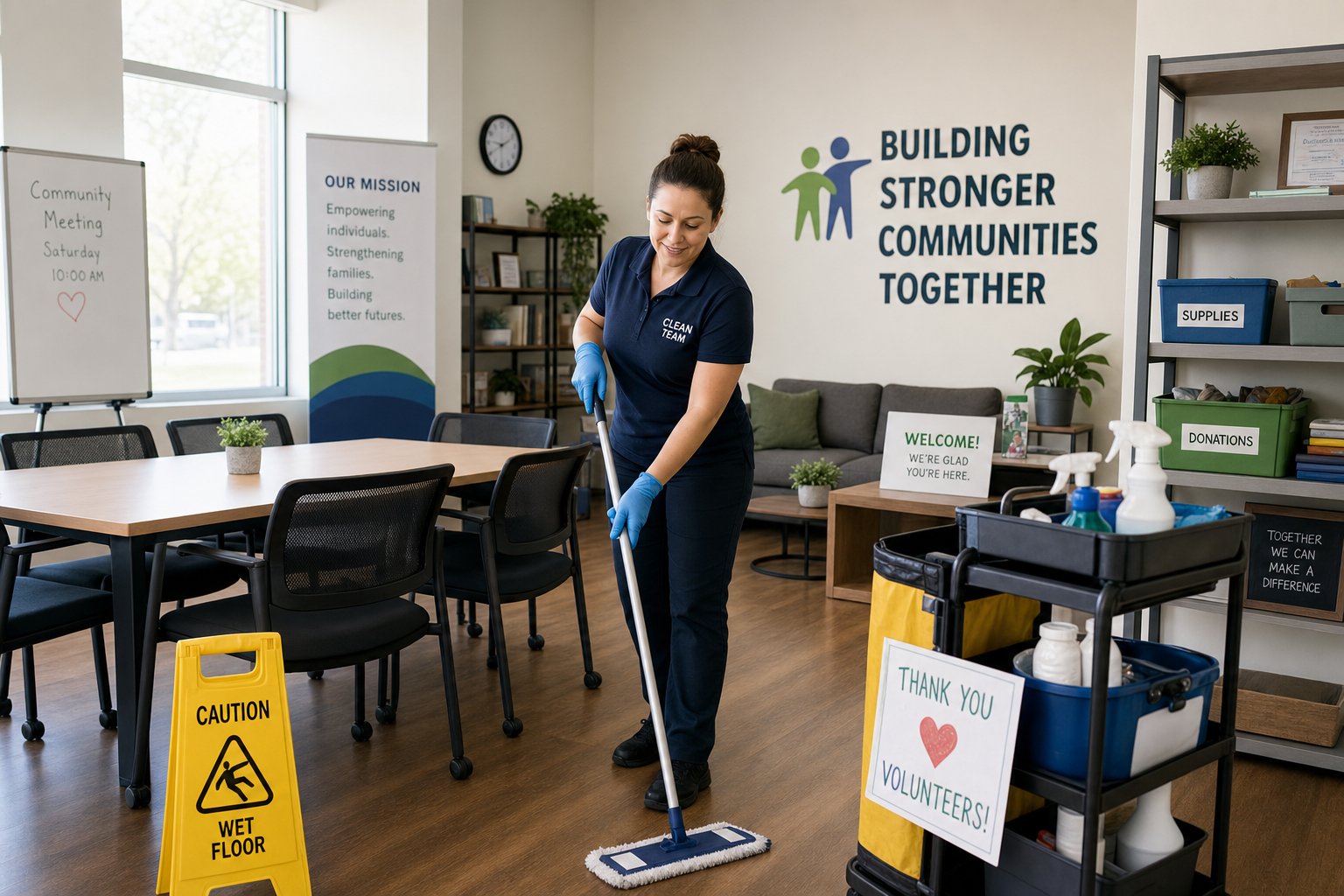
Nonprofit office cleaning in NYC has to stretch a mission-driven budget without making staff, donors, or community members carry the risk of an unmanaged facility. A small arts nonprofit in Harlem, a workforce program in the Bronx, and a social-services office near Downtown Brooklyn may share office basics, yet differ in public traffic, food programs, classrooms, and privacy needs. GreenPoint Maintenance Services provides MBE-certified commercial cleaning with fixed pricing, Green Seal certified products, and JaniTrack verification. Call GreenPoint at 347-332-9348 to schedule a walkthrough that separates essential service from optional periodic work.
Why nonprofits need a scope built around mission use
A nonprofit facility may serve as office, classroom, pantry, counseling site, event room, and public reception in the same week. Cleaning frequency should follow usage, not the organization’s tax status. ISSA standards encourage clear appearance and task definitions, while practical operations require a route that protects confidential files, donated goods, food-contact areas, and accessible paths. GreenPoint begins by mapping staff-only, public, program, storage, and restricted zones before assigning labor.
That zoning makes a limited budget more effective. A 6,000-square-foot office might receive daily restrooms, trash, kitchens, and touchpoints; three-times-weekly office cleaning; and monthly detail work for vents, baseboards, and interior glass. GreenPoint Maintenance Services writes those frequencies into a fixed-price scope with no hourly billing or hidden fees. A facilities lead can call 347-332-9348 when a grant-funded program, tenant, or event adds a room so the service can be adjusted transparently.
NYC neighborhood access and community traffic
Local context changes the route. A food pantry near Fordham Road may have deliveries and queues before the office opens; a community center in East Harlem may need evening classrooms reset after programs; a nonprofit near Fulton Street may share security and elevator rules with several tenants. GreenPoint records loading windows, public entrances, accessible routes, alarm procedures, and the safest sequence for occupied spaces. The goal is to clean without blocking a client, volunteer, or case worker.
Weather and transit also affect entrance soil. Salt from winter sidewalks, rain near subway exits, and summer dust from construction can make the lobby the most visible maintenance zone. GreenPoint can increase mat care, schedule a daytime restroom check, or add post-event service at a known price. If a site serves clients from multiple boroughs or runs a weekend program, call 347-332-9348 for a route that matches the calendar rather than a generic five-day template.
Reception, counseling, and privacy-sensitive rooms
A nonprofit’s reception area should feel calm, accessible, and dignified. Daily work typically includes counters, door pulls, seating touchpoints, floors, waste, glass, and dispensers, while counseling or case-management rooms need careful cleaning without moving paperwork. GreenPoint trains staff to leave confidential documents, client belongings, and locked storage alone. The written scope names cleanable surfaces and an escalation contact for anything that appears sensitive or out of place.
The [ADA compliance and facility maintenance](/blog/ada-compliance-facility-maintenance/) guide is useful when evaluating clear corridors, ramps, restroom access, and door hardware. Cleaning supports accessibility when carts, wet-floor signs, and waste bins do not obstruct routes. GreenPoint documents a blocked path as an exception and can notify the facility lead through the agreed channel. A walkthrough at 347-332-9348 lets the nonprofit prioritize public-facing rooms without overbuying detail work in staff areas.
Community rooms, classrooms, and food programs
Community rooms and classrooms need service after use, not simply at the end of a calendar week. Tables, chair backs, shared supplies, whiteboards, floors, and touchpoints can collect soil quickly when volunteers, children, or participants rotate through. Food programs add counters, sinks, refrigerator handles, and waste separation. GreenPoint uses color-coded microfiber and distinct tools for restrooms, kitchens, and program rooms, then records any room that could not be serviced because an activity ran late.
A nonprofit should decide whether staff or the vendor handles dishes, food storage, toys, or donated goods. Clear boundaries protect both volunteers and cleaners. GreenPoint can provide a nightly environmental route while the program team handles member-owned items, or price an approved reset separately. For frequency benchmarks, see [cleaning frequency standards by facility type](/blog/cleaning-frequency-standards-by-facility-type/). Call 347-332-9348 before a fundraiser or holiday drive so added traffic does not surprise the crew.
JaniTrack proof for boards, funders, and facility leads
A nonprofit often has one operations person wearing several hats, so proof must be quick to review. JaniTrack captures timestamps, GPS-tagged photos of approved areas, task completion, notes, and exceptions. GreenPoint can configure the dashboard to show a restroom check, cleaned entry, or post-event reset without photographing client information, donation records, or confidential screens. That creates a practical record for internal reviews without turning cleaning into a paperwork burden.
Evidence also supports grant and board conversations about stewardship. If a building has repeated supply shortages, high-touch failures, or waste overflow after a program, GreenPoint can show the pattern and propose a frequency change. ATP testing is available for agreed surfaces when quantitative trend data is useful, but it is not a clinical test. The [what is ATP bioluminescence testing](/blog/what-is-atp-bioluminescence-testing-cleaning/) article explains the distinction. GreenPoint’s 98% client retention reflects accountable service and responsive communication.
Green cleaning and chemical safety on a nonprofit budget
GreenPoint uses Green Seal certified products where they are appropriate for the surface and task, while following every label for dilution, dwell time, ventilation, and protective equipment. This can help a nonprofit reduce strong odors and support building sustainability goals, but “green” never means less disciplined. OSHA’s [Hazard Communication Standard](https://www.osha.gov/hazcom) requires accessible safety information and communication about chemical hazards. The scope identifies product storage, SDS access, and the process for reporting a spill.
A facility that serves children, older adults, or people with respiratory sensitivities may need additional communication about reentry and fragrance. GreenPoint schedules intensive floor or restroom work when the building can ventilate, marks wet surfaces, and uses approved products consistently. Fixed pricing makes a grant budget easier to manage; call 347-332-9348 if a new program changes the chemical or consumables requirement.
Budgeting and grant-ready cleaning specifications
Nonprofit leaders should compare complete scopes, not just the lowest monthly number. Pricing depends on square footage, public traffic, restroom count, program rooms, food areas, service windows, consumables, periodic floor work, and the response standard for spills. The [commercial cleaning cost per square foot](/blog/commercial-cleaning-cost-per-square-foot/) guide gives broad benchmarks, but a 5,000-square-foot pantry and a 5,000-square-foot administrative office will not price the same. GreenPoint separates recurring tasks from optional deep cleaning so a board can see what each dollar buys.
A good RFP or quote names frequencies, quality expectations, staff coverage, insurance, training, escalation, and documentation. GreenPoint Maintenance Services is MBE/MWBE certified in New York programs, registered in SAM.gov, and serves New York, New Jersey, Connecticut, Pennsylvania, and Florida. That can support supplier-diversity goals while keeping the local route specific to the building. Request a walkthrough and fixed-price proposal at 347-332-9348.
Volunteer cleaning versus professional service
Volunteers can be valuable for decluttering, event setup, and donation sorting, but they are not a substitute for a trained janitorial program in public or regulated spaces. Volunteers may lack chemical training, exposure controls, equipment, or the time to clean restrooms and high-touch points consistently. GreenPoint can help an organization define a safe boundary: volunteers handle approved organizing tasks while trained staff perform environmental cleaning, floor care, restroom sanitation, and waste removal.
The [church cleaning tips for volunteers versus professionals](/blog/church-cleaning-tips-volunteers-vs-professionals/) article offers a similar decision framework for shared community spaces. GreenPoint can build a hybrid scope if the nonprofit documents who owns each task and how exceptions are escalated. A 98% client-retention record is useful evidence, but the immediate test is whether the vendor can explain the route, supervision, and response time. Call 347-332-9348 to review options without committing to unnecessary extras.
Choosing a nonprofit cleaning company in NYC
Ask whether a provider will visit the site, protect confidential information, cover absences, handle after-hours access, and provide a written scope. Ask how the crew separates restrooms from food areas, what happens after a late program, and whether proof is available to the facilities lead. GreenPoint provides named supervision, fixed pricing, JaniTrack visibility, and a practical process for adjusting service when the mission expands.
Start with [questions to ask a commercial cleaning company](/blog/questions-to-ask-commercial-cleaning-company/) and then call GreenPoint at 347-332-9348. GreenPoint Maintenance Services can support sites in Manhattan, the Bronx, Brooklyn, Queens, Staten Island, Westchester, Long Island, New Jersey, Connecticut, Pennsylvania, and Florida, with local access notes captured during each walkthrough.
Frequently asked questions
How much does nonprofit office cleaning cost in NYC? Cost depends on square footage, public traffic, restrooms, kitchens, program rooms, frequency, consumables, and access. GreenPoint issues a fixed-price scope after a walkthrough so the organization can compare defined service rather than hourly labor.
Can GreenPoint work around client privacy? Yes. The scope identifies restricted rooms and protected information, and cleaners are instructed not to move paperwork or photograph confidential material. JaniTrack photos are limited to approved environmental areas.
Can volunteers share the cleaning work? Yes, for approved organizing or event tasks. GreenPoint recommends trained professionals handle chemical use, restrooms, floors, waste, and high-touch sanitation while volunteers follow a clear boundary.
Does GreenPoint use green products? GreenPoint uses Green Seal certified products where appropriate and follows the product label, SDS, contact time, ventilation, and protective-equipment requirements for every task.
How do we schedule a walkthrough? Call 347-332-9348 or email info@greenpointms.com with the address, approximate size, programs, operating hours, and desired budget window. GreenPoint will map the zones and propose a transparent service plan.
Make the facility support the mission every day. Call GreenPoint Maintenance Services at 347-332-9348 for a nonprofit walkthrough and fixed-price quote; GreenPoint brings Green Seal products, JaniTrack proof, and 98% client retention.