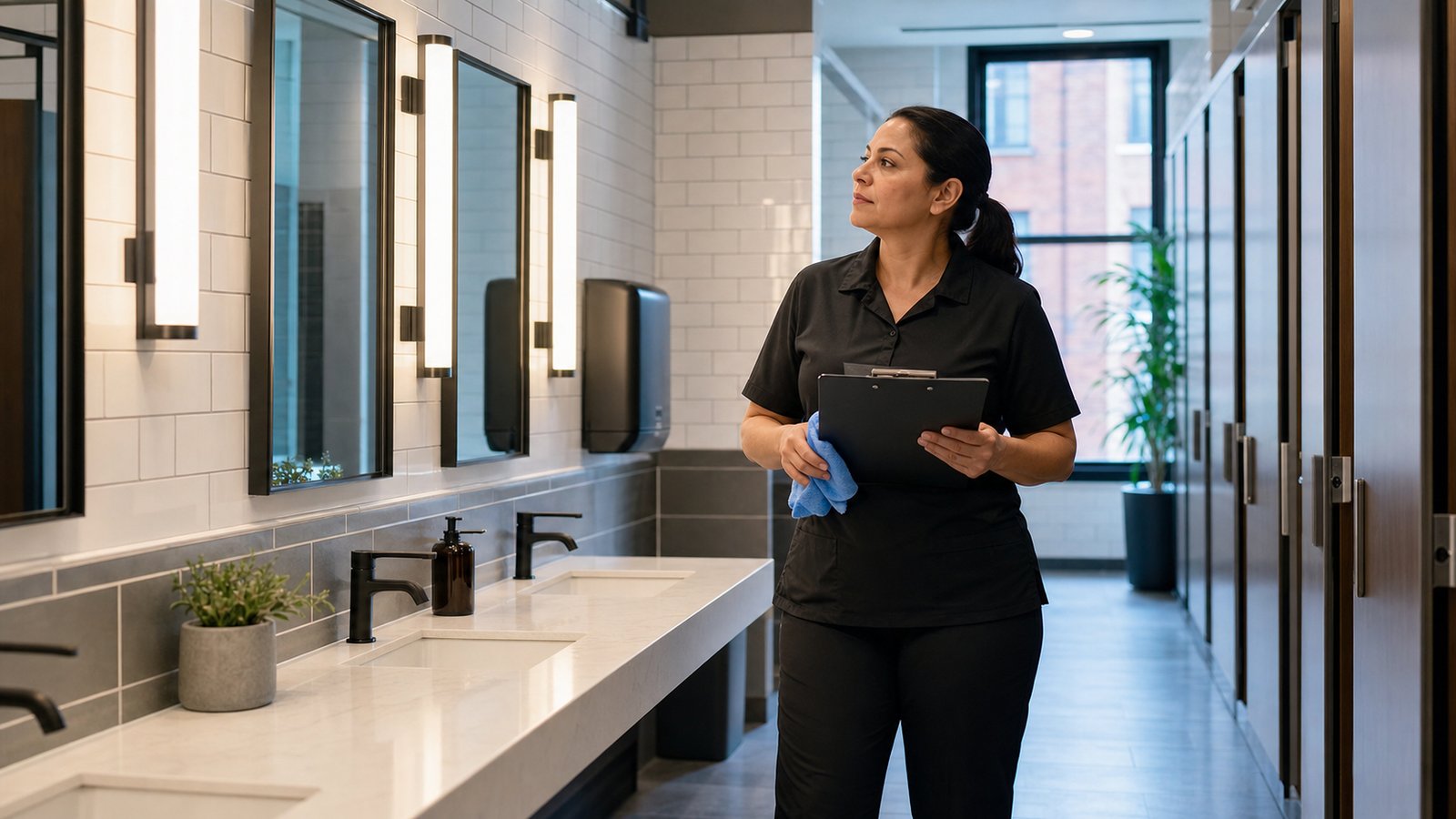
If you manage a Brooklyn facility—office, school, industrial site, or retail—the fastest way to trigger tenant complaints is inconsistent restroom cleaning. “Looks clean” is subjective, which is why the best facilities use a scoring system with measurable checks. This guide targets buyers searching for “restroom cleaning scoring Brooklyn” and shows how to build an objective metric program: appearance scores, supply compliance, odor triggers, and verification proof. GreenPoint Maintenance Services uses JaniTrack time-stamped GPS-tagged photos and can add ATP testing for objective hygiene validation. To schedule a walkthrough, call 347-332-9348.
Why restroom scoring matters more in Brooklyn: density and reputation risk
Brooklyn buildings often serve a mix of staff, visitors, and customers—think Downtown Brooklyn near MetroTech, industrial corridors in Sunset Park, and retail streets in Williamsburg. Restrooms in these environments face high peak loads and fast “re-soiling.” Without metrics, you get a cycle of complaints, reactive cleanups, and finger-pointing. A scoring program creates common language: the vendor knows what “pass” means, and the client can track improvement over time. GreenPoint builds these programs as part of a broader quality assurance system with documented completion.
Define the score: appearance, hygiene, and supply availability
A restroom score should include at least three categories: (1) appearance (mirrors, partitions, fixtures, floors), (2) hygiene risk points (touch surfaces, odors, visible residue), and (3) supplies (soap, paper, liners). Many facilities use a 0–100 score with weighted sections—for example 50% appearance, 30% hygiene, 20% supplies. The key is consistency: the same checklist and weights every time. GreenPoint recommends setting a target of 90+ for public-facing restrooms and 85+ for employee-only restrooms, with a remediation plan if a zone drops below threshold.
Inspection frequency: how often to score without wasting time
Score too rarely and you miss problems; score too often and your supervisors become full-time auditors. A practical Brooklyn approach is: daily spot checks for high-traffic restrooms, weekly scored inspections for standard restrooms, and monthly deep audits that include behind-toilet areas, vents, and grout. You can align this with your broader cleaning schedule using standards like [cleaning frequency standards](/blog/cleaning-frequency-standards-by-facility-type/). GreenPoint uses fixed routes and verification so you can see what was done between inspections.
Objective evidence: photo verification and ATP testing
The most defensible scoring systems use evidence. Photos document appearance, while ATP testing provides a quick, objective indicator of organic residue on high-touch points (faucet handles, flush levers, door pulls). GreenPoint’s JaniTrack platform captures time-stamped GPS-tagged photos, which helps prove completion and supports training when a score drops. For a deep dive on ATP, see [what is ATP bioluminescence testing](/blog/what-is-atp-bioluminescence-testing-cleaning/). If you’re building a broader QA program, reference [quality assurance commercial cleaning program](/blog/quality-assurance-commercial-cleaning-program/).
Top 12 checklist items that correlate with complaints
In GreenPoint’s field experience, these items drive most complaint tickets: (1) odor at entry, (2) wet or sticky floors near sinks, (3) visible residue on toilet bases, (4) overflowing trash, (5) empty soap, (6) empty paper, (7) streaked mirrors, (8) grime on door handles/plates, (9) urine splash on partitions, (10) clogged dispensers, (11) unfilled liner boxes, and (12) missed corners behind doors. Build these into your scoring form with yes/no checks and a notes field for root cause.
Root-cause analysis: when the score drops, what do you do?
A score isn’t useful unless it triggers action. GreenPoint recommends a three-step response: (1) immediate remediation within a defined SLA (often 2–4 hours for public-facing restrooms), (2) supervisor coaching with photo examples, and (3) process change—adjust frequency, add mid-day touch-ups, or change products/tools. If staffing turnover is impacting consistency, see [janitorial employee turnover impact](/blog/janitorial-employee-turnover-impact/). The goal is to reduce repeat failures in the same zone.
Brooklyn-specific planning: schools, industrial sites, and retail
Different facilities need different scoring emphasis. Schools often prioritize touchpoint hygiene and inspection documentation, especially when aligning with NYC DOE expectations. Industrial sites in areas like Red Hook or Sunset Park may prioritize floor safety (slip resistance) and robust trash handling. Retail restrooms in high-foot-traffic corridors (Atlantic Terminal area, Barclays Center event days) need mid-day checks and fast restocking. GreenPoint can tailor scoring weights by facility type while keeping the same 0–100 framework for reporting.
FAQ: Restroom cleaning scoring and metrics in Brooklyn
Q1: What’s a good target score for public restrooms? A: Many facilities set 90+ as a target for public-facing restrooms and treat anything below 85 as a corrective action trigger. Q2: How do we avoid “pencil-whipped” inspections? A: Require evidence: time-stamped photos, random rechecks, and periodic ATP testing for high-touch points. Q3: Should we score odor separately? A: Yes—odor is a leading indicator for complaints. Track odor events and correlate with frequency and product changes. Q4: How often should restrooms be serviced? A: It depends on traffic; start with a baseline and adjust. Use [cleaning frequency standards](/blog/cleaning-frequency-standards-by-facility-type/) as a starting point. Q5: Can GreenPoint provide reporting to management? A: Yes—GreenPoint delivers score trends, completion verification via JaniTrack, and corrective action notes in a monthly report.
Get a Brooklyn restroom scoring program that’s verifiable
A well-run restroom program reduces complaints, improves tenant retention, and protects your facility’s reputation. GreenPoint Maintenance Services builds scoring checklists, trains teams, and verifies execution with JaniTrack GPS-tagged photos. Schedule a walkthrough and fixed-price quote by calling 347-332-9348 or emailing info@greenpointms.com. GreenPoint is MBE/MWBE certified, SAM.gov registered, and known for proof-driven quality with 98% client retention.
Stop guessing whether restrooms are clean. GreenPoint Maintenance Services will implement a Brooklyn-ready scoring system and verify service with JaniTrack time-stamped GPS-tagged photos (with optional ATP testing for objective hygiene checks). Call 347-332-9348 for a walkthrough and fixed-price quote.