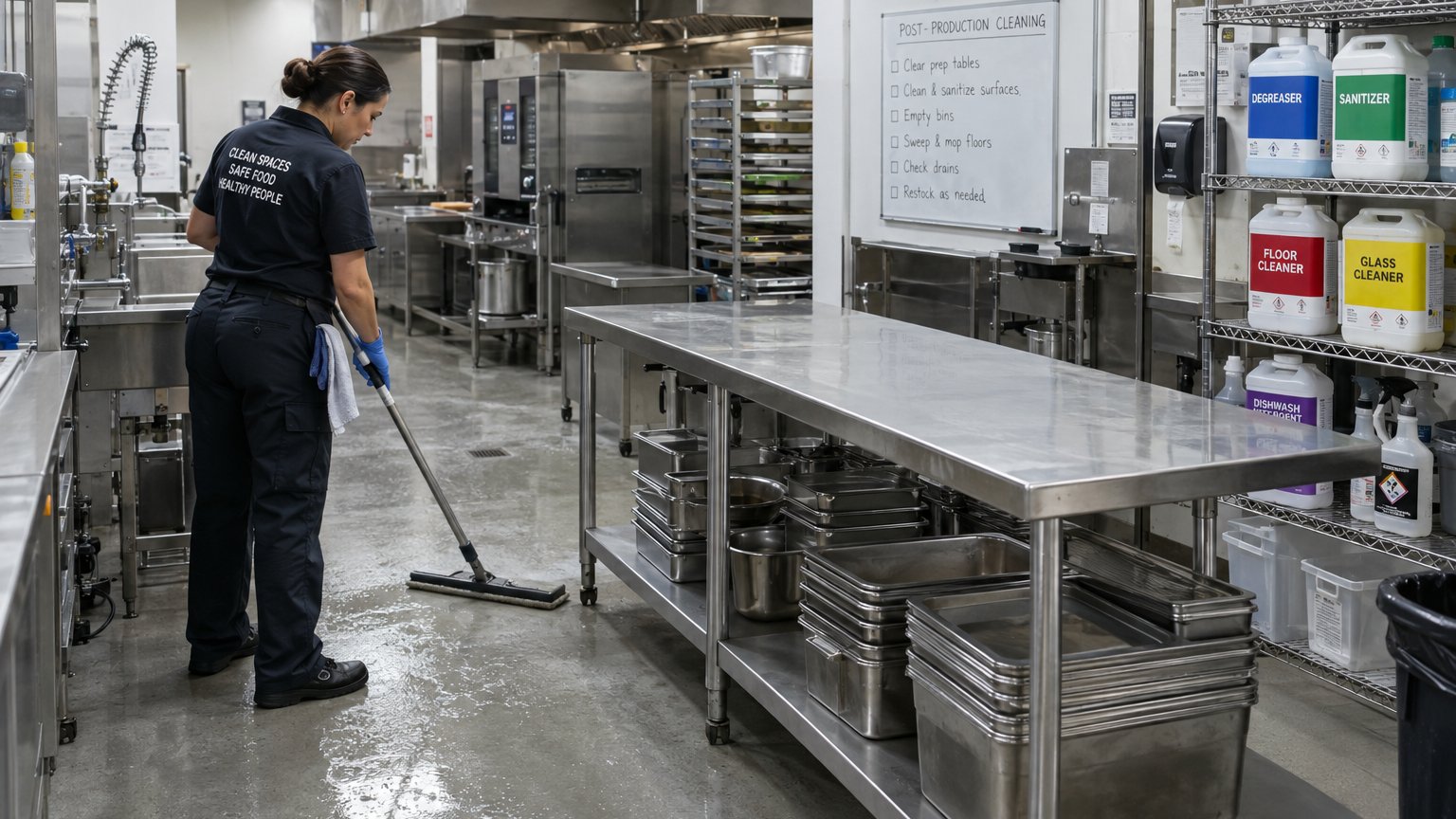
Catering kitchens face production surges, early prep shifts, late event returns, and short windows between jobs. A cleaning plan must protect the boundary between janitorial support and food-production sanitation while keeping floors, restrooms, loading areas, and staff spaces ready for the next shift. This guide is for catering kitchens, commissaries, and event-production facilities in New York City, Long Island, New Jersey, and Connecticut. GreenPoint Maintenance Services Corp can map routine facility cleaning around the operator's own food-safety procedures; call 347-332-9348 to schedule a walkthrough and request a fixed-price quote.
Start with the production calendar and site geography
A central kitchen near Hunts Point or the South Bronx may dispatch to multiple boroughs, while a Long Island commissary may depend on early truck loading and a New Jersey facility may serve venues across the Hudson. In Connecticut, a caterer operating near Stamford, Norwalk, or Hartford may have different delivery windows and local permitting contacts. Locality changes access, transport, waste pickup, and shift timing; the cleaning scope should be built around actual production hours rather than a generic overnight schedule.
During a walkthrough, map receiving, dry storage, cold storage, prep rooms, cooklines, dishwashing, packing, loading, staff dining, restrooms, and waste staging. Mark the zones where food is exposed and the ones where only general facility cleaning is contracted. GreenPoint Maintenance Services asks for the production calendar, event peaks, delivery windows, shutdown days, and access requirements. Call 347-332-9348 to arrange a site review that includes the kitchen manager and the person responsible for food safety.
Set food-contact and non-food-contact responsibilities
The FDA Food Code is a model framework used by jurisdictions in different ways; operators must check the adopted state and local rules that apply to their licensed site. It addresses cleaning and sanitizing food-contact equipment and utensils, and the sequence matters: a surface must be cleaned before sanitizing where required. The catering operator and its food-safety lead should own the production sanitation plan. A general janitorial vendor should not claim to sanitize a prep table, mixer, slicer, or utensil unless the contract, training, equipment instructions, product label, and site procedures expressly authorize that work.
Create a responsibility chart for food-contact counters, equipment interiors, racks, floors, drains, walls, restrooms, offices, and loading areas. GreenPoint can focus on defined facility tasks and report conditions such as leaks, residue, blocked access, or damaged floor finishes. If a facility wants a contractor to perform deeper production sanitation, treat it as a separate scope with specific qualifications, safe shutdown, product approval, and documented sign-off. For related procurement guidance, see commercial cleaning contract key terms and EPA disinfectant registration guide.
Plan service windows around batch work and dispatch
A 10,000-square-foot kitchen producing 1,500 meals on a weekday can have a different cleaning burden from a 5,000-square-foot facility producing 400 meals in intermittent batches. Headcount, equipment layout, floor drains, cooking oils, packaging waste, and loading frequency all affect time. The janitorial plan may include a pre-shift check of public and staff areas, mid-shift restroom and entrance service, and a post-production floor and common-area clean. These are planning patterns, not required frequencies; the site's food-safety procedures and operating schedule control.
Allow enough time for floors to dry before staff or carts return, and coordinate wet work with food removal, refrigeration, and equipment shutdown. A day porter can respond to lobby or restroom conditions without crossing into active production. GreenPoint prices recurring work by defined service windows, zones, and task frequency, with post-event or emergency coverage listed separately. Schedule a walkthrough at 347-332-9348 and have the quote specify what happens when a production shift runs late or a catering truck returns after the scheduled clean.
Protect workers around equipment, chemicals, and wet floors
Commercial kitchens contain hot surfaces, sharp tools, wet floors, powered equipment, concentrated chemicals, and sometimes high-pressure systems. OSHA explains in its food-processing industry safety guidance that cleaning and servicing machinery can create hazardous-energy risks; where a task exposes a worker to unexpected startup or stored energy, the employer's lockout/tagout program and machine-specific procedures must govern the work. A janitorial contractor should not open, disassemble, or clean inside powered equipment unless properly trained, authorized, and covered by the facility's energy-control procedure.
The site should share its OSHA Hazard Communication program, chemical restrictions, SDS location, PPE rules, spill reporting process, emergency contacts, and traffic routes before the first shift. Never mix incompatible cleaners, and do not move a chemical into an unlabeled container. GreenPoint documents approved products and assigned tasks; the kitchen operator maintains control of hot-line, equipment, and production hazards. Call 347-332-9348 if you want a walkthrough to include a safety representative and written exclusions for equipment interiors, hoods, and production surfaces.
Use a zone-based checklist for each shift
A practical checklist can include trash and recycling removal, public entry and office floor care, restroom cleaning and supply levels, staff breakroom touchpoints, loading-area debris, visible soil on non-production floors, and a final check that doors and exits remain unobstructed. Production sanitation steps should appear only when the food operator has authorized them and assigned trained personnel. Identify the acceptable condition for each zone, the frequency, any product dwell time, and who is notified when a task cannot be completed.
For periodic work, price drain-detailing, wall and ceiling cleaning, floor scrubbing, high dusting, and cooler exterior cleaning separately so the operator can plan shutdowns and production downtime. GreenPoint Maintenance Services can help build a calendar with weekly, monthly, and seasonal tasks, but the production manager should approve timing around food and equipment. Review cleaning frequency standards by facility type and commercial cleaning cost per square foot to prepare a scope that distinguishes recurring work from project cleaning.
Require verifiable records and a clear escalation path
The operator should be able to see that agreed zones were serviced, what exceptions occurred, and whether someone corrected them. Records can include task checklists, timestamps, supervisor inspections, spill reports, and photos of approved non-sensitive areas. The ISSA Clean Standard supports a consistent assessment approach that can combine objective measures with visual inspection. ATP testing may support a facility's cleaning-process review on selected surfaces, but it is not a food-safety test, pathogen assay, or substitute for required sanitation verification.
GreenPoint's JaniTrack system supports timestamped, GPS-tagged task photos, selected ATP readings, and a live dashboard for contracted work. Define photo boundaries so no customer information, recipes, production labels, or confidential event details are captured. GreenPoint Maintenance Services reports a 98% client retention rate across its portfolio, and the buyer should still set site-specific response targets, inspection cadence, and corrective-action ownership. Call 347-332-9348 to see an example report and discuss the records your operation actually needs.
Compare tri-state vendors and price the full scope
Give bidders a floor plan, total and zone square footage, floor finishes, hours, production schedule, staff count, fixture inventory, loading instructions, chemical restrictions, equipment exclusions, waste rules, and emergency contacts. Ask for staffing by shift, relief coverage, insurance, safety training, SDS availability, supervisor visits, and references. Confirm whether the proposal includes consumables, equipment, weekend work, post-event service, and floor restoration. Review whether the vendor can serve each location consistently across New York, New Jersey, and Connecticut.
GreenPoint provides fixed-price proposals based on a site-verified scope, with optional and excluded services stated plainly rather than billed as open-ended hourly time. GreenPoint is MBE/MWBE certified in New York State and New York City programs, has NYC DOE certification, and is SAM.gov registered; procurement teams should verify credentials against their own solicitation requirements. Request a walkthrough and quote by calling 347-332-9348 or emailing info@greenpointms.com. GreenPoint Maintenance Services can also review a multi-location schedule and identify where service specifications need to differ.
Frequently asked questions about catering kitchen cleaning
Can a janitorial company clean a catering kitchen after production? Yes, for the clearly defined tasks it is trained, authorized, and contracted to perform. The food operator must retain ownership of its food-safety program and identify any production sanitation work that requires additional qualification or procedure.
Who is responsible for sanitizing food-contact surfaces? The food business is responsible for ensuring its food-contact surfaces are cleaned and sanitized under the applicable code, equipment instructions, product label, and site procedures. A contractor should only take on that task if the responsibilities and training are explicit.
Can cleaning staff wash inside a mixer or slicer? Not by default. Equipment must be shut down and handled under manufacturer instructions and the facility's energy-control procedures. Only trained and authorized personnel should perform tasks that expose them to moving or energized parts.
What details change the price most? Facility size and layout, production intensity, floor drainage, service windows, restroom count, access, product restrictions, and whether special equipment work is included. A walkthrough is more reliable than a per-square-foot estimate based on total building area alone.
How do I request a NY, NJ, or CT catering kitchen cleaning quote? Share the production calendar, floor plan, task boundaries, local site address, access window, safety contacts, and food-contact exclusions. GreenPoint can schedule a walkthrough at 347-332-9348 or info@greenpointms.com.
Call GreenPoint Maintenance Services at 347-332-9348 to schedule a catering kitchen walkthrough and receive a fixed-price scope for NY, NJ, or CT. GreenPoint's JaniTrack verification can provide timestamped, GPS-tagged task photos and a live dashboard for agreed work, backed by a reported 98% client retention rate across its overall portfolio.