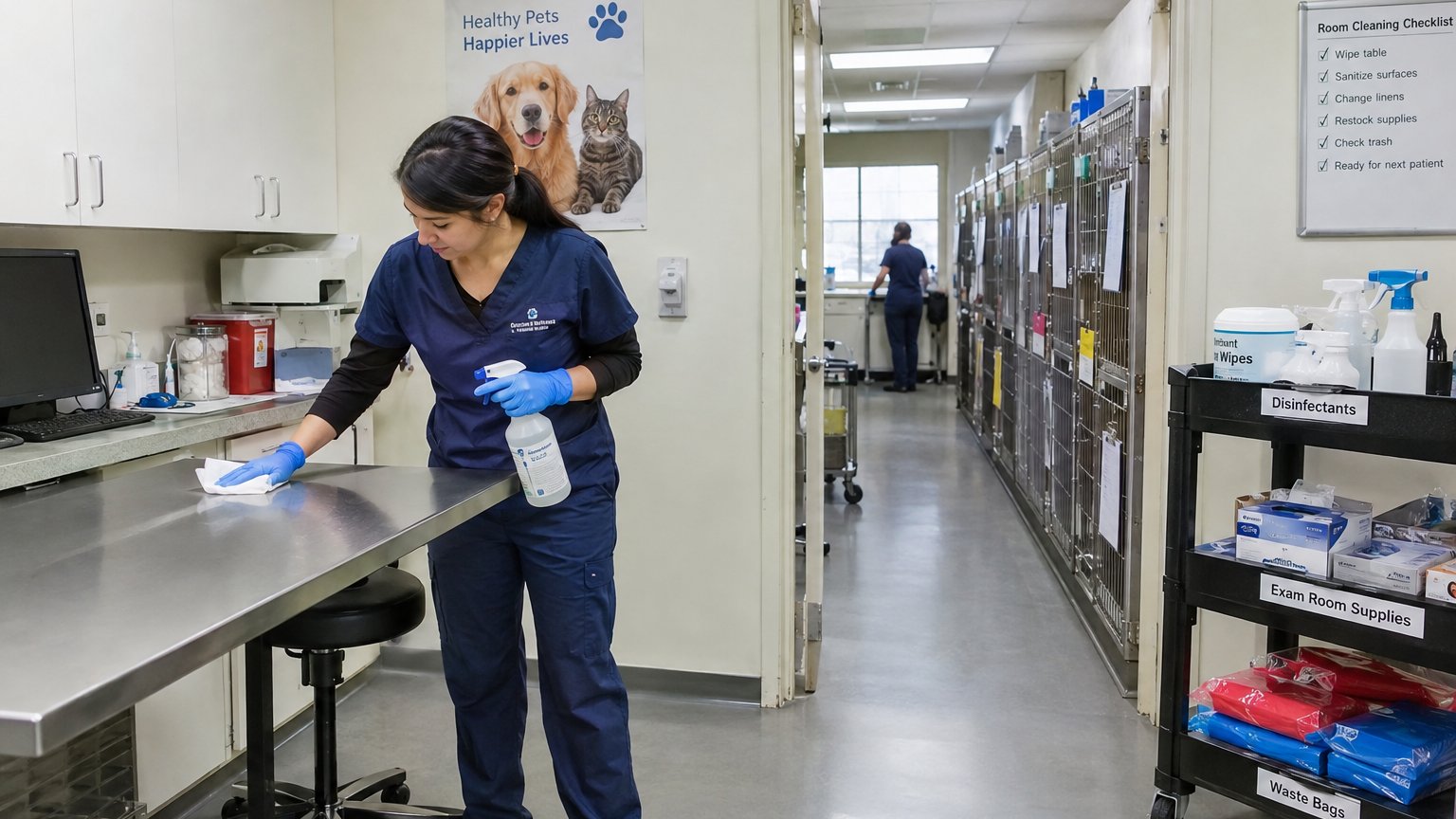
Veterinary facilities combine public waiting areas with exam rooms, treatment spaces, kennels, isolation rooms, and sometimes imaging or surgical suites. A janitorial vendor must understand where routine cleaning stops and clinical infection-control work begins. This buyer guide is for practices in Manhattan, the Bronx, Brooklyn, Queens, Staten Island, Westchester, and nearby New Jersey and Connecticut communities. GreenPoint Maintenance Services Corp can scope recurring commercial cleaning around the clinic's own infection-prevention procedures; call 347-332-9348 to arrange a walkthrough and confirm which areas are appropriate for a contracted cleaning crew.
Map traffic and animal-care zones before setting a route
A small Upper East Side practice near major hospitals may have a steady flow of appointments, while a Queens animal hospital near a highway corridor may include boarding, urgent care, or extended hours. A Bronx clinic close to a transit stop may see sharp lobby peaks; Brooklyn practices near Atlantic Avenue or Downtown Brooklyn may need delivery access and after-hours planning. These examples point to operational differences, not a single neighborhood-specific cleaning rule. Start with a floor plan and classify each room by patient contact, animal contact, public access, and restricted status.
GreenPoint recommends a written room matrix showing the cleaning owner, frequency, approved product, required PPE, tools, and escalation contact. Mark waiting rooms and offices separately from exam rooms, treatment areas, kennels, and isolation spaces. The clinic's medical director or infection-prevention lead should decide whether any clinical area can be included in routine janitorial work. Schedule a walkthrough by calling 347-332-9348, and include the practice manager or clinical lead so that a price does not imply services the clinic never intended to outsource.
Separate janitorial work from clinical infection-control duties
The CDC's veterinary infection-prevention compendium emphasizes cleaning visible organic matter before disinfection and following the EPA-registered product's label, including dilution and contact time. The clinic should own clinical decisions about which pathogens are relevant, what product is approved, and whether a room requires a special cleaning sequence. Janitorial tasks may include agreed floor and general-surface care, but staff should not clean animal-care instruments, medication-preparation surfaces, cages between patients, or treatment equipment unless specifically trained and contracted.
The CDC veterinary compendium also recommends facility-specific checklists that identify cleaning frequencies, procedures, products, and responsible staff for areas such as waiting rooms, exam rooms, treatment areas, and kennels. GreenPoint can align its assigned tasks to the clinic's approved written procedures without replacing veterinary judgment. The clinic must decide who handles body-fluid spills, sharps, animal waste, laundry, and medical waste. A vendor that blurs those responsibilities creates avoidable exposure and documentation gaps. Use the medical office cleaning requirements and OSHA guide to prepare questions for the service provider.
Set disinfectant use around the label, not a shortcut
A common quality failure is applying a disinfectant and immediately wiping it off even though the label requires a longer wet contact period. EPA explains that a treated surface must remain visibly wet for the product's stated contact time; the time varies by product and claim. Staff should remove soil first when required, use the right concentration, cover the target surface, and allow the labeled contact time. Do not assume that a pleasant scent, a generic 'antibacterial' claim, or a fast-drying wipe satisfies the clinic's infection-control plan.
GreenPoint's product list and procedures should be reviewed with the clinic before service starts, especially for sensitive equipment, animal-contact areas, and surfaces that may be licked or touched by pets. GreenPoint uses Green Seal certified products where they fit the approved scope, but a green-certified general cleaner is not automatically a clinical disinfectant. The buyer should document product names, EPA registration details when relevant, use dilution, contact time, and any required rinse. Call 347-332-9348 to have product review included in the walkthrough.
Design separate routines for waiting rooms, exam rooms, and kennels
Waiting areas generally need frequent attention to floors, entry glass, seating, waste bins, and restrooms, with a day check during busy clinic hours. Exam rooms may turn over several times in a shift, so the veterinary team should perform the between-patient cleaning and disinfection prescribed by its clinical protocol. A contracted night crew can then complete agreed terminal or routine room tasks only if they have the training and access the practice requires. Kennels need procedures that account for occupancy, visible soil, animal movement, and the separation of cleaning tools.
As a planning example, a clinic with 10 exam rooms, 2 treatment rooms, 16 kennel runs, and a public waiting area should price those zones separately rather than multiply the gross floor area by one rate. A 2,500-square-foot appointment practice with limited boarding is not equivalent to a 12,000-square-foot animal hospital operating overnight. GreenPoint uses room counts, operating hours, occupancy, floor materials, and touchpoint expectations to build an understandable fixed-price scope. For general frequency planning, see cleaning frequency standards by facility type.
Keep spills, sharps, and regulated waste under clinic control
Before service begins, the practice should define how a cleaner recognizes and reports a suspected blood or body-fluid spill, who is authorized to respond, where spill kits are stored, and what PPE is required. OSHA's Bloodborne Pathogens Standard applies to occupational exposure to blood and other potentially infectious materials; the employer must determine exposure controls and provide appropriate training and protective measures. A general janitorial agreement should not silently transfer clinical waste handling or sharps disposal to untrained staff.
GreenPoint can document a stop-work and notification process for any excluded task, and the clinic can identify a 24-hour contact for urgent incidents. Keep sharps containers, anesthetic materials, pharmaceuticals, specimens, and animal remains in the clinic's controlled workflow. In NYC, some animal-related premises covered by Health Code Article 161 have permits based on the activity, so the facility should confirm its own applicable obligations with NYC Health rather than applying one rule to every veterinary practice. Call GreenPoint at 347-332-9348 to make exclusions explicit in the service schedule.
Use verification that improves the next shift
A useful quality program checks both appearance and process. It may include a room-by-room checklist, supervisor inspection, documented missed-task alerts, client sign-off for exceptions, and periodic ATP testing on selected surfaces. ATP testing measures residual biological material; it is not a pathogen test and cannot certify that a veterinary room is infection-free. Define what is sampled, when it is sampled, and what corrective action follows a result so the data actually changes practice.
GreenPoint's JaniTrack workflow can supply timestamped, GPS-tagged task photos, selected ATP readings, and a live dashboard. The veterinary client should agree on privacy protections so that images do not capture client records, staff faces, animals, or protected treatment details. GreenPoint Maintenance Services can show a sample workflow and response path during a site review. Phone 347-332-9348 to schedule a walkthrough; ask the proposal to identify the frequency of inspections and the person accountable for closing each corrective action.
Compare local vendor proposals without hiding labor assumptions
For an apples-to-apples bid, provide each vendor with the same room list, floor plan, clinic hours, access windows, approved chemicals, waste exclusions, supply responsibilities, and expected response times. Ask how the vendor handles callouts, staff turnover, clinic closures, holidays, and urgent spill notices. Request proof of insurance, worker screening, training records, safety data sheet access, and supervisor coverage. A low rate that excludes kennel corridors, restrooms, or daily high-touch cleaning may not be the least-cost option once the scope is corrected.
GreenPoint Maintenance Services offers fixed pricing based on defined tasks, not hourly billing, and lists exclusions and optional work separately. GreenPoint is MBE/MWBE certified in New York State and New York City programs, with NYC DOE certification, and reports 98% client retention across its portfolio. Those credentials do not replace a practice's clinical review, references, or insurance checks. To compare a proposed route for Manhattan, Brooklyn, Queens, the Bronx, Westchester, New Jersey, or Connecticut, call 347-332-9348 or email info@greenpointms.com.
Frequently asked questions about veterinary clinic cleaning
Can a commercial cleaning company disinfect exam rooms between patients? The veterinary team should own the between-patient clinical procedure unless the contractor is expressly trained, authorized, and contracted for it. A janitorial crew can perform separate scheduled tasks under written clinic procedures; clarify responsibility room by room.
What disinfectant should a veterinary clinic use? The clinic should select an EPA-registered product with claims appropriate to its risks and follow the product label, including pre-cleaning, dilution, surface compatibility, PPE, and wet contact time. Ask the veterinarian or infection-prevention lead to approve the facility product list.
How often should a kennel be cleaned? Frequency depends on occupancy, visible soil, animal turnover, and clinic protocol. The facility should clean and disinfect between uses when required by its procedure and promptly address contamination. The vendor scope should say who performs each step and what documentation is recorded.
Does ATP testing prove a room is pathogen-free? No. ATP is a process-verification measure for residual organic material on a sampled surface. It does not identify a pathogen or replace the clinic's infection-control procedures, visual inspection, or correct product use.
How can a NYC veterinary practice request a cleaning quote? Prepare a room list, access schedule, task exclusions, approved products, and waste-handling rules, then arrange a site walkthrough. GreenPoint can review the proposed scope at 347-332-9348 or info@greenpointms.com.
Request a veterinary clinic walkthrough from GreenPoint Maintenance Services at 347-332-9348. GreenPoint's JaniTrack process can document assigned tasks with timestamped, GPS-tagged photos, selected ATP verification, and a live dashboard; its reported 98% client retention is a portfolio-wide company figure.