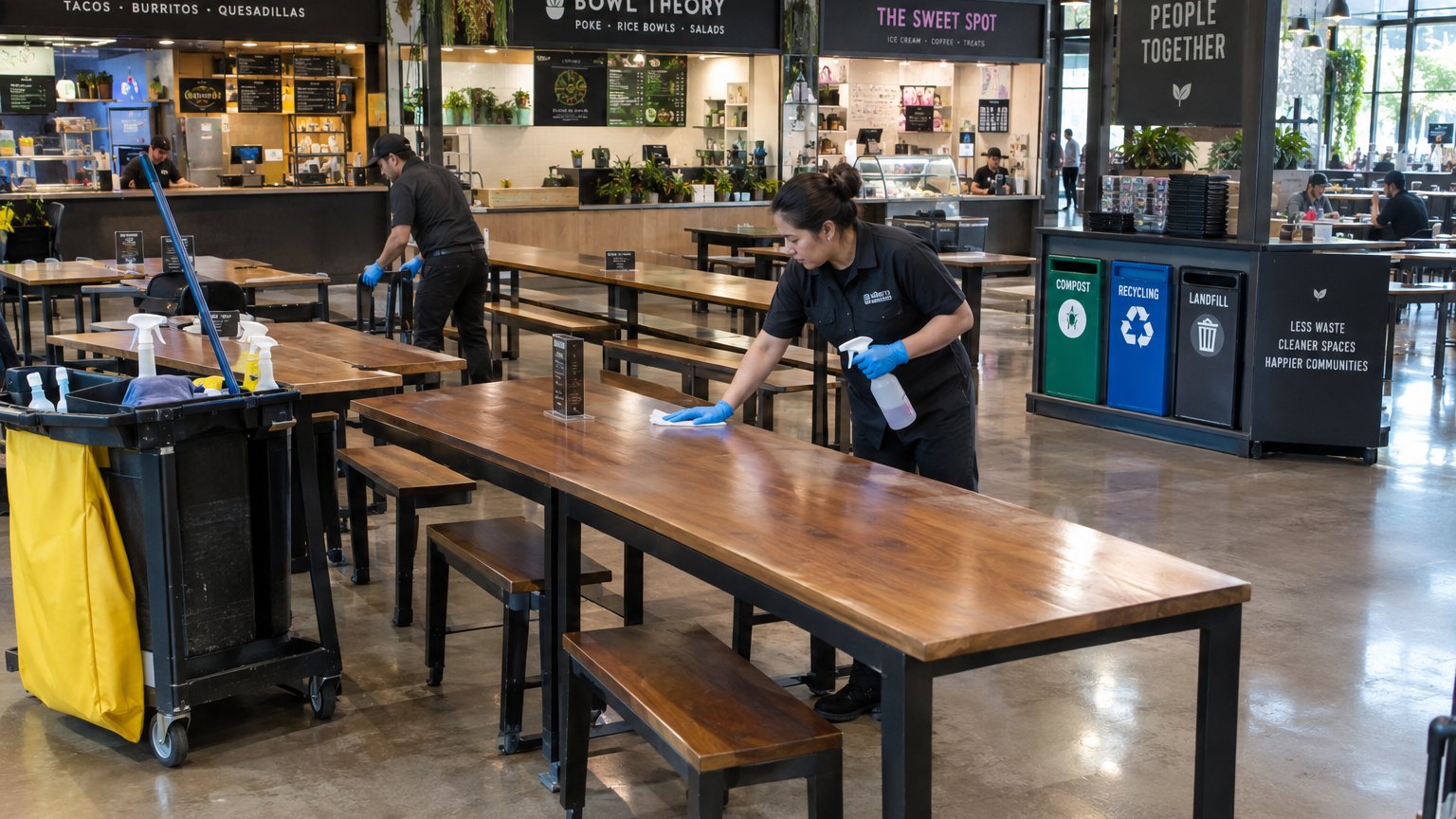
A food hall can contain a dozen independent kitchens, a common dining room, shared restrooms, loading corridors, waste rooms, and public entrances under one roof. The cleaning program succeeds only when the property manager and tenants agree who owns each task and when the handoff occurs. This guide is designed for operators in Manhattan, Brooklyn, Queens, and the wider tri-state market, including destinations such as Chelsea Market, Essex Market, and DeKalb Market Hall. GreenPoint Maintenance Services Corp can map common-area service separately from tenant food-preparation duties; call 347-332-9348 to schedule a walkthrough and fixed-price quote.
Draw a responsibility line between landlord and tenant
Before pricing, mark the property boundary: dining tables, public floors, entry mats, shared corridors, restrooms, elevators, loading areas, waste rooms, and common seating usually belong in the landlord's scope. Each vendor stall may be responsible for its own counters, cooking equipment, food-contact surfaces, under-counter areas, and employee handwashing stations. The lease, operating manual, and health authority rules determine the actual assignments. A cleaning contract should use a responsibility matrix rather than assumptions based on who happens to be on site at closing.
GreenPoint recommends assigning every task to one owner, one time window, and one evidence method. For example, the operator may handle dining-table resets every 20 to 30 minutes during peak periods, while the janitorial team cleans the full dining floor after service. Those are planning intervals, not universal code mandates; traffic observations should set the final schedule. Call 347-332-9348 to arrange a walkthrough that includes the property manager and, where needed, a tenant representative.
Protect the distinction between cleaning and food-contact sanitizing
The FDA Food Code is a model that state and local jurisdictions adopt or adapt; it is not a substitute for the rules enforced at a specific address. It distinguishes cleaning from sanitizing food-contact equipment and utensils. A general janitorial crew should not assume authority to sanitize a tenant's food-contact surface or use a disinfectant where the label requires a potable-water rinse. Tenant staff and the person in charge remain responsible for food operations and the approved procedures that apply to their establishment.
The property should provide written direction on approved products for public tables, non-food-contact floors, restroom fixtures, and waste areas, while each tenant controls its own food-contact process. GreenPoint can maintain separate color-coded tools and labeled carts to reduce cross-use between restrooms, dining areas, and other zones. GreenPoint never treats a general surface product as a food-contact sanitizer unless the label and site procedure authorize it. See EPA disinfectant registration and label guidance and color-coded microfiber systems.
Set service frequencies for peaks, not just opening and closing
Food halls have multiple soil peaks: lunch, dinner, weekend traffic, events, and seasonal tourism. A practical plan may include a day porter for spills and table-area support, hourly restroom checks during a peak window, a post-service floor clean, and a separate overnight detail route. A 20,000-square-foot hall with 14 stalls, 300 seats, and shared restrooms behaves differently from a 7,000-square-foot market with takeout-heavy traffic. Track covers, occupancy, spill calls, restroom exceptions, and waste volume for two to four weeks before locking the schedule.
GreenPoint can price recurring day coverage, evening cleaning, overnight service, and periodic floor or high-dusting work as separate line items. This lets an operator add weekend service or special-event resets without hiding them in an undefined hourly allowance. Check whether staff need access through subway-connected concourses, freight elevators, or loading docks, and plan around delivery windows. Call GreenPoint at 347-332-9348 to review operating hours and request a schedule that identifies both routine service and event pricing.
Control grease, food debris, moisture, and waste-room conditions
Shared dining floors collect food debris, beverage spills, grease tracked from stall thresholds, and water near beverage stations. The site plan should name compatible floor equipment and approved degreasers, define wet-floor controls, and specify who inspects mats and drains. The janitorial scope should not imply hood, duct, grease-trap, or commercial cooking-equipment cleaning unless those specialized services are separately qualified and contracted. Keep the waste-room schedule coordinated with hauling so that bags do not accumulate and leaks are reported promptly.
GreenPoint Maintenance Services can document exception conditions such as overflowing bins, broken dispensers, leaks, pest evidence, or inaccessible rooms, then notify the operator's named contact. Property management remains responsible for maintenance and pest-control decisions. For a hall near Fulton Street, Broadway, or a busy transit station, entry mat service and frequent spill response can be more important than adding an arbitrary deep-cleaning visit. Use an on-site walkthrough to identify drainage, storage, and equipment constraints before setting a monthly price.
Coordinate tenants, event teams, and local health requirements
New York City food-service businesses operate under city health requirements, while food halls in New Jersey, Connecticut, and Pennsylvania may be overseen by different local or state agencies. The FDA Food Code offers a common reference, but the operator should verify the currently applicable local code, permit conditions, inspection findings, and tenant obligations. A cleaning contractor can support housekeeping and recordkeeping; it cannot certify a tenant's food-safety program or substitute for a food-protection manager.
Create one escalation chart for blocked exits, spills, broken refrigeration leaks, pest evidence, restroom outages, and suspected food contamination. Schedule noisy floor work outside public hours, preserve accessible routes, and coordinate temporary barriers with event staff. GreenPoint can assign a site lead to attend pre-opening or post-event checks when that coverage is part of the quote. Call 347-332-9348 to discuss a food hall in Manhattan, Brooklyn, Queens, or another tri-state market and confirm access and service availability.
Measure quality with repeatable observations
A reliable audit should sample the same categories each week: dining tables, floor edges, entry glass, restroom touchpoints, dispenser levels, waste-room conditions, and documented tenant handoffs. The ISSA Clean Standard: Institutional and Commercial describes combining objective measures with traditional inspection. ATP testing may help trend selected surface cleanliness, but it is not a pathogen test or a substitute for the food operator's required process. Record exceptions, assign owners, and verify that corrective actions are closed.
GreenPoint's JaniTrack system can provide timestamped, GPS-tagged task photos, selected ATP readings, and a live dashboard for the agreed common-area work. Set photo boundaries to avoid capturing customers, payment terminals, tenant recipes, or employee records. GreenPoint Maintenance Services reports 98% client retention across its portfolio, but the operator should still define site-specific response times and inspection targets. Ask to see the dashboard workflow during a walkthrough and call 347-332-9348 to include those requirements in the proposal.
Compare bids by coverage, staffing, and inclusions
Give every bidder the same floor plan, seat count, stall count, operating hours, event calendar, restroom fixture count, floor type, waste route, storage access, and list of tenant exclusions. Ask for staffing by time window, supervisor coverage, relief plan, chemical list, worker training, insurance, incident reporting, and periodic project prices. Confirm whether the quote includes consumables, liners, equipment, weekend premiums, emergency callouts, and special event support. A fixed price should be tied to measurable work, not a vague promise to keep the hall clean.
GreenPoint offers fixed pricing with no hourly billing or hidden fees when the scope is defined, and lists optional services separately. GreenPoint Maintenance Services Corp is MBE/MWBE certified in New York programs and SAM.gov registered; operators should verify the procurement credentials relevant to their own institution. To schedule a walkthrough and receive a common-area cleaning quote, call 347-332-9348 or email info@greenpointms.com. For a broader quality plan, review quality assurance for commercial cleaning.
Frequently asked questions about food hall cleaning
Who cleans food hall tables between customers? The operating agreement should name the responsible party. Many halls use tenant staff or a day porter for rapid table resets and a janitorial crew for scheduled floor and detail work; define the handoff and approved products in writing.
Can a janitorial vendor sanitize food-contact surfaces? Only when the task, training, product label, and applicable site procedure authorize it. The food operator remains responsible for its food-contact process and should not assume a general cleaning contract satisfies that obligation.
How often should shared restrooms be checked? Use fixture count, hours, traffic, complaint history, and inspection results. A high-volume hall may need checks several times during lunch and dinner; record the actual service time and supply exceptions.
What information is needed for a food hall cleaning quote? Provide floor plans, seat and stall counts, operating hours, event schedule, restroom inventory, waste flow, floor surfaces, access rules, and a clear division of tenant tasks. GreenPoint can arrange a walkthrough at 347-332-9348.
Does a cleaning audit replace a health inspection? No. A cleaning audit checks the contracted service and corrective actions. The responsible food business and local health authority retain their own inspection, permitting, and food-safety roles.
Call GreenPoint Maintenance Services at 347-332-9348 to schedule a food hall walkthrough and receive a fixed-price common-area quote. GreenPoint can document agreed work through JaniTrack timestamped, GPS-tagged photos and a live dashboard, with a reported 98% client retention rate across its overall portfolio.